
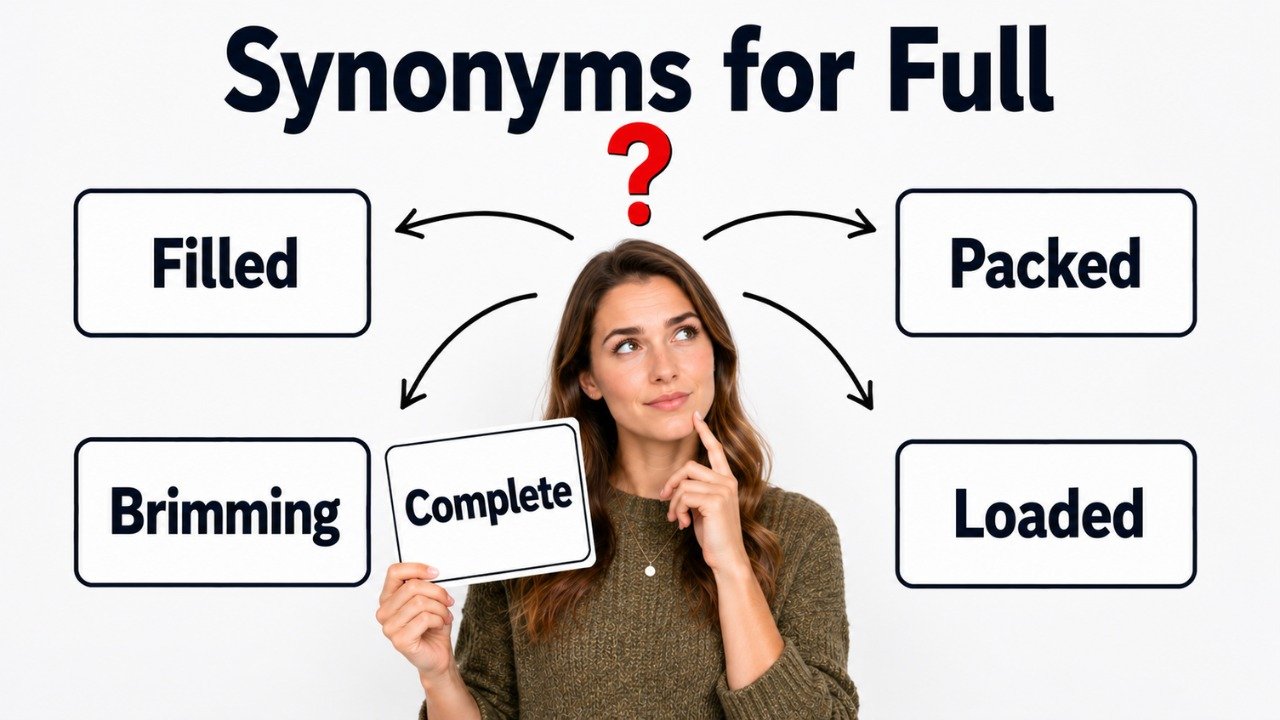
Quick Answer: The best synonyms for full include complete, filled, packed, crowded, abundant, comprehensive, satisfied, satiated, busy, and mature. Use complete when nothing is missing, filled when a container contains something, and packed or crowded when a place has many people or objects. Abundant describes a large supply, while comprehensive suits detailed reports and explanations. Satisfied and satiated describe having eaten enough. Busy or booked works for schedules, and mature describes something that has reached full development.
Pronunciation and Word Details
Word: Full.
Pronunciation: /fʊl/.
Part of Speech: Adjective, noun, and adverb.
Meaning: Containing as much as possible, complete in every part, or having enough of something.
US Pronunciation:
UK Pronunciation:
What Does “Full” Mean?
Full means containing as much as possible, having no empty space, or including everything that is required.
As an adjective, full can describe containers, rooms, schedules, meals, reports, emotions, and stages of development. In the sentence “The glass is full,” the word means that the glass contains as much liquid as it can hold.
Full can also mean complete. A full explanation includes all necessary information, while a full set contains every required item. In these contexts, complete, comprehensive, or entire may replace full.
When describing food, full means that someone has eaten enough and is no longer hungry. Satisfied, satiated, and sated are suitable alternatives for this meaning.
The word can also describe a busy schedule, a crowded place, strong emotion, complete maturity, or a large amount of something. The intended meaning must be clear before choosing a synonym.
Meaning, Tone, and Context of “Full”
Full is a common, neutral, and highly flexible word. It appears naturally in casual speech, formal writing, academic explanations, business communication, descriptions, and everyday conversation.
In ordinary language, full often describes a container, room, stomach, or schedule. Sentences such as “The bag is full” and “My afternoon is full” are direct and conversational.
In formal or academic writing, full may be replaced with complete, comprehensive, extensive, or exhaustive. These words often communicate a more precise meaning. A comprehensive report, for example, is not simply full of information. It covers a subject broadly and carefully.
Full may also carry an emotional or descriptive tone. Someone can be full of hope, energy, confidence, anger, or curiosity. In these situations, the word emphasizes that a feeling or quality is present in a strong amount.
The correct synonym depends on whether full refers to capacity, completion, quantity, satisfaction, availability, development, or intensity.
When and How to Use “Full”
For Maximum Capacity
Use full when a container, room, vehicle, or space cannot hold much more.
Example: The storage box is full of old photographs.
For Completeness
Use full when every required part, detail, or item is included.
Example: Please provide a full description of what happened.
For Crowded Places
Use full when a place contains many people or objects.
Example: The hall was full before the program began.
For Large Quantities
Use full when something exists in a generous or abundant amount.
Example: The garden is full of colorful flowers.
For Eating Enough
Use full when someone has eaten enough and no longer feels hungry.
Example: I cannot eat another serving because I am full.
For Busy Schedules
Use full when no more appointments, tasks, or activities can easily be added.
Example: Her schedule is full for the rest of the week.
For Strong Feelings
Use full when a person strongly experiences an emotion or quality.
Example: He was full of confidence before the presentation.
For Complete Development
Use full when something has reached its mature size, strength, or condition.
Example: The tree reaches its full height after several years.
Best Synonyms for Full
Complete: Containing every necessary part with nothing missing.
Example: The application is complete and ready for review.
Filled: Containing a substance, object, person, or material.
Example: The basket was filled with fresh fruit.
Packed: Containing many objects or people in a limited space.
Example: The auditorium was packed for the performance.
Crowded: Containing more people or objects than is comfortable.
Example: The waiting area became crowded during the afternoon.
Abundant: Existing in a large and plentiful quantity.
Example: Fresh water is abundant in this region.
Comprehensive: Covering all or nearly all important details of a subject.
Example: The guide provides a comprehensive explanation of the process.
Satisfied: No longer needing or wanting more, especially after eating.
Example: The meal left everyone satisfied.
Satiated: Completely satisfied after consuming enough food or drink.
Example: After the large dinner, the guests felt satiated.
Busy: Having many activities, duties, or appointments.
Example: She has a busy schedule this morning.
Mature: Fully developed in growth, ability, or character.
Example: The plant becomes mature during its third year.
50 Synonyms for Full with Short Meanings
- Complete: Containing all necessary parts.
- Entire: Including every part of something.
- Whole: Complete and not divided or damaged.
- Total: Including the complete amount or number.
- Filled: Containing something within available space.
- Packed: Filled tightly with people or objects.
- Crowded: Containing too many people or things.
- Occupied: Being used or containing someone.
- Loaded: Carrying or containing a large amount.
- Brimming: Filled to the top or edge.
- Overflowing: So full that the contents extend beyond the limits.
- Stuffed: Filled tightly or excessively.
- Crammed: Packed into a small or limited space.
- Jammed: Filled so tightly that movement becomes difficult.
- Saturated: Completely filled or absorbed with something.
- Replete: Fully supplied or filled with something.
- Abundant: Available in a large quantity.
- Ample: More than enough for a particular need.
- Plentiful: Existing in a generous supply.
- Copious: Present in a large amount.
- Rich: Containing a large amount of a valuable quality.
- Generous: Larger or more plentiful than expected.
- Substantial: Large, important, or considerable in amount.
- Comprehensive: Including all important information or details.
- Thorough: Complete, careful, and detailed.
- Exhaustive: Covering every possible detail or part.
- Extensive: Covering a large area, amount, or range.
- Detailed: Containing many specific pieces of information.
- Inclusive: Containing everything or everyone concerned.
- Unabridged: Complete and not shortened.
- Maximum: Representing the greatest possible amount.
- Absolute: Complete and without limitation.
- Mature: Fully developed in growth or character.
- Developed: Having reached an advanced or complete stage.
- Grown: Having reached physical maturity.
- Rounded: Having a complete or well balanced form.
- Plump: Having a pleasantly full and rounded shape.
- Solid: Strong, substantial, or filled throughout.
- Deep: Strong, complete, or extending far inward.
- Intense: Existing at a powerful or extreme level.
- Busy: Containing many tasks or activities.
- Booked: Having no available appointments or spaces.
- Engaged: Occupied with an activity or responsibility.
- Satisfied: Having received or consumed enough.
- Satiated: Completely satisfied after eating or drinking.
- Sated: Having no desire for more.
- Content: Satisfied with what is available.
- Fulfilled: Completely satisfied or successfully completed.
- Hearty: Large, generous, and satisfying.
- At Capacity: Containing the greatest amount possible.
Read Also:
Synonyms for Feedback
Synonyms for Full by Context
When Full Means Containing No More
When full describes a container, room, vehicle, or area with little or no available space, use filled, packed, crowded, loaded, brimming, stuffed, crammed, jammed, or at capacity.
Filled: A neutral word describing something that contains a substance or object.
Example: The shelves were filled with books.
Packed: Suggests that many people or things have been placed close together.
Example: The train was packed during the morning journey.
Brimming: Describes a container filled almost to the edge.
Example: Her cup was brimming with hot tea.
Crammed: Suggests that objects or people have been forced into a limited space.
Example: The drawer was crammed with papers.
At Capacity: Means that a place or system has reached its maximum limit.
Example: The parking area is currently at capacity.
When Full Means Complete
When full means that nothing is missing, suitable synonyms include complete, entire, whole, total, comprehensive, thorough, exhaustive, inclusive, and unabridged.
Complete: The strongest general choice when every required part is present.
Example: We received the complete set of instructions.
Entire: Emphasizes all parts or the whole amount.
Example: She read the entire document before responding.
Comprehensive: Best for reports, plans, studies, guides, and explanations that cover many important details.
Example: The report offers a comprehensive review of the issue.
Exhaustive: Suggests that every possible detail or option has been considered.
Example: The team completed an exhaustive investigation.
Unabridged: Describes a book, recording, or text that has not been shortened.
Example: He purchased the unabridged edition of the novel.
When Full Means Abundant
When full describes a large quantity or supply, use abundant, ample, plentiful, copious, rich, generous, or substantial.
Abundant: Describes something available in a very large amount.
Example: Wildlife is abundant in the protected forest.
Ample: Means that more than enough is available for a particular purpose.
Example: We have ample time to complete the assignment.
Plentiful: Describes something that is easy to find because much of it exists.
Example: Fresh produce is plentiful during the summer.
Rich: Describes something containing a large amount of flavor, detail, value, or quality.
Example: The region has a rich cultural history.
Substantial: Emphasizes a large, important, or meaningful amount.
Example: The project requires a substantial investment of time.
When Full Means No Longer Hungry
When full describes having eaten enough, use satisfied, satiated, sated, content, replete, or fulfilled.
Satisfied: A natural and common alternative for having eaten enough.
Example: The guests felt satisfied after the meal.
Satiated: A more formal word meaning completely satisfied after eating.
Example: The large breakfast left him satiated.
Sated: Means that a desire or appetite has been completely satisfied.
Example: The travelers were tired but sated after dinner.
Replete: A formal word describing someone or something fully supplied.
Example: The diners left the table replete and cheerful.
Content: Describes a comfortable feeling of satisfaction.
Example: After a simple meal, she felt content.
When Full Means Busy
When full refers to a schedule or period with no available time, choose busy, booked, occupied, engaged, or at capacity.
Busy: The most natural general choice for many activities or responsibilities.
Example: I have a busy afternoon ahead.
Booked: Means that all available appointments, rooms, seats, or times have been reserved.
Example: The consultant is booked until next week.
Occupied: Means that a person, place, or period is currently being used.
Example: She was occupied with an important assignment.
Engaged: Suggests active involvement in a task, conversation, or responsibility.
Example: The manager is engaged in a meeting.
When Full Means Fully Developed
When full refers to growth, shape, strength, or development, use mature, developed, grown, rounded, plump, or solid.
Mature: Describes something that has reached a complete stage of growth.
Example: The mature tree provides plenty of shade.
Developed: Describes something that has progressed to an advanced stage.
Example: The region has a highly developed transport system.
Grown: Refers to something that has reached adult size or maturity.
Example: The puppy became a fully grown dog.
Rounded: Describes a balanced shape, personality, education, or ability.
Example: The program gives students a rounded education.
Plump: Describes a pleasantly full and rounded physical shape.
Example: The garden produced plump tomatoes.
Another Word for Full
Complete is the best general replacement for full when the meaning is that nothing is missing. However, the most accurate alternative depends on the sentence.
Use filled for containers, packed for crowded places, comprehensive for detailed information, satisfied for eating, and busy for schedules.
Original: Please send me the full report.
Better Option: Please send me the complete report.
Original: The room was full of visitors.
Better Option: The room was crowded with visitors.
Original: Her calendar is full this week.
Better Option: Her calendar is booked this week.
Original: I felt full after dinner.
Better Option: I felt satisfied after dinner.
When Not to Use “Full”
Avoid full when a more precise word can clearly explain the intended meaning. The word is broad, so it can sound vague in formal or descriptive writing.
Weak: The report gives a full explanation.
Better: The report gives a comprehensive explanation.
Do not use full for a crowded place when the number of people creates discomfort or difficulty. Crowded, packed, or crammed communicates the situation more accurately.
Weak: The narrow hallway was full.
Better: The narrow hallway was crowded.
Avoid full when discussing an official schedule with no available times. Booked is usually clearer.
Weak: The doctor is full for today.
Better: The doctor is fully booked for today.
Do not use full when you mean complete emotional satisfaction. Content, satisfied, or fulfilled may sound more natural.
Weak: She felt full after achieving her goal.
Better: She felt fulfilled after achieving her goal.
Full may also sound too informal in academic writing. Comprehensive, exhaustive, extensive, or complete can provide greater precision.
Weak: The study contains a full analysis of the results.
Better: The study contains a comprehensive analysis of the results.
Words Commonly Confused With Full
Full vs Complete: Full often refers to capacity or amount, while complete means that no required part is missing.
Full vs Filled: Full describes the condition of something, while filled often describes the action or result of putting something inside it.
Full vs Whole: Full means containing as much as possible. Whole means complete, undivided, or not damaged.
Full vs Packed: Full is neutral, while packed suggests that people or objects are placed very close together.
Full vs Crowded: Full may simply mean that no space remains. Crowded often suggests discomfort because too many people or objects are present.
Full vs Comprehensive: Full is a broad everyday word. Comprehensive is more formal and means covering all important aspects of a subject.
Full vs Satisfied: Full describes the physical condition of having eaten enough. Satisfied can describe both physical and emotional contentment.
Full vs Satiated: Full is common and conversational. Satiated is more formal and means that hunger or desire has been completely satisfied.
Full vs Abundant: Full usually describes something containing a large amount. Abundant describes something existing in a large supply.
Which Synonym Should You Choose?
Choose complete when every required part or item is included.
Choose entire when referring to all of something without exception.
Choose whole when something is undivided, undamaged, or considered as one complete unit.
Choose filled when a container or space contains something.
Choose packed when many people or objects are close together.
Choose crowded when too many people or objects make a space uncomfortable.
Choose brimming when a container is filled nearly to the edge.
Choose at capacity when a building, service, or system cannot accept more people or material.
Choose abundant when something exists in a very large supply.
Choose ample when there is more than enough for a particular need.
Choose comprehensive for reports, explanations, plans, reviews, and guides.
Choose exhaustive when every possible detail, example, or option has been covered.
Choose unabridged for books, texts, and recordings that have not been shortened.
Choose satisfied for a natural description of having eaten enough.
Choose satiated or sated in formal writing about complete satisfaction.
Choose busy for a schedule containing many activities.
Choose booked when no appointments, rooms, or seats remain available.
Choose mature when something has reached a complete stage of growth.
Choose intense when full describes a strong emotion, flavor, sound, or experience.
Real Life Examples of “Full” in Sentences
Original: The bottle is full of water.
Better Option: The bottle is filled with water.
Original: The theater was full last night.
Better Option: The theater was packed last night.
Original: She provided a full explanation.
Better Option: She provided a comprehensive explanation.
Original: We need the full list before the meeting.
Better Option: We need the complete list before the meeting.
Original: The market was full of shoppers.
Better Option: The market was crowded with shoppers.
Original: His week is full of appointments.
Better Option: His week is packed with appointments.
Original: I am full after that meal.
Better Option: I am satisfied after that meal.
Original: The area is full of natural resources.
Better Option: The area has abundant natural resources.
Original: The plant has reached its full size.
Better Option: The plant has reached its mature size.
Original: The article contains a full discussion of the problem.
Better Option: The article contains an extensive discussion of the problem.
Synonym Groups and Usage Differences
Capacity Group
Filled, packed, loaded, brimming, overflowing, stuffed, crammed, jammed, and at capacity describe spaces or containers holding a large amount.
Filled is neutral. Brimming suggests reaching the edge, while overflowing means the contents have moved beyond the limit. Crammed and jammed suggest excessive tightness.
Example: The suitcase was crammed with clothing.
Completion Group
Complete, entire, whole, total, comprehensive, thorough, exhaustive, inclusive, and unabridged describe something with no important part missing.
Complete is the most flexible word. Comprehensive suits detailed coverage, while exhaustive suggests that every possibility has been considered.
Example: The researcher conducted a thorough review of the evidence.
Quantity Group
Abundant, ample, plentiful, copious, rich, generous, and substantial describe large amounts.
Abundant and plentiful emphasize supply. Ample means more than enough, while substantial suggests an important or considerable amount.
Example: The new workspace provides ample room for the team.
Satisfaction Group
Satisfied, satiated, sated, content, fulfilled, and replete express different forms of having enough.
Satisfied is common and flexible. Satiated and sated focus on appetite or desire. Fulfilled usually describes emotional satisfaction or achievement.
Example: Completing the project made her feel fulfilled.
Schedule Group
Busy, booked, occupied, engaged, packed, and at capacity describe limited availability.
Busy means having many activities. Booked specifically means that appointments or spaces have been reserved.
Example: The hotel is fully booked for the weekend.
Development Group
Mature, developed, grown, rounded, plump, and solid describe completed growth, shape, or formation.
Mature suits living things, ideas, and behavior. Developed describes progress, while rounded suggests balance or completeness.
Example: The course helped her develop a rounded set of skills.
Intensity Group
Absolute, deep, intense, solid, and rich can replace full when describing strength, certainty, flavor, sound, or emotion.
Deep and intense emphasize powerful feelings. Rich often describes strong flavor, color, history, or detail.
Example: She expressed deep confidence in the plan.
Antonyms of Full
The opposite of full changes according to the intended meaning.
Empty: Containing nothing.
Vacant: Not occupied or being used.
Hollow: Empty inside.
Incomplete: Missing one or more necessary parts.
Partial: Including only part of something.
Unfinished: Not brought to completion.
Scarce: Available only in a limited amount.
Insufficient: Not enough for a particular purpose.
Depleted: Reduced or used until little remains.
Sparse: Thinly distributed or present in small amounts.
Hungry: Needing or wanting food.
Unsatisfied: Not having received enough.
Available: Free to accept an appointment, task, or reservation.
Free: Not busy, occupied, or reserved.
Immature: Not yet fully developed.
Comparison of Full and Related Words
Full vs Complete
Full often refers to capacity, while complete means that nothing necessary is missing.
Example With Full: The container is full of rice.
Example With Complete: The collection is complete.
Full vs Filled
Full describes a present condition. Filled describes the result of putting something into a space or container.
Example With Full: The glass is full.
Example With Filled: She filled the glass with water.
Full vs Packed
Full simply means that little or no space remains. Packed suggests that people or objects are tightly arranged.
Example With Full: The cupboard is full of dishes.
Example With Packed: The suitcase is packed with clothing.
Full vs Crowded
Full can describe any occupied space. Crowded suggests that too many people or objects are present for comfort.
Example With Full: The classroom was full.
Example With Crowded: The narrow classroom felt crowded.
Full vs Comprehensive
Full is common and broad. Comprehensive is formal and describes something that covers all important areas or details.
Example With Full: She gave a full account of the event.
Example With Comprehensive: She prepared a comprehensive account of the event.
Full vs Satisfied
Full usually describes physical satisfaction after eating. Satisfied can describe food, results, relationships, decisions, and experiences.
Example With Full: I feel full after lunch.
Example With Satisfied: I feel satisfied with the final result.
Full vs Abundant
Full describes something containing a large amount. Abundant describes a resource or quality that exists in plentiful supply.
Example With Full: The field is full of flowers.
Example With Abundant: Wildflowers are abundant in the field.
Common Phrases and Expressions With Full
Full of Life: Energetic, enthusiastic, and lively.
Example: The young child is always full of life.
Full of Energy: Having a large amount of physical or mental strength.
Example: She felt full of energy after resting.
Full Attention: Complete concentration on someone or something.
Example: Please give the speaker your full attention.
Full Support: Complete approval, encouragement, or assistance.
Example: The proposal has our full support.
Full Confidence: Complete trust in a person, decision, or plan.
Example: We have full confidence in the team.
Full Responsibility: Complete duty or accountability for something.
Example: He accepted full responsibility for the mistake.
Full Capacity: The greatest amount that a place, machine, or system can hold or produce.
Example: The factory is operating at full capacity.
Full Detail: All available or necessary information.
Example: The incident was described in full detail.
Full Extent: The complete degree, size, or seriousness of something.
Example: We did not understand the full extent of the damage.
Full Circle: Returning to the original position, situation, or idea.
Example: Her career came full circle when she returned as a teacher.
Common Mistakes to Avoid
Avoid replacing full with complete in every sentence. Complete works when nothing is missing, but it does not naturally describe every container, room, or stomach.
Do not use crowded when you only mean that a container has reached its limit. Crowded usually describes people or objects in a space and often suggests discomfort.
Avoid using satiated in casual conversation unless a formal or literary tone is suitable. Full or satisfied usually sounds more natural in everyday speech.
Do not confuse comprehensive with lengthy. A comprehensive explanation covers all important areas, but it does not have to be unnecessarily long.
Be careful with entire and whole. Both refer to all of something, but whole often emphasizes unity or an undamaged condition.
Avoid vague combinations such as “very full information.” Use complete information, detailed information, or comprehensive information instead.
Do not write “full with” when “full of” is required. A room is full of people, while a container may be filled with water.
Use the correct comparative form. Write fuller and fullest when comparing degrees of fullness, although more complete may sound better in formal contexts involving information or tasks.
Conclusion
The best synonyms for full depend on what the word describes. Complete, entire, and whole express completeness, while filled, packed, crowded, and brimming describe capacity. Abundant, ample, and plentiful suit large quantities. Comprehensive and exhaustive work well for reports or explanations. Satisfied, satiated, and sated describe having eaten enough, while busy and booked refer to limited availability. Choosing the right synonym for full makes each sentence clearer, more accurate, and better suited to its context.
FAQs About Synonyms for Full
What Is the Best Synonym for Full?
Complete is the best general synonym when full means that nothing is missing. Filled is better for containers, while packed suits crowded spaces.
What Is Another Word for a Full Container?
Filled, loaded, brimming, stuffed, packed, and overflowing can describe a full container. The best choice depends on how much it contains.
What Is a Formal Synonym for Full?
Comprehensive, complete, exhaustive, replete, extensive, and saturated are formal alternatives. Each word applies to a different context.
What Is a Synonym for Full After Eating?
Satisfied, satiated, sated, replete, and content can describe someone who has eaten enough.
What Is a Synonym for a Full Schedule?
Busy, booked, occupied, engaged, packed, and at capacity can describe a schedule with little or no available time.
Are Full and Complete the Same?
They overlap, but they are not always interchangeable. Full often relates to capacity, while complete means that every necessary part is present.
What Is the Opposite of Full?
Common opposites include empty, vacant, incomplete, partial, hungry, available, scarce, and depleted. The correct antonym depends on the context.
