
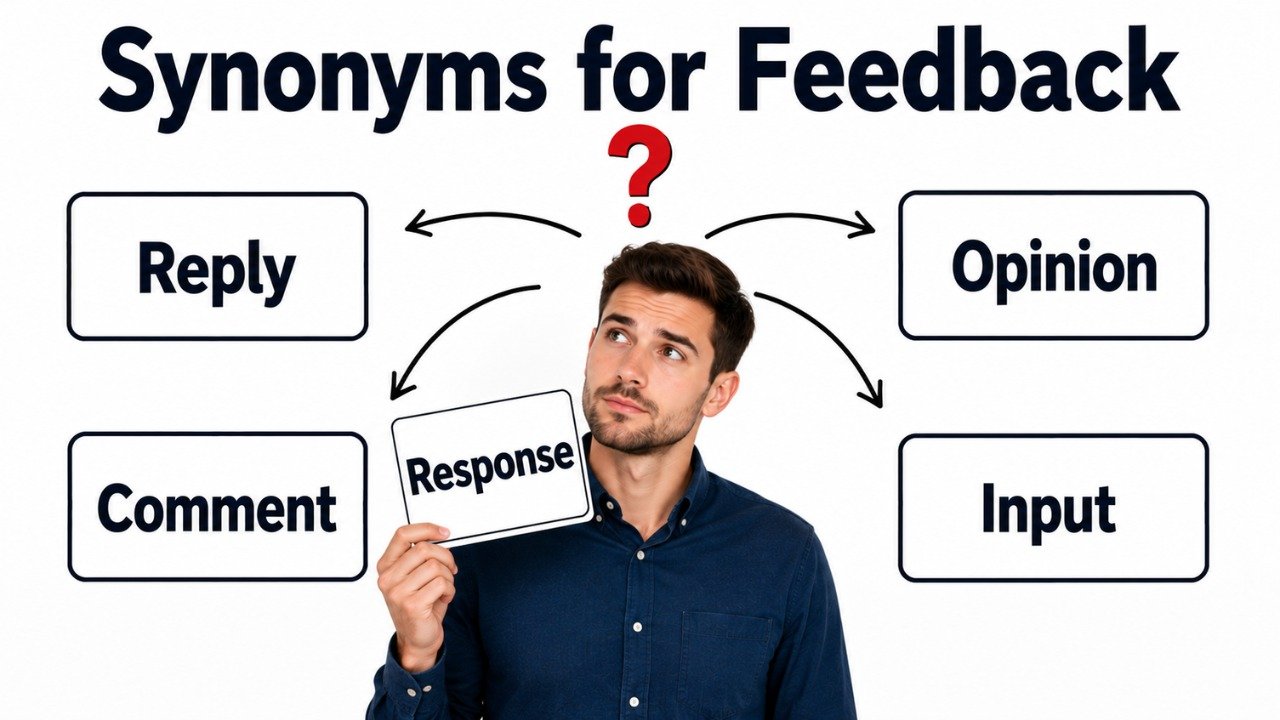
Quick Answer: The best synonyms for feedback include response, input, reaction, comment, opinion, assessment, evaluation, review, critique, and advice. Use response for a general reply, input for helpful ideas in professional settings, reaction for an emotional or immediate result, and evaluation for a formal judgment. Review works well for detailed examination, critique suits thoughtful analysis, and advice is appropriate when the purpose is to guide improvement.
Pronunciation and Word Details
Word: Feedback.
Pronunciation: /ˈfiːd.bæk/
Part of Speech: Noun.
Meaning: Feedback is information, opinions, or reactions given to help someone understand the quality, effect, or performance of something.
US Pronunciation:
UK Pronunciation:
What Does “Feedback” Mean?
Feedback means information or a reaction provided in response to an action, idea, product, performance, message, or experience. It is mainly used as a noun and often helps a person understand what worked well and what could be improved.
In professional settings, feedback may include comments about an employee’s performance, a project, a report, or a business decision.
Example: The manager gave helpful feedback on the presentation.
In education, feedback helps learners understand their strengths, errors, and areas for improvement.
Example: The teacher provided detailed feedback on the essay.
In everyday conversation, feedback can refer to an opinion or reaction.
Example: I would appreciate your feedback on my idea.
The word also has a technical meaning. In a system, feedback is information returned to influence or regulate future activity.
Example: The control system uses feedback to maintain a steady temperature.
Feedback may be positive, negative, neutral, formal, informal, detailed, brief, requested, or unexpected. Its exact meaning depends on who gives it, why it is given, and how it will be used.
Meaning, Tone, and Context of “Feedback”
Feedback is a neutral and widely used word. It appears in professional communication, education, customer service, creative work, technical writing, personal development, and everyday conversation.
In workplace communication, feedback usually sounds professional and constructive.
Example: The team requested feedback before finalizing the plan.
In education, the word has a supportive and instructional tone.
Example: Her feedback helped the student improve the argument.
In casual conversation, feedback may simply mean an opinion or reaction.
Example: Give me some feedback on this color choice.
Feedback can sound positive when it recognizes strengths.
Example: The audience gave positive feedback after the performance.
It can also sound critical when it points out weaknesses or mistakes.
Example: The report received critical feedback from the reviewers.
Unlike criticism, feedback does not always focus on faults. Good feedback may include praise, suggestions, corrections, questions, observations, and practical guidance.
The word is generally uncountable. Writers normally say some feedback, helpful feedback, or pieces of feedback rather than feedbacks.
When and How to Use “Feedback”
For Professional Performance
Use feedback when discussing a person’s work, behavior, results, communication, or progress.
Example: The supervisor provided feedback on the employee’s performance.
For Written Work
Use feedback for comments that help improve an essay, report, proposal, article, or document.
Example: The editor gave detailed feedback on the first draft.
For Products and Services
Use feedback when people share their experiences, satisfaction, complaints, or suggestions.
Example: Customer feedback revealed several areas that needed improvement.
For Learning and Education
Use feedback when an instructor explains what a learner did well and what should be corrected.
Example: Regular feedback helped the class develop stronger writing skills.
For Creative Projects
Use feedback when someone reacts to a design, story, painting, performance, or other creative work.
Example: The artist asked for honest feedback on the new collection.
For Ideas and Decisions
Use feedback when you want opinions before making a final choice.
Example: We gathered feedback before changing the schedule.
For Emotional Reactions
Use reaction or response instead of feedback when the focus is mainly on an immediate emotional effect.
Example: Her reaction to the announcement was unexpectedly positive.
For Technical Systems
Use feedback when output information returns to a system and affects its future operation.
Example: The device adjusts its activity according to feedback from the sensor.
Best Synonyms for Feedback
Response
Synonym: Response means an answer, reply, or reaction to a message, action, or event.
Example: We received a positive response to the proposal.
Input
Synonym: Input means ideas, information, or opinions offered to support a decision or process.
Example: The project leader welcomed input from every team member.
Reaction
Synonym: Reaction means an immediate emotional, physical, or practical response.
Example: The audience’s reaction showed that the message was effective.
Comment
Synonym: Comment means a spoken or written observation about something.
Example: She added a useful comment to the report.
Opinion
Synonym: Opinion means a personal belief, judgment, or view.
Example: I would like your opinion on the new design.
Assessment
Synonym: Assessment means a careful judgment of quality, ability, condition, or performance.
Example: The supervisor completed an assessment of the training program.
Evaluation
Synonym: Evaluation means a formal examination used to determine quality, value, or effectiveness.
Example: The evaluation identified several opportunities for improvement.
Review
Synonym: Review means a detailed examination or judgment of something.
Example: The document received a thorough review before publication.
Critique
Synonym: Critique means a thoughtful analysis that discusses strengths and weaknesses.
Example: Her critique of the proposal was detailed and constructive.
Advice
Synonym: Advice means guidance or recommendations about what someone should do.
Example: He asked for advice on improving his presentation skills.
50 Synonyms for Feedback with Short Meanings
- Response: An answer or reaction to something.
- Input: Ideas or information offered for consideration.
- Reaction: An emotional, physical, or practical response.
- Comment: A spoken or written observation.
- Opinion: A personal belief or judgment.
- Assessment: A judgment of quality, ability, or condition.
- Evaluation: A formal examination of value or effectiveness.
- Review: A detailed examination or judgment.
- Critique: An analysis of strengths and weaknesses.
- Advice: Guidance about what someone should do.
- Suggestion: An idea offered for consideration.
- Guidance: Helpful direction or instruction.
- Observation: A statement based on something noticed.
- Remark: A brief spoken or written comment.
- Reply: A direct answer to a message or question.
- Answer: Information given in response to a question.
- Viewpoint: A particular way of considering something.
- Perspective: A personal position or way of understanding an issue.
- Impression: An opinion or feeling formed after an experience.
- Judgment: A considered opinion or decision.
- Appraisal: A formal judgment of quality, value, or performance.
- Analysis: A detailed examination of information or results.
- Report: An organized account of findings or performance.
- Recommendation: A suggested action or choice.
- Commentary: A collection of explanatory or critical comments.
- Criticism: Comments pointing out faults or weaknesses.
- Praise: Positive approval of good work or behavior.
- Approval: A favorable opinion or expression of support.
- Disapproval: A negative judgment or lack of support.
- Correction: Information showing how an error should be fixed.
- Note: A brief written comment or reminder.
- Annotation: A written explanation or comment added to text.
- Insight: A useful and clear understanding of something.
- Reflection: Careful thought about an experience or result.
- Rating: A measured judgment shown through a level or category.
- Score: A numerical expression of quality or performance.
- Testimonial: A statement describing a positive experience or result.
- Complaint: An expression of dissatisfaction.
- Endorsement: A public or formal expression of approval.
- Consultation: A discussion held to obtain opinions or guidance.
- Reassessment: A fresh evaluation after further consideration.
- Response signal: Information returned by a device or system.
- Return signal: A signal sent back to influence system activity.
- Customer response: An opinion or reaction from a customer.
- User response: A reaction or comment from a person using something.
- Performance review: A formal examination of someone’s work.
- Progress report: Information explaining current development or results.
- Evaluation result: A conclusion reached through careful assessment.
- Constructive criticism: Helpful criticism intended to support improvement.
- Follow up: Additional information or response given after an earlier exchange.
Read Also:
Synonyms for Familiar

Synonyms for Feedback by Context
When Feedback Means a General Response
Response, reply, answer, reaction, and follow up are useful when feedback refers to what someone says or does after receiving information.
Response: A broad alternative suitable for formal and casual situations.
Example: We received an encouraging response from the participants.
Reply: Best for a direct answer to a message or question.
Example: Her reply included several useful suggestions.
Reaction: Best when the emotional or immediate effect matters.
Example: The audience’s reaction was warm and enthusiastic.
When Feedback Means an Opinion
Opinion, viewpoint, perspective, impression, judgment, and comment work well when someone shares a personal view.
Opinion: A clear and common replacement.
Example: We asked each participant for an opinion.
Perspective: Useful when someone offers a particular way of understanding an issue.
Example: Her perspective helped the team see the problem differently.
Impression: Suitable for an early or general opinion.
Example: My first impression of the design was positive.
When Feedback Means Professional Input
Input, recommendation, suggestion, consultation, guidance, and advice are suitable when people contribute ideas to a project or decision.
Input: Common in professional and collaborative communication.
Example: Your input will help us improve the final plan.
Recommendation: Best when a person suggests a specific action.
Example: The committee accepted her recommendation.
Consultation: Appropriate for a discussion with an expert or informed group.
Example: The decision was made after consultation with the department leaders.
When Feedback Means Formal Evaluation
Assessment, evaluation, appraisal, review, analysis, rating, score, and performance review fit formal contexts.
Assessment: Measures quality, condition, progress, or ability.
Example: The assessment showed steady improvement.
Evaluation: Examines effectiveness, value, or results.
Example: The program evaluation revealed several strengths.
Appraisal: Often used for professional performance or value.
Example: Her annual appraisal included clear development goals.
When Feedback Means Constructive Guidance
Critique, constructive criticism, correction, advice, guidance, observation, and suggestion help someone improve.
Critique: Offers a balanced analysis of strengths and weaknesses.
Example: The writer welcomed a thoughtful critique of the chapter.
Correction: Identifies and fixes a specific error.
Example: The teacher added a correction beside the sentence.
Guidance: Provides supportive direction.
Example: His guidance made the process easier to understand.
When Feedback Is Positive
Praise, approval, endorsement, testimonial, positive response, and favorable comment express satisfaction or support.
Praise: Recognizes achievement or quality.
Example: The team received praise for completing the work early.
Approval: Shows that someone accepts or supports something.
Example: The revised proposal gained the director’s approval.
Testimonial: Describes a positive personal experience.
Example: The participant provided a testimonial about the training.
When Feedback Is Negative
Criticism, complaint, disapproval, negative response, and unfavorable review express dissatisfaction or concern.
Criticism: Points out faults or weaknesses.
Example: The plan received criticism because its goals were unclear.
Complaint: Expresses dissatisfaction with a service, result, or experience.
Example: The office investigated the complaint immediately.
Disapproval: Communicates that something is not accepted or supported.
Example: Several members expressed disapproval of the decision.
When Feedback Has a Technical Meaning
Response signal, return signal, output information, and system response can describe information that returns to a device or process.
Response Signal: Information produced in response to an action or input.
Example: The controller receives a response signal from the sensor.
Return Signal: Information sent back to guide further operation.
Example: The system changes its output according to the return signal.
Another Word for Feedback
Response is the best general replacement for feedback because it can describe an answer, opinion, or reaction. However, input is often better in professional discussions, while evaluation suits formal performance judgments and critique suits detailed analysis.
Original: We need your feedback on the proposal.
Better Option: We need your input on the proposal.
Original: The teacher gave feedback on my essay.
Better Option: The teacher gave an evaluation of my essay.
Original: The audience provided positive feedback.
Better Option: The audience gave a positive response.
Original: She offered detailed feedback on the design.
Better Option: She offered a detailed critique of the design.
When Not to Use “Feedback”
Feedback should not be used when a more exact word would explain the purpose, tone, or form of the response more clearly.
When You Mean Advice
Feedback describes a reaction or evaluation, while advice tells someone what action to take.
Weak: She gave me feedback about which course to choose.
Better: She gave me advice about which course to choose.
When You Mean a Direct Reply
Use reply or answer when someone responds directly to a question or message.
Weak: I am waiting for his feedback to my question.
Better: I am waiting for his answer to my question.
When You Mean an Emotional Reaction
Use reaction when the focus is on feelings rather than useful information.
Weak: His feedback to the surprise was immediate.
Better: His reaction to the surprise was immediate.
When You Mean a Formal Judgment
Use evaluation, assessment, or appraisal when the process follows clear standards.
Weak: The employee received formal feedback at the end of the year.
Better: The employee received a formal performance appraisal at the end of the year.
When You Mean a Complaint
Feedback may sound too neutral when someone clearly expresses dissatisfaction.
Weak: The office received feedback about repeated delays.
Better: The office received a complaint about repeated delays.
When Repetition Weakens the Paragraph
Using feedback repeatedly can make writing sound vague and monotonous.
Weak: The team requested feedback, reviewed the feedback, and used the feedback to improve the plan.
Better: The team requested input, reviewed the comments, and used the recommendations to improve the plan.
Words Commonly Confused With Feedback
Feedback vs Advice: Feedback explains how something performed or was received. Advice recommends what someone should do next.
Feedback vs Criticism: Feedback can be positive, neutral, or negative. Criticism usually focuses on errors, faults, or weaknesses.
Feedback vs Review: Feedback may be brief and informal. A review is usually a more organized examination or judgment.
Feedback vs Evaluation: Feedback may include any reaction or comment. Evaluation usually follows standards and reaches a formal conclusion.
Feedback vs Response: Response is a broad answer or reaction. Feedback is usually information that can guide understanding or improvement.
Feedback vs Opinion: Opinion is a personal belief or judgment. Feedback often relates directly to a specific performance, experience, or piece of work.
Feedback vs Input: Input usually refers to ideas or information offered before or during a decision. Feedback often follows an action, result, or completed draft.
Feedback vs Critique: Feedback may be short and general. A critique provides deeper analysis of strengths, weaknesses, methods, and effects.
Feedback vs Testimonial: Feedback may be positive or negative. A testimonial is usually a positive statement about an experience or result.
Which Synonym Should You Choose?
Choose response when you need a broad word for an answer or reaction.
Choose input when asking colleagues, readers, or participants to contribute ideas.
Choose reaction when describing an immediate emotional or practical result.
Choose comment when referring to a brief spoken or written observation.
Choose opinion when asking for a personal belief or judgment.
Choose assessment when measuring quality, ability, progress, or condition.
Choose evaluation for a formal examination based on standards or evidence.
Choose review when something is examined carefully before a decision is made.
Choose critique when discussing strengths and weaknesses in detail.
Choose advice when someone needs guidance about what to do next.
Choose suggestion when offering a possible improvement without giving a firm instruction.
Choose appraisal when discussing professional performance or value.
Choose correction when identifying a specific mistake and showing how to fix it.
Choose praise when the message is clearly positive and recognizes success.
Choose complaint when the response expresses dissatisfaction.
Choose rating or score when feedback is expressed numerically.
Choose response signal when discussing machines, devices, or technical systems.
Real Life Examples of “Feedback” in Sentences
Original: The manager gave useful feedback on my presentation.
Better Option: The manager gave useful advice on my presentation.
Original: We asked the team for feedback on the schedule.
Better Option: We asked the team for input on the schedule.
Original: The teacher wrote feedback beside each paragraph.
Better Option: The teacher wrote comments beside each paragraph.
Original: The company received positive feedback from its customers.
Better Option: The company received positive responses from its customers.
Original: Her feedback helped us identify the main problem.
Better Option: Her analysis helped us identify the main problem.
Original: The designer requested honest feedback on the new layout.
Better Option: The designer requested an honest critique of the new layout.
Original: The employee received feedback during the annual meeting.
Better Option: The employee received an appraisal during the annual meeting.
Original: His feedback showed that he disliked the proposal.
Better Option: His reaction showed that he disliked the proposal.
Original: The report includes feedback from several experts.
Better Option: The report includes observations from several experts.
Original: We used the feedback to improve the training program.
Better Option: We used the recommendations to improve the training program.
Synonym Groups and Usage Differences
Response Group
Response, reply, answer, reaction, and follow up belong to this group. They describe what happens after a message, action, question, or event.
Response is the broadest option. Reply is usually direct, while reaction emphasizes an immediate effect.
Example: The organization received a favorable response to the announcement.
Opinion Group
Opinion, viewpoint, perspective, impression, judgment, and remark express what someone thinks or feels.
Opinion is simple and direct. Perspective suggests a particular way of understanding an issue, while impression may be based on an early experience.
Example: Her perspective added depth to the discussion.
Professional Input Group
Input, suggestion, recommendation, consultation, advice, and guidance help with planning or decision making.
Input is collaborative and neutral. Recommendation is more specific, while advice often explains what someone should do.
Example: The committee requested input before approving the policy.
Evaluation Group
Assessment, evaluation, appraisal, review, analysis, rating, and score judge quality, progress, value, or performance.
Evaluation is formal and broad. Appraisal often relates to professional performance, while rating and score express results through levels or numbers.
Example: The final evaluation showed that the program met its goals.
Improvement Group
Critique, constructive criticism, correction, observation, and guidance are used to support improvement.
A critique is detailed and balanced. A correction addresses a particular mistake, while constructive criticism identifies weaknesses in a helpful manner.
Example: The editor’s critique strengthened the final chapter.
Positive Response Group
Praise, approval, endorsement, testimonial, and favorable comment show satisfaction or support.
Praise recognizes success. Approval shows acceptance, while endorsement communicates strong support.
Example: The new plan received approval from the committee.
Negative Response Group
Criticism, complaint, disapproval, unfavorable review, and negative reaction communicate dissatisfaction.
Criticism highlights faults. A complaint describes a problem that someone expects to be addressed.
Example: The department responded quickly to the complaint.
Technical Group
Response signal, return signal, system response, and output information describe data returned within a process.
These terms are used in engineering, electronics, computing, and control systems.
Example: The machine adjusts its speed according to the return signal.
Antonyms of Feedback
The opposite of feedback depends on whether the word refers to a response, opinion, evaluation, or information.
Silence: The absence of a spoken or written response.
Nonresponse: A failure to answer or react.
Indifference: A lack of interest, concern, or reaction.
Neglect: Failure to give proper attention or consideration.
Unawareness: A lack of knowledge about a result or effect.
Approval: A positive response that can oppose criticism or disapproval.
Disapproval: A negative response that can oppose praise or endorsement.
Uncertainty: A lack of clear judgment or evaluation.
Inattention: Failure to observe or respond carefully.
Isolation: Separation from reactions, opinions, or outside information.
Withholding: The deliberate decision not to provide information or an opinion.
No comment: A refusal or inability to provide a response.
Comparison: Feedback vs Related Words
Feedback vs Response
Feedback is information intended to explain a result or support improvement. Response is any answer or reaction.
Example With Feedback: The editor gave feedback on the article’s structure.
Example With Response: The editor sent a response to my message.
Feedback vs Advice
Feedback discusses what already exists or has already happened. Advice suggests what someone should do.
Example With Feedback: Her feedback identified weaknesses in the report.
Example With Advice: Her advice explained how to improve the report.
Feedback vs Criticism
Feedback may include praise and suggestions. Criticism usually focuses on weaknesses or problems.
Example With Feedback: The teacher’s feedback included praise and corrections.
Example With Criticism: The teacher’s criticism focused on the unclear conclusion.
Feedback vs Review
Feedback can be brief, informal, and personal. A review is normally more organized and detailed.
Example With Feedback: Please give me feedback on the first paragraph.
Example With Review: The committee completed a full review of the report.
Feedback vs Evaluation
Feedback may come from anyone and take many forms. Evaluation usually follows established standards.
Example With Feedback: Participants gave feedback after the workshop.
Example With Evaluation: The trainer completed an evaluation of each participant’s progress.
Feedback vs Input
Feedback usually follows a performance, action, or result. Input often contributes to a plan before it is completed.
Example With Feedback: We requested feedback after the event.
Example With Input: We requested input while planning the event.
Feedback vs Opinion
Feedback is connected to a particular experience, task, or result. Opinion can concern any belief or subject.
Example With Feedback: She gave feedback on my presentation.
Example With Opinion: She shared her opinion about public speaking.
Feedback vs Critique
Feedback can be general or brief. A critique usually provides detailed analysis.
Example With Feedback: His feedback was positive.
Example With Critique: His critique examined the argument, evidence, and structure.
Common Phrases and Expressions With “Feedback”
Positive Feedback: A favorable response that recognizes strengths or success.
Negative Feedback: A response that identifies dissatisfaction, errors, or weaknesses.
Constructive Feedback: Helpful information intended to encourage improvement.
Honest Feedback: A truthful opinion given without hiding important concerns.
Detailed Feedback: A response containing specific explanations and observations.
Immediate Feedback: Information or a reaction provided without delay.
Customer Feedback: Opinions, complaints, and suggestions from customers.
Employee Feedback: Comments about work experiences, management, or workplace conditions.
Performance Feedback: Information about how effectively someone completed a task or role.
Feedback Session: A planned discussion for sharing reactions, evaluations, and suggestions.
Feedback Form: A document used to collect opinions and experiences.
Feedback Loop: A process in which results return as information and influence future actions.
Common Mistakes to Avoid
Using Feedbacks as a Plural
Feedback is usually an uncountable noun. Do not normally add s when referring to several comments.
Incorrect: We received many feedbacks from the participants.
Correct: We received a great deal of feedback from the participants.
Correct: We received several pieces of feedback from the participants.
Writing Feedback as a Verb
Feedback is normally a noun. The verb phrase is feed back, written as two words.
Incorrect: Please feedback your comments to the team.
Correct: Please feed your comments back to the team.
Natural Option: Please send your comments to the team.
Confusing Feedback With Advice
Feedback evaluates or responds to something. Advice recommends an action.
Incorrect: She gave feedback about which job I should accept.
Better: She gave advice about which job I should accept.
Using Feedback Too Vaguely
Explain what kind of response you need.
Vague: Please provide feedback.
Clear: Please comment on the report’s accuracy, organization, and conclusion.
Requesting Honest Feedback but Rejecting Criticism
Useful feedback may include both positive observations and concerns. Ask for constructive feedback when improvement is the goal.
Weak Request: Tell me only what you liked.
Better Request: Tell me what worked well and what could be improved.
Repeating Feedback in Every Sentence
Use precise alternatives to improve readability.
Repetitive: The feedback included feedback from managers and feedback from employees.
Improved: The report included evaluations from managers and comments from employees.
Choosing an Overly Formal Synonym
Evaluation and appraisal may sound too formal for casual conversation.
Unnatural: Give me an appraisal of my new haircut.
Natural: Give me your honest opinion of my new haircut.
Treating Criticism as the Only Type of Feedback
Feedback may include praise, questions, observations, suggestions, and corrections.
Incomplete: Feedback means telling someone what is wrong.
Better: Feedback explains strengths, weaknesses, reactions, and opportunities for improvement.
Conclusion
Synonyms for feedback should be chosen according to the purpose and tone of the message. Response is a strong general alternative, input suits professional collaboration, and opinion works for personal views. Use assessment, evaluation, or appraisal for formal judgments, critique for detailed analysis, and advice for future guidance. Praise communicates approval, while complaint expresses dissatisfaction. Choosing a precise replacement helps readers understand whether you need a reaction, recommendation, evaluation, or constructive suggestion.
FAQs About Synonyms for Feedback
What Is the Best Synonym for Feedback?
Response is the best general synonym. Input, opinion, evaluation, review, and critique may be more accurate in specific contexts.
What Is a Professional Word for Feedback?
Input, assessment, evaluation, appraisal, recommendation, and performance review are suitable professional alternatives.
What Is Another Word for Positive Feedback?
Praise, approval, endorsement, favorable response, and positive comment are useful alternatives for positive feedback.
What Is Another Word for Negative Feedback?
Criticism, complaint, disapproval, unfavorable review, and negative response can replace negative feedback.
Is Feedback the Same as Advice?
No. Feedback responds to an action, performance, or result, while advice recommends what someone should do next.
Can Feedback Be Plural?
Feedback is normally uncountable. Use feedback or pieces of feedback rather than feedbacks.
Is Feedback a Verb?
Feedback is mainly a noun. When used as a verb phrase, feed back is normally written as two separate words.
