
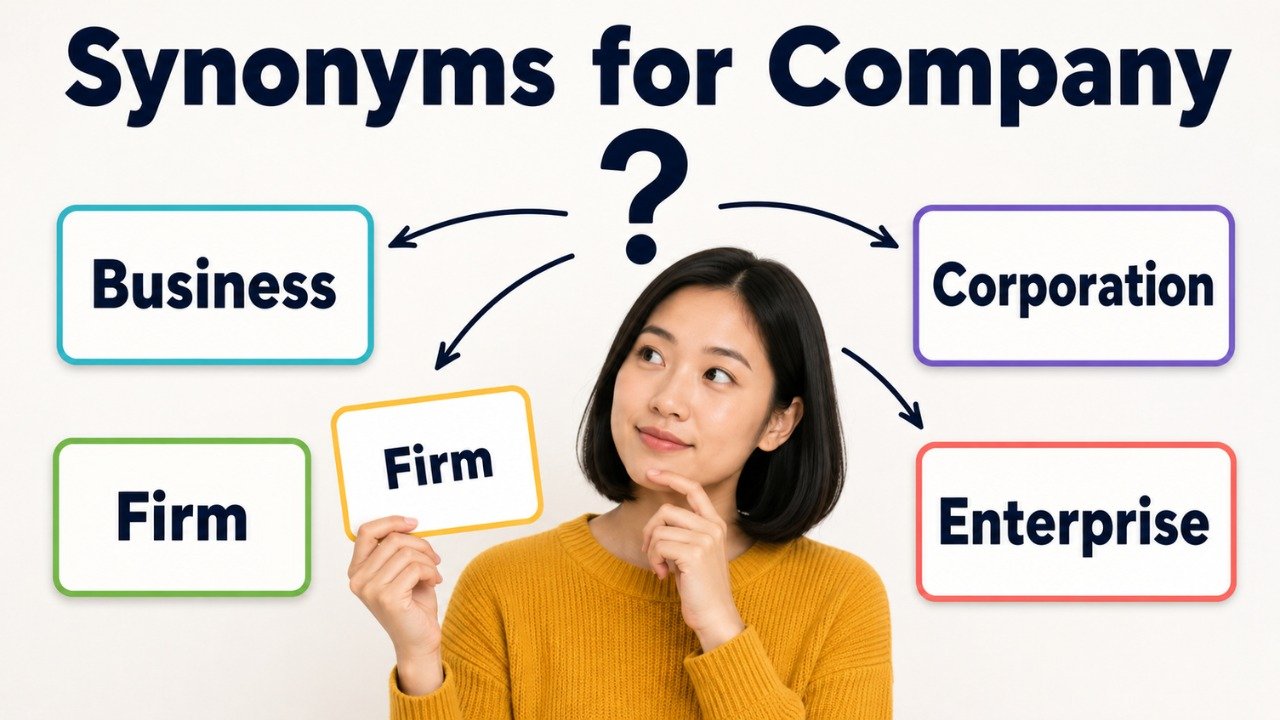
Quick Answer: The best synonyms for company are business, firm, corporation, enterprise, organization, companionship, association, group, team, and visitors. Use business or firm for a commercial operation. Corporation is suitable for a legally registered business, while enterprise emphasizes commercial activity or an ambitious venture. Organization is broader and may describe commercial or noncommercial groups. Companionship refers to friendly presence, association describes a connected group, and visitors is best when company means guests in someone’s home.
Pronunciation and Word Details
Word: Company
Pronunciation: /ˈkʌmpəni/
Part of Speech: Noun
Meaning: Company can mean a business organization, the presence of other people, a group with a shared purpose, invited guests, or an organized unit.
US Pronunciation:
UK Pronunciation:
What Does “Company” Mean?
Company most commonly means a business that sells products, provides services, employs workers, or performs commercial activities. In this sense, business, firm, corporation, enterprise, and organization are common alternatives.
Example: She works for a technology company.
The word can also mean the presence or companionship of another person.
Example: I enjoyed her company during the journey.
Company may refer to guests or visitors spending time with someone.
Example: We are expecting company this evening.
It can also describe a group of people who perform, work, travel, or serve together. A theater company, for example, is a group of performers, while a military company is an organized unit of soldiers.
The correct synonym depends on the sentence. Firm works well for professional services, companionship emphasizes emotional connection, troupe fits performers, and unit suits an organized group.
Meaning, Tone, and Context of “Company”
Company is generally a neutral and widely understood word. Its tone and meaning change according to context.
In commercial writing, company is a standard term for an organization that conducts business. It can refer to a small local operation, a large corporation, a professional firm, or a new venture.
In legal and financial contexts, corporation may be more precise when the organization has a specific legal structure. Enterprise is common when emphasizing commercial activity, initiative, or ambition.
In everyday conversation, company often means companionship or the presence of another person. Saying that someone enjoys your company usually expresses warmth, friendliness, or emotional comfort.
When company means guests, it has a casual and domestic tone. The phrase expecting company normally means that visitors will arrive soon.
In artistic contexts, company may describe performers who work together. A dance company, theater company, or acting company may be called a troupe, ensemble, cast, or performing group.
In military contexts, company refers to an organized body of soldiers. Unit, formation, troop, or detachment may be suitable alternatives, depending on the exact structure.
When and How to Use “Company”
For a Business: Use company when referring generally to a commercial organization that provides products or services.
Example: The company plans to open another office next year.
For a Professional Firm: Use firm when describing a business that provides specialized professional services.
Example: She joined a respected accounting firm.
For a Legal Business Entity: Use corporation when the legal structure or formal registration of a business matters.
Example: The corporation released its annual financial report.
For Commercial Activity: Use enterprise when emphasizing initiative, ambition, or an organized business venture.
Example: The family turned its small workshop into a successful enterprise.
For Companionship: Use company when referring to the presence of another person and the enjoyment that presence provides.
Example: He appreciated her company during the long trip.
For Guests: Use company when visitors are coming to someone’s home or gathering place.
Example: We cleaned the living room because we were expecting company.
For a Group: Use company for people working, traveling, performing, or serving together.
Example: A company of actors arrived for the festival.
For Performers: Use troupe, ensemble, or cast when the group performs on stage.
Example: The dance troupe performed three original pieces.
For an Organized Unit: Use unit, formation, or detachment when referring to an organized group in a formal structure.
Example: The unit completed the training exercise successfully.
Best Synonyms for Company
Business: An organization that sells goods or provides services.
Example: She started a small business from her home.
Firm: A commercial organization, especially one offering professional services.
Example: He works for an engineering firm.
Corporation: A legally established business organization treated as a separate entity.
Example: The corporation employs thousands of workers.
Enterprise: A business activity or ambitious commercial organization.
Example: Their farming enterprise expanded into several regions.
Organization: A structured group created for a particular purpose.
Example: The organization provides educational services.
Companionship: Friendly presence and social connection with another person.
Example: Older residents often value companionship and regular conversation.
Association: A group of people connected by a profession, interest, or purpose.
Example: She joined a local writers association.
Group: A number of people or things considered together.
Example: A group of volunteers helped clean the park.
Team: People working together toward a shared objective.
Example: The design team completed the project early.
Visitors: People who come to see someone or spend time at a place.
Example: The family prepared dinner for their visitors.
50 Synonyms for Company with Short Meanings
- Business: An organization that sells goods or services.
- Firm: A commercial organization, especially in a professional field.
- Corporation: A legally registered business entity.
- Enterprise: A commercial organization or ambitious venture.
- Organization: A structured group created for a purpose.
- Establishment: A business or institution operating from a particular place.
- Concern: A business organization or commercial operation.
- Agency: A business that provides a particular service.
- Venture: A new business activity involving opportunity and risk.
- Partnership: A business owned or managed by two or more people.
- Operation: A business or organized commercial activity.
- Startup: A recently created business seeking growth.
- Institution: An established organization serving a social or professional purpose.
- Conglomerate: A large business made up of several different companies.
- Group: A collection of businesses or people connected together.
- House: A commercial organization, especially in publishing, finance, or fashion.
- Outfit: An informal word for a business or organized group.
- Practice: A professional business run by doctors, lawyers, or other specialists.
- Office: A business location or professional organization.
- Commercial Enterprise: An organization created to conduct business.
- Companionship: The friendly presence of another person.
- Fellowship: Friendly association based on shared interests or experiences.
- Association: Connection with people or a formally organized group.
- Presence: The state of being with someone.
- Society: Social contact or an organized community of people.
- Friendship: A close and supportive personal relationship.
- Accompaniment: The state of going somewhere with another person.
- Escort: A person who accompanies someone for support or protection.
- Attendance: The presence of a person at a place or event.
- Social Contact: Interaction and communication with other people.
- Guests: People invited to visit a person or place.
- Visitors: People who come to see someone or enter a place temporarily.
- Callers: People who visit someone, often briefly.
- Party: A group of people gathered or traveling together.
- Gathering: A number of people meeting in one place.
- Assembly: A group of people brought together for a purpose.
- Circle: A group connected by friendship, work, or shared interests.
- Crowd: A large number of people gathered together.
- Team: People cooperating toward a shared goal.
- Crew: A group working together, especially on a vehicle or project.
- Band: A group joined for a shared activity or purpose.
- Troupe: A group of actors, dancers, or performers.
- Ensemble: A group of performers working together.
- Cast: The performers appearing in a play, film, or production.
- Collective: A group whose members share responsibilities or goals.
- Unit: An organized group forming part of a larger structure.
- Formation: An organized arrangement of people, especially personnel.
- Detachment: A group separated from a larger organized body.
- Body: A group of people acting together in an official capacity.
- Contingent: A group representing a larger organization or community.
Read Also:
Synonyms for Provoke

Synonyms for Company by Context
When Company Means a Business
Business, firm, corporation, enterprise, establishment, concern, agency, venture, partnership, and operation describe commercial organizations.
Business is the broadest alternative. Firm is often used for professional services. Corporation refers to a specific legal structure, while enterprise can suggest ambition and commercial initiative.
Example: The business provides repair services throughout the region.
Example: She accepted a position at a legal firm.
When Company Means a Large Organization
Corporation, conglomerate, institution, organization, group, and commercial enterprise work well for larger or more formally structured organizations.
Conglomerate describes a large business controlling several different companies. Institution often refers to an established organization with social, educational, financial, or professional importance.
Example: The conglomerate operates businesses in several industries.
Example: The institution has served the community for many decades.
When Company Means a Small Business
Startup, venture, practice, office, operation, establishment, and outfit can describe smaller commercial organizations.
Startup is suitable for a recently created business. Practice commonly refers to a professional business, while outfit is an informal alternative.
Example: The startup developed a useful scheduling tool.
Example: She opened a private dental practice.
When Company Means Companionship
Companionship, fellowship, friendship, presence, association, society, social contact, and accompaniment describe the experience of being with another person.
Companionship emphasizes emotional support and friendly presence. Fellowship often involves shared values or experiences. Presence is more neutral and simply means being there.
Example: He valued the companionship of his old friends.
Example: Her calm presence made the journey more enjoyable.
When Company Means Guests
Guests, visitors, callers, party, and gathering can replace company when people visit someone’s home or attend an event.
Guests are normally invited. Visitors may arrive for personal, social, or professional reasons. Callers usually make a brief visit.
Example: We prepared an extra room for our guests.
Example: Several visitors arrived during the afternoon.
When Company Means a Group
Group, team, crew, band, collective, assembly, circle, crowd, body, and contingent refer to people considered together.
Team emphasizes cooperation. Crew often describes people performing practical work. Collective suggests shared responsibility, while contingent refers to representatives from a larger group.
Example: A team of researchers examined the results.
Example: A contingent of volunteers attended the meeting.
When Company Means Performers
Troupe, ensemble, cast, band, and performing group describe people who entertain an audience.
Troupe is commonly used for dancers or actors. Ensemble emphasizes coordinated performance. Cast refers specifically to the performers in a production.
Example: The theater troupe toured several cities.
Example: The entire cast returned for the final performance.
When Company Means an Organized Unit
Unit, formation, detachment, contingent, body, and crew may describe an organized group within a larger structure.
Unit is the broadest formal alternative. Detachment describes a group assigned separately from the main body. Formation emphasizes organized arrangement.
Example: The unit received new equipment.
Example: A small detachment remained at the base.
Another Word for Company
Business is usually the best general replacement when company refers to a commercial organization. However, the strongest alternative depends on the type, size, legal structure, and purpose of the organization.
Use firm for professional services, corporation for a formal legal entity, enterprise for ambitious commercial activity, and startup for a newly created business. When company means friendly presence, companionship is the best alternative. When it means guests, visitors or guests are more precise.
Original: She owns a cleaning company.
Better Option: She owns a cleaning business.
Original: He joined a company that provides legal advice.
Better Option: He joined a firm that provides legal advice.
Original: I enjoyed your company during dinner.
Better Option: I enjoyed your companionship during dinner.
Original: We are having company this weekend.
Better Option: We are having guests this weekend.
When Not to Use “Company”
Avoid company when the sentence requires a more specific word. Company is broad and may refer to a business, companionship, guests, performers, or an organized unit.
Use corporation when the legal structure matters. Use firm for a professional service provider. Use startup for a recently created business. Use companionship when describing emotional or social presence.
Weak: The company was legally created as a separate entity.
Better: The corporation was legally created as a separate entity.
Weak: She works for a company of lawyers.
Better: She works for a law firm.
Weak: He needed company after moving to a new city.
Better: He needed companionship after moving to a new city.
Weak: We prepared dinner because company was arriving.
Better: We prepared dinner because guests were arriving.
Avoid using company when organization is more appropriate for a group that does not primarily conduct commercial activity.
Weak: The charitable company supports local families.
Better: The charitable organization supports local families.
Do not use company as a direct replacement for corporation in every legal or financial sentence. Not every company has the legal structure of a corporation.
Avoid repeating company several times in one paragraph when more precise alternatives would improve clarity.
Repetitive: The company bought another company because the company wanted to expand.
Better: The corporation acquired another business because the organization wanted to expand.
Words Commonly Confused With Company
Company vs Business: Company refers to an organized commercial entity, while business can mean the organization, its activities, or commerce in general.
Company vs Corporation: Company is a broad term for a commercial organization. Corporation describes a business with a specific legal identity and structure.
Company vs Firm: Company can describe almost any commercial organization. Firm is commonly used for professional service businesses such as legal, accounting, consulting, and engineering practices.
Company vs Enterprise: Company identifies an organization. Enterprise emphasizes commercial activity, initiative, ambition, or a challenging venture.
Company vs Organization: Company usually suggests commercial activity. Organization is broader and includes businesses, charities, clubs, institutions, and public bodies.
Company vs Agency: A company may sell products or provide services. An agency mainly performs a specialized service or represents clients.
Company vs Partnership: Company is a broad business term. Partnership specifically describes ownership or management shared by two or more parties.
Company vs Companionship: Company can mean another person’s presence. Companionship emphasizes friendship, emotional support, and social connection.
Company vs Guests: Company may refer generally to people visiting. Guests are people who have been invited or welcomed.
Company vs Group: Company can describe a business or an organized body. Group is a broad term for any number of people or things considered together.
Which Synonym Should You Choose?
Choose business when referring generally to an organization that sells products or provides services.
Choose firm when discussing professional services, including legal, accounting, consulting, architectural, or engineering work.
Choose corporation when the legal structure, ownership, liability, or formal registration of the organization matters.
Choose enterprise when emphasizing commercial ambition, initiative, risk, or development.
Choose organization when referring to a structured group that may be commercial, charitable, educational, social, or professional.
Choose agency when the business provides specialized services or represents clients.
Choose startup when describing a recently established company focused on innovation or growth.
Choose partnership when two or more people share ownership or responsibility.
Choose practice for a professional business operated by doctors, lawyers, therapists, or similar specialists.
Choose companionship when company means friendly presence or emotional connection.
Choose guests when referring to invited visitors.
Choose team when the people cooperate toward a shared goal.
Choose troupe for actors or dancers.
Choose ensemble when performers work together as a coordinated group.
Choose cast for all performers in a dramatic production.
Choose unit when referring to an organized body within a larger structure.
Real Life Examples of “Company” in Sentences
Original: She works for a company that designs buildings.
Better Option: She works for a firm that designs buildings.
Original: The company was registered as a separate legal entity.
Better Option: The corporation was registered as a separate legal entity.
Original: They hope to turn the project into a successful company.
Better Option: They hope to turn the project into a successful enterprise.
Original: The company opened its first office last year.
Better Option: The business opened its first office last year.
Original: He enjoyed the company of his neighbors.
Better Option: He enjoyed the companionship of his neighbors.
Original: We are expecting company after dinner.
Better Option: We are expecting guests after dinner.
Original: A company of dancers performed at the event.
Better Option: A troupe of dancers performed at the event.
Original: The acting company rehearsed throughout the afternoon.
Better Option: The cast rehearsed throughout the afternoon.
Original: The company completed the assignment successfully.
Better Option: The unit completed the assignment successfully.
Original: She prefers the company of thoughtful people.
Better Option: She prefers the society of thoughtful people.
Synonym Groups and Usage Differences
Business Organization Group
Business, firm, corporation, enterprise, establishment, concern, agency, partnership, operation, and startup describe commercial organizations.
Business is the most flexible choice. Firm suits professional services, corporation carries a legal meaning, and startup emphasizes recent creation and growth.
Example: The new business quickly attracted local customers.
Formal Organization Group
Organization, institution, conglomerate, group, body, and commercial enterprise describe structured or established entities.
Institution often suggests stability and social importance. Conglomerate describes a large collection of different businesses under shared control.
Example: The institution provides training for young professionals.
Companionship Group
Companionship, fellowship, friendship, presence, society, accompaniment, and social contact describe the experience of being with others.
Companionship is warm and personal. Fellowship often grows from shared values, while presence simply indicates that someone is there.
Example: She appreciated his quiet companionship.
Visitor Group
Guests, visitors, callers, party, gathering, and attendance relate to people arriving, meeting, or being present.
Guests are invited, visitors may be expected or unexpected, and callers normally remain for a shorter period.
Example: The hosts welcomed their guests warmly.
Working Group
Team, crew, collective, band, group, and circle describe people working or interacting together.
Team emphasizes a shared objective. Crew suggests practical duties, while collective emphasizes shared responsibility or ownership.
Example: The production crew arrived before sunrise.
Performance Group
Troupe, ensemble, cast, band, and company describe groups of performers.
Troupe is useful for dancers and actors. Ensemble highlights coordination, while cast identifies performers in one particular production.
Example: The ensemble performed with impressive precision.
Organized Unit Group
Unit, formation, detachment, contingent, body, and crew describe organized groups within larger systems.
Unit is neutral and widely applicable. Detachment refers to a smaller group assigned separately, while contingent often represents a larger organization.
Example: A contingent of delegates attended the conference.
Antonyms of Company
The opposite of company depends on whether the word means a business, companionship, visitors, or a group.
Solitude: The state of being alone.
Isolation: Separation from other people or groups.
Loneliness: Sadness caused by a lack of companionship.
Seclusion: The condition of being private and away from others.
Absence: The state of not being present.
Separation: The condition of being apart.
Individual: One person acting alone rather than as part of a group.
Loner: A person who usually avoids the company of others.
Competitor: A business or person trying to achieve the same commercial goal.
Rival: A person or organization competing for the same success.
Opponent: A person or group acting against another.
Customer: A person who buys from a business rather than belonging to it.
Independence: The state of operating without control or assistance from others.
Dissolution: The formal ending of a company or organization.
Closure: The act of permanently ending business operations.
Comparison of Company vs Related Words
Company vs Business
Company usually refers to the organization itself. Business can refer to the organization, its commercial activities, or the general practice of buying and selling.
Example With Company: The company employs fifty people.
Example With Business: The business has grown steadily this year.
Company vs Firm
Company is a broad commercial term. Firm is commonly used for businesses providing specialized professional services.
Example With Company: She joined a manufacturing company.
Example With Firm: She joined an architectural firm.
Company vs Corporation
Company can refer to many types of commercial organizations. Corporation describes a formally registered legal entity that exists separately from its owners.
Example With Company: The company produces household equipment.
Example With Corporation: The corporation issued shares to investors.
Company vs Enterprise
Company identifies a commercial organization. Enterprise often emphasizes initiative, risk, ambition, or the entire commercial activity.
Example With Company: The company employs local workers.
Example With Enterprise: Their agricultural enterprise has expanded rapidly.
Company vs Organization
Company usually has a commercial meaning. Organization is broader and can include businesses, charities, clubs, institutions, and professional groups.
Example With Company: The company sells medical equipment.
Example With Organization: The organization provides free educational support.
Company vs Agency
Company may provide goods or services. Agency mainly provides a specialized service, represents clients, or acts on behalf of others.
Example With Company: The company manufactures office furniture.
Example With Agency: The agency manages advertising projects for clients.
Company vs Companionship
Company may simply mean another person’s presence. Companionship suggests a warmer relationship involving friendship, comfort, or emotional support.
Example With Company: I appreciated your company on the journey.
Example With Companionship: The dog provided companionship during his recovery.
Company vs Guests
Company can be an uncountable collective term for people visiting. Guests clearly identifies the people who have been invited or welcomed.
Example With Company: We are expecting company tonight.
Example With Guests: Our guests will arrive at seven.
Common Phrases and Expressions With “Company”
Keep Someone Company: Stay with someone so that the person is not alone.
Example: I stayed to keep her company while she waited.
Enjoy Someone’s Company: Take pleasure in spending time with someone.
Example: We always enjoy their company.
In Good Company: Among respected, successful, or similar people.
Example: Anyone making that mistake is in good company.
Part Company: Separate, leave, or end a relationship.
Example: The partners decided to part company after the disagreement.
Expecting Company: Preparing for visitors to arrive.
Example: We are expecting company this afternoon.
Company Policy: A rule or standard followed by a business.
Example: The decision followed company policy.
Company Culture: The shared values, habits, and working environment of a business.
Example: Respect is an important part of the company culture.
Company Representative: A person authorized to speak or act for a business.
Example: A company representative answered the questions.
Parent Company: A business that owns or controls another business.
Example: The parent company approved the expansion plan.
Private Company: A business owned privately rather than publicly traded.
Example: The manufacturer remains a private company.
Common Mistakes to Avoid
A common mistake is treating company, business, and corporation as exact equivalents. Business is broad, while corporation has a specific legal meaning.
Incorrect: Every small business is a corporation.
Better: Some small businesses are corporations, while others use different ownership structures.
Another mistake is using company for a noncommercial group when organization would be clearer.
Weak: The community company provides free meals.
Better: The community organization provides free meals.
Do not use firm for every type of business. Firm is most natural for professional services.
Unnatural: She works for a grocery firm.
Better: She works for a grocery company.
Avoid using companionship when you simply mean attendance or physical presence. Companionship usually suggests friendly or emotional connection.
Unclear: The official provided companionship at the ceremony.
Better: The official attended the ceremony.
Do not confuse company with accompany. Company is usually a noun, while accompany is a verb.
Incorrect: She will company me to the appointment.
Better: She will accompany me to the appointment.
Avoid repeating company several times when exact alternatives would improve readability.
Repetitive: The company bought a company that supplied products to another company.
Better: The corporation acquired a supplier that sold products to another business.
Writers should also consider whether company means guests, companionship, performers, or a business before selecting a synonym. A word that works in one context may sound incorrect in another.
Conclusion
Understanding synonyms for company helps you choose clearer words for businesses, groups, guests, performers, and social relationships. Business is the strongest general alternative for a commercial organization, while firm suits professional services and corporation carries a formal legal meaning. Use enterprise for ambitious commercial activity, organization for a structured group, and startup for a recently created business. When company means social presence, choose companionship. Guests or visitors fit home settings, while troupe, ensemble, cast, team, and unit describe different organized groups.
FAQs About Synonyms for Company
What Is the Best Synonym for Company?
Business is the best general synonym when company refers to a commercial organization. The most accurate choice still depends on the sentence.
Is Firm the Same as Company?
Firm and company can have similar meanings, but firm is especially common for professional service businesses such as legal, accounting, consulting, and engineering practices.
What Is a Formal Synonym for Company?
Corporation, enterprise, organization, establishment, and commercial enterprise are useful formal alternatives.
What Is Another Word for Company in Business?
Business, firm, corporation, enterprise, agency, partnership, operation, and establishment are suitable choices.
What Is Another Word for Someone’s Company?
Companionship, presence, fellowship, friendship, society, and accompaniment can describe being with another person.
What Does Expecting Company Mean?
Expecting company means that guests or visitors are expected to arrive soon.
What Is a Synonym for a Company of Performers?
Troupe, ensemble, cast, band, and performing group are useful alternatives for a company of performers.
