
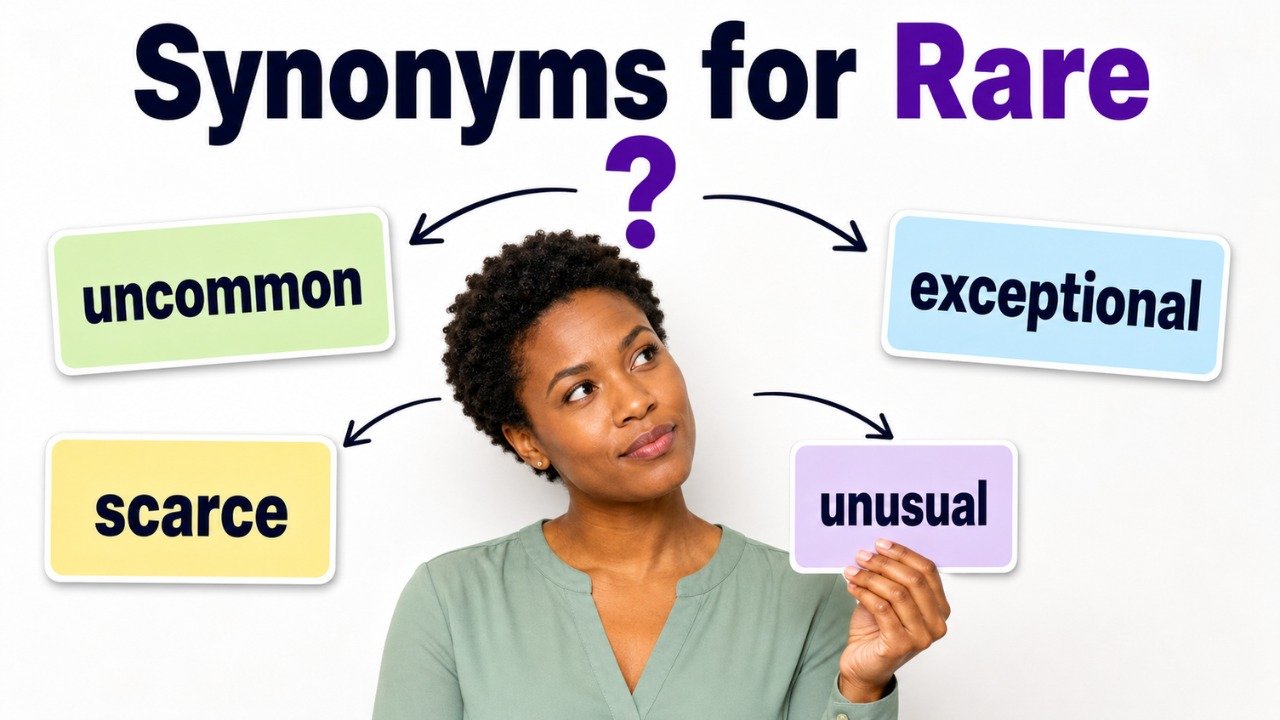
Quick Answer: The most useful synonyms for rare are uncommon, unusual, scarce, infrequent, exceptional, extraordinary, unique, distinctive, limited, and precious. Choose uncommon or unusual for something not regularly seen. Use scarce or limited when referring to supply or availability. Infrequent is best for events that do not happen often. Exceptional and extraordinary express impressive quality. Unique describes something unlike anything else, while underdone or lightly cooked describes rare meat.
Pronunciation and Word Details
Word: Rare
Pronunciation: /reər/
Part of Speech: Adjective
Meaning: Rare describes something that is uncommon, difficult to find, unusually valuable, infrequent, or lightly cooked.
US Pronunciation:
UK Pronunciation:
What Does “Rare” Mean?
Rare means uncommon, unusual, or not frequently found. It is mainly used as an adjective to describe objects, events, qualities, species, opportunities, and experiences that occur in small numbers or are difficult to encounter.
The word can also describe something unusually excellent or valuable. A rare talent, for example, is an exceptional ability that few people possess.
When discussing availability, rare can mean scarce or limited. A rare mineral may exist only in a few locations. When discussing frequency, it can mean infrequent. A rare event does not happen regularly.
Rare also has a culinary meaning. Rare meat is cooked briefly, leaving the center red or pink.
Meaning, Tone, and Context of “Rare”
Rare usually has a neutral tone, but its emotional effect depends on the context. It may express admiration, concern, value, scarcity, or unusualness.
In formal and academic writing, rare often describes medical conditions, biological species, historical events, scientific materials, or statistical occurrences. More precise alternatives such as infrequent, scarce, limited, or atypical may sometimes be preferred.
In everyday conversation, rare commonly describes unusual opportunities, remarkable skills, valuable objects, or events that do not happen often.
The word can have a positive tone when describing rare beauty, rare talent, or a rare opportunity. It can have a concerning tone when describing a rare illness, an endangered species, or a scarce resource.
In cooking, rare is a specific term for the level of doneness of meat. This meaning should not be confused with raw, because rare meat has normally been exposed to heat.
When and How to Use “Rare”
For Uncommon Things: Use rare for something that is not normally seen, found, or experienced.
Example: Seeing snow in this region is rare.
For Limited Availability: Use rare when an item, material, or resource exists in small quantities.
Example: The museum displayed a rare collection of ancient coins.
For Infrequent Events: Use rare when an event does not happen regularly.
Example: Power failures are rare in this neighborhood.
For Exceptional Qualities: Use rare to praise a quality, ability, or personal characteristic that few people possess.
Example: She has a rare ability to explain difficult ideas clearly.
For Valuable Objects: Use rare for something that is valuable because few examples exist.
Example: The collector purchased a rare manuscript.
For Unusual Opportunities: Use rare when a chance or experience is not normally available.
Example: This internship offers a rare opportunity to learn from experienced researchers.
For Species and Natural Features: Use rare when a plant, animal, mineral, or natural event is seldom observed.
Example: The forest provides shelter for several rare bird species.
For Food Preparation: Use rare to describe meat cooked for a short time with a red or warm pink center.
Example: He ordered his steak rare.
Best Synonyms for Rare
Uncommon: Not regularly found, seen, or experienced.
Example: Such generosity is uncommon in highly competitive environments.
Unusual: Different from what is normal, expected, or familiar.
Example: The researchers noticed an unusual pattern in the results.
Scarce: Available only in a small or insufficient quantity.
Example: Clean water became scarce during the long dry season.
Infrequent: Not happening often or regularly.
Example: Her visits became infrequent after she moved away.
Exceptional: Much better, stronger, or more impressive than usual.
Example: The student demonstrated exceptional writing ability.
Extraordinary: Extremely unusual, impressive, or remarkable.
Example: The rescue team showed extraordinary courage.
Unique: Being the only one of its kind or clearly different from everything else.
Example: Each handmade bowl has a unique design.
Distinctive: Having a quality that makes something easy to recognize.
Example: The flower has a distinctive shape and fragrance.
Limited: Small in amount, number, availability, or range.
Example: Tickets for the private exhibition are limited.
Precious: Rare, valuable, loved, or deserving careful protection.
Example: Fresh water is a precious resource in dry regions.
50 Synonyms for Rare with Short Meanings
- Uncommon: Not often found, seen, or experienced.
- Unusual: Different from what is normal or expected.
- Scarce: Existing in a small or insufficient quantity.
- Infrequent: Not happening often.
- Exceptional: Unusually excellent or impressive.
- Extraordinary: Very unusual, remarkable, or surprising.
- Unique: Being the only one of its kind.
- Distinctive: Clearly different and easy to recognize.
- Singular: Remarkably unusual or exceptional.
- Remarkable: Worth noticing because of unusual qualities.
- Limited: Restricted in number, amount, or availability.
- Sparse: Thinly distributed or present in small numbers.
- Scant: Barely sufficient in amount or quantity.
- Meager: Small and less than what is needed or expected.
- Restricted: Controlled or available only in limited amounts.
- Precious: Valuable because of rarity, importance, or affection.
- Valuable: Worth a significant amount or deserving appreciation.
- Choice: Carefully selected for high quality.
- Select: Chosen because of superior quality or special value.
- Exquisite: Extremely beautiful, delicate, or skillfully made.
- Fine: Having excellent quality or craftsmanship.
- Superior: Better in quality than most comparable things.
- Outstanding: Exceptionally good or impressive.
- Special: Different from ordinary things in a positive way.
- Atypical: Not showing the usual characteristics of a group.
- Anomalous: Different from an established pattern or expectation.
- Irregular: Not following the normal pattern or schedule.
- Curious: Strange, unusual, or interesting.
- Odd: Different from what is normal or expected.
- Unfamiliar: Not commonly known, recognized, or experienced.
- Unprecedented: Never previously known, experienced, or recorded.
- Unheard of: So unusual that it has not been known before.
- One of a Kind: Completely unique and without an exact match.
- Hard to Find: Difficult to locate or obtain.
- Few and Far Between: Occurring very rarely or at widely separated intervals.
- Seldom Seen: Not commonly observed.
- Seldom Found: Difficult to discover or locate.
- Occasional: Happening sometimes but not regularly.
- Sporadic: Occurring irregularly and at scattered times.
- Isolated: Existing separately or occurring only once.
- Exclusive: Available only to a limited group.
- In Short Supply: Available in a smaller quantity than needed.
- Thin on the Ground: Present in very small numbers.
- Deficient: Lacking a sufficient amount of something.
- Insufficient: Not available in the quantity required.
- Underdone: Cooked less than the usual amount.
- Lightly Cooked: Exposed to heat for only a short period.
- Pink: Cooked while still retaining a pink center.
- Seared: Quickly cooked on the outside while remaining less cooked inside.
- Undercooked: Not cooked as thoroughly as expected or required.
Read Also:
Synonyms for Punishment

Synonyms for Rare by Context
When Rare Means Uncommon
Uncommon, unusual, atypical, odd, anomalous, and unfamiliar describe something outside the normal pattern. Uncommon is usually neutral, while unusual emphasizes difference. Atypical and anomalous are more suitable for formal, scientific, or analytical writing.
Example: The doctor observed an atypical response to the treatment.
Example: It is unusual to experience such warm weather in winter.
When Rare Means Scarce
Scarce, limited, sparse, scant, restricted, and in short supply describe something that exists in small quantities. Scarce is especially useful for resources, products, food, water, and materials.
Example: Affordable housing is scarce in the city center.
Example: Reliable information about the event remains limited.
When Rare Means Infrequent
Infrequent, occasional, sporadic, isolated, seldom seen, and few and far between describe events that do not occur regularly.
Example: Complaints about the service are infrequent.
Example: Rainfall in the desert is sporadic.
When Rare Means Exceptional
Exceptional, extraordinary, remarkable, outstanding, singular, and superior describe an ability, achievement, quality, or person who stands above the ordinary.
Example: The musician displayed exceptional technical skill.
Example: Her recovery was extraordinary.
When Rare Means Valuable
Precious, valuable, choice, select, fine, and exquisite suggest that something is desirable because of its quality, beauty, importance, or limited availability.
Example: The library protects several precious historical documents.
Example: The shop displayed a select collection of handmade furniture.
When Rare Describes Food
Underdone, lightly cooked, pink, and seared may replace rare when describing meat, depending on the exact cooking method and desired level of doneness.
Example: The steak was lightly cooked and pink in the center.
Example: The chef seared the meat briefly on both sides.
Another Word for Rare
Uncommon is often the best general replacement for rare because it clearly describes something that is not regularly seen, found, or experienced. However, the strongest alternative depends on whether the sentence refers to frequency, quantity, quality, uniqueness, value, or food preparation.
Original: It is rare for the temperature to fall below freezing here.
Better Option: It is uncommon for the temperature to fall below freezing here.
Original: Fresh vegetables were rare after the storm.
Better Option: Fresh vegetables were scarce after the storm.
Original: She possesses a rare ability to remain calm under pressure.
Better Option: She possesses an exceptional ability to remain calm under pressure.
Original: The animal has a rare pattern on its wings.
Better Option: The animal has a distinctive pattern on its wings.
When Not to Use “Rare”
Avoid using rare when a more specific word would explain your meaning more accurately. Rare can refer to frequency, scarcity, excellence, uniqueness, or food preparation, so it may sound vague without enough context.
Use scarce for insufficient resources, infrequent for events, exceptional for outstanding abilities, and unique for something that has no exact equivalent.
Weak: The village has rare water during summer.
Better: The village has scarce water supplies during summer.
Weak: His attendance at meetings is rare.
Better: His attendance at meetings is infrequent.
Weak: She produced a rare academic paper.
Better: She produced an exceptional academic paper.
Weak: The vase has a rare shape.
Better: The vase has a distinctive shape.
Weak: This is a rare product with only twenty units available.
Better: This is a limited product with only twenty units available.
Do not use rare as an automatic replacement for unique. Something can be rare without being completely unique. Several examples may exist, even when they are difficult to find.
Words Commonly Confused With Rare
Rare vs Scarce: Rare means uncommon or difficult to find. Scarce means that the available quantity is too small or limited. A rare object may be valuable, while a scarce resource may be insufficient for demand.
Rare vs Unique: Rare means that few examples exist. Unique means that only one exact example exists or that something has qualities unlike anything else.
Rare vs Unusual: Rare emphasizes low frequency or limited occurrence. Unusual emphasizes a difference from what is normal or expected.
Rare vs Exceptional: Rare describes something uncommon. Exceptional usually describes something unusually excellent, impressive, or far above average.
Rare vs Infrequent: Rare can describe objects, qualities, events, and availability. Infrequent applies mainly to events or actions that do not happen often.
Rare vs Limited: Rare suggests that something naturally exists or occurs in small numbers. Limited suggests that the amount, access, time, or availability has been restricted.
Rare vs Raw: Rare meat has been cooked briefly, while raw meat has not been cooked. The words should not be treated as exact equivalents.
Rare vs Precious: Rare describes limited occurrence or availability. Precious emphasizes value, emotional importance, beauty, or the need for protection.
Which Synonym Should You Choose?
Choose uncommon when you need a neutral and widely understood alternative for something that is not often seen.
Choose unusual when something differs from normal expectations.
Choose scarce when discussing resources, supplies, products, food, water, or materials that are difficult to obtain.
Choose infrequent when describing actions, visits, events, meetings, or problems that do not happen regularly.
Choose exceptional when praising ability, performance, intelligence, service, quality, or achievement.
Choose extraordinary when the quality or event is highly impressive and far beyond the ordinary.
Choose unique when something is genuinely one of a kind.
Choose distinctive when something has a recognizable appearance, sound, style, feature, or quality.
Choose limited in reports, notices, and formal communication about restricted quantities, time, access, or availability.
Choose atypical or anomalous in academic, medical, scientific, and technical writing when something differs from an established pattern.
Choose precious when emphasizing emotional, cultural, financial, or practical value.
Choose underdone or lightly cooked when describing the preparation of meat.
Real Life Examples of “Rare” in Sentences
Original: It is rare to see this bird near the city.
Better Option: It is uncommon to see this bird near the city.
Original: Heavy rainfall is rare in this region.
Better Option: Heavy rainfall is infrequent in this region.
Original: The country contains several rare minerals.
Better Option: The country contains several scarce minerals.
Original: She has a rare gift for understanding people.
Better Option: She has an exceptional gift for understanding people.
Original: The artist developed a rare painting style.
Better Option: The artist developed a distinctive painting style.
Original: This was a rare moment in the history of the organization.
Better Option: This was an unprecedented moment in the history of the organization.
Original: The shop sells rare handmade decorations.
Better Option: The shop sells exclusive handmade decorations.
Original: The old book is extremely rare.
Better Option: The old book is extremely hard to find.
Original: Such acts of kindness are rare.
Better Option: Such acts of kindness are few and far between.
Original: He asked for his steak to be rare.
Better Option: He asked for his steak to be lightly cooked and pink in the center.
Synonym Groups and Usage Differences
Uncommonness Group
Uncommon, unusual, atypical, anomalous, odd, and unfamiliar describe something outside ordinary experience. Uncommon focuses on low occurrence, while unusual focuses on noticeable difference.
Example: The scientists recorded an unusual change in temperature.
Scarcity Group
Scarce, limited, sparse, scant, restricted, and insufficient relate to low quantity or availability. Scarce often suggests demand is greater than supply.
Example: Medical supplies became scarce after the emergency.
Frequency Group
Infrequent, occasional, sporadic, isolated, seldom seen, and few and far between describe how often something happens. Infrequent is neutral, while sporadic suggests an irregular pattern.
Example: Communication between the two offices was sporadic.
Excellence Group
Exceptional, extraordinary, remarkable, outstanding, superior, and exquisite express impressive quality. Exceptional works well for skills and performance, while exquisite commonly describes beauty, taste, detail, or craftsmanship.
Example: The building contains exquisite decorative details.
Uniqueness Group
Unique, singular, distinctive, one of a kind, and unprecedented describe things that stand apart. Unique is strongest when no exact equivalent exists.
Example: The architect created a distinctive entrance for the building.
Value Group
Precious, valuable, choice, select, and fine emphasize importance or superior quality. Precious may also express emotional value.
Example: The diary became a precious family possession.
Food Preparation Group
Underdone, lightly cooked, pink, and seared relate to food that has received limited cooking. These alternatives are not interchangeable in every recipe because they describe different cooking results.
Example: The meat was seared outside but remained pink inside.
Antonyms of Rare
The opposite of rare changes according to whether rare refers to frequency, quantity, quality, uniqueness, or food preparation.
Common: Found, seen, or experienced frequently.
Ordinary: Normal and lacking unusual features.
Typical: Showing the usual qualities of a group or situation.
Frequent: Happening regularly or many times.
Regular: Occurring according to a consistent pattern.
Widespread: Existing or happening across many places.
Abundant: Available in large quantities.
Plentiful: Existing in more than sufficient amounts.
Numerous: Present in large numbers.
Familiar: Well known or easily recognized.
Conventional: Following accepted or traditional patterns.
Average: Typical in quality, amount, or ability.
Commonplace: Ordinary and frequently encountered.
Universal: Found or applicable almost everywhere.
Well Done: Thoroughly cooked, especially when referring to meat.
Comparison of Rare vs Related Words
Rare vs Uncommon
Rare and uncommon both describe something that does not occur frequently. Rare often suggests a stronger degree of scarcity or unusualness. Uncommon is usually more neutral.
Example With Rare: The museum owns a rare ceremonial mask.
Example With Uncommon: It is uncommon to see this style in modern homes.
Rare vs Scarce
Rare describes something that exists in small numbers. Scarce emphasizes limited availability, particularly when the amount may not meet demand.
Example With Rare: The butterfly is rare in this part of the country.
Example With Scarce: Food became scarce after the roads were closed.
Rare vs Unique
Rare means that few examples exist. Unique means that something is the only one of its kind or has no exact equivalent.
Example With Rare: The collector owns several rare coins.
Example With Unique: Each coin has a unique identification mark.
Rare vs Exceptional
Rare focuses on uncommonness, while exceptional usually expresses unusually high quality or ability.
Example With Rare: Her condition is rare.
Example With Exceptional: Her progress has been exceptional.
Rare vs Infrequent
Rare can describe objects, qualities, or events. Infrequent mainly describes actions or events that do not occur often.
Example With Rare: The library contains a rare document.
Example With Infrequent: Updates to the document are infrequent.
Rare vs Unusual
Rare relates to frequency or scarcity. Unusual means noticeably different from what is expected, even when it is not scarce.
Example With Rare: Snow is rare in the coastal town.
Example With Unusual: The snow had an unusual yellowish appearance.
Rare vs Limited
Rare often describes something naturally uncommon. Limited frequently refers to an amount, opportunity, service, or period that has been restricted.
Example With Rare: The region contains a rare plant species.
Example With Limited: Access to the protected area is limited.
Rare vs Underdone
Rare is an accepted level of meat preparation. Underdone can suggest that food has received less cooking than expected or desired.
Example With Rare: She ordered a rare steak.
Example With Underdone: The chicken appeared underdone and required more cooking.
Common Phrases and Expressions With “Rare”
Rare Occurrence: An event that does not happen often.
Rare Opportunity: A valuable chance that is not normally available.
Rare Talent: An exceptional ability possessed by very few people.
Rare Species: A plant or animal found only in small numbers.
Rare Condition: A medical or physical condition affecting relatively few cases.
Rare Beauty: Unusual and exceptional attractiveness.
Rare Find: A valuable or interesting object that is difficult to discover.
Rare Chance: An uncommon possibility or opportunity.
Rare Quality: An unusual and often admirable characteristic.
Rare Collection: A group of valuable objects that are difficult to obtain.
Rare Moment: An unusual event or brief experience.
Rare Steak: Meat cooked briefly so that the center remains red or warm pink.
Common Mistakes to Avoid
One common mistake is using rare when scarce would communicate limited supply more clearly. Water, food, housing, and other resources are often described as scarce when demand exceeds availability.
Another mistake is treating rare and unique as exact synonyms. A rare object may have several existing examples. A unique object has no exact equivalent.
Writers may also repeat rare too frequently when describing several qualities in the same paragraph. Use alternatives such as unusual, exceptional, distinctive, limited, or infrequent to make the writing more precise.
Avoid using exceptional merely to mean uncommon when no positive quality is involved. An exceptional performance is unusually good, while a rare event is simply unlikely to happen.
Do not confuse rare meat with raw meat. Rare meat has received some cooking, while raw meat has not been cooked.
In comparative sentences, rarer is generally smoother and more natural than more rare.
Awkward: This bird is more rare than the other species.
Better: This bird is rarer than the other species.
Avoid vague statements that do not explain why something is rare.
Vague: This is a rare situation.
Clearer: This is an infrequent situation that has occurred only twice in ten years.
Conclusion
Understanding synonyms for rare helps you describe uncommon objects, limited resources, infrequent events, exceptional abilities, and valuable opportunities more precisely. Uncommon and unusual are strong general alternatives. Scarce works best for limited supplies, while infrequent describes events that seldom happen. Choose exceptional or extraordinary for impressive quality, distinctive for recognizable features, and unique for something truly one of a kind. For food, use lightly cooked or underdone carefully because each term communicates a slightly different result.
FAQs About Synonyms for Rare
What Is the Best Synonym for Rare?
Uncommon is the best general synonym because it describes something that is not regularly found, seen, or experienced.
Is Unusual the Same as Rare?
Not exactly. Rare means something happens or exists infrequently, while unusual means it differs from what is normal or expected.
Can Scarce Replace Rare?
Scarce can replace rare when discussing limited resources, products, materials, food, or supplies. It is less suitable for describing talents or unusual events.
What Is a Formal Synonym for Rare?
Infrequent, atypical, anomalous, exceptional, and limited are useful formal alternatives. The correct choice depends on the intended meaning.
What Is a Stronger Word Than Rare?
Extraordinary, exceptional, unprecedented, or one of a kind may sound stronger, depending on whether you mean impressive, previously unknown, or completely unique.
What Is a Synonym for a Rare Opportunity?
Exceptional opportunity, unusual chance, uncommon possibility, unique opportunity, and exclusive opportunity are useful alternatives.
What Is the Opposite of Rare?
Common, ordinary, frequent, typical, abundant, widespread, and plentiful are common opposites of rare.
