
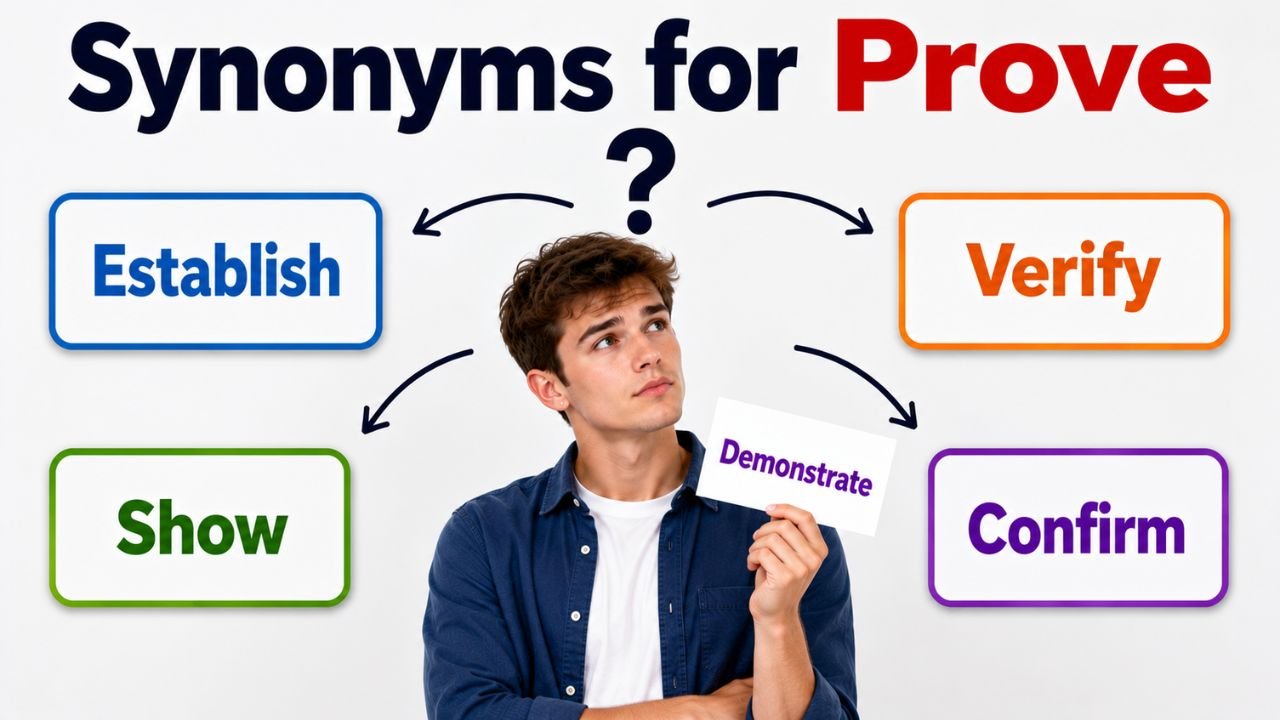
Quick Answer: Synonyms for prove include demonstrate, establish, confirm, verify, validate, substantiate, corroborate, authenticate, show, and vindicate. Use demonstrate when presenting clear evidence, establish when showing that something is true, and verify when checking accuracy. Confirm is suitable when removing doubt, while substantiate and corroborate are useful for supporting claims with evidence. Authenticate works best for identity or originality, and vindicate is appropriate when evidence shows that someone was right or innocent.
Pronunciation and Word Details
Word: Prove.
Pronunciation: /pruːv/.
Part of Speech: Verb.
Meaning: To use evidence, facts, actions, or results to show that something is true, correct, genuine, or effective.
US Pronunciation:
UK Pronunciation:
What Does “Prove” Mean?
Prove means to show through evidence, facts, results, or actions that something is true, correct, genuine, or effective. It is a verb commonly used when discussing claims, theories, identities, abilities, innocence, and performance.
In “The evidence proved his innocence,” prove means established something as true. In “She proved that she could lead the team,” it means demonstrated ability through action.
The word can also describe testing the quality or effectiveness of something. In baking, prove may refer to allowing dough to rise before it is baked.
The exact meaning depends on whether the sentence concerns evidence, verification, personal ability, authenticity, testing, or results.
Meaning, Tone, and Context of “Prove”
Prove usually has a confident, factual, and decisive tone. It suggests that enough evidence or experience exists to remove reasonable doubt.
The word is common in formal writing, academic discussions, scientific explanations, legal arguments, reports, essays, professional communication, and everyday conversation. It may sound strong because it presents a conclusion as established rather than merely possible.
In formal contexts, prove often refers to evidence and logical reasoning. In casual speech, it may describe demonstrating talent, winning an argument, or showing that someone was right.
Prove can also carry an emotional tone. A person may want to prove their worth, loyalty, honesty, or ability. In these cases, the word describes gaining recognition through actions rather than presenting physical evidence.
When and How to Use “Prove”
For Establishing Truth: Use prove when evidence clearly shows that a statement, belief, or claim is true.
Example: The records prove that the payment was made on time.
For Confirming Accuracy: Use prove when facts or tests establish that information is correct.
Example: Further analysis proved the original calculation correct.
For Supporting a Claim: Use prove when evidence strengthens a position or argument.
Example: The writer used historical documents to prove her main claim.
For Demonstrating Ability: Use prove when someone shows skill, competence, or value through actions.
Example: He proved his ability by completing the difficult assignment successfully.
For Establishing Innocence: Use prove when evidence shows that a person did not commit an act.
Example: The new information helped prove her innocence.
For Confirming Authenticity: Use prove when establishing that an object, signature, identity, or document is genuine.
Example: The certificate proved that the artwork was authentic.
For Showing Effectiveness: Use prove when results demonstrate that a method, product, or idea works.
Example: The new approach proved effective in reducing errors.
For Testing Quality: Use prove when an experience or challenge tests whether something is dependable.
Example: Difficult conditions will prove the strength of the material.
Best Synonyms for Prove
Demonstrate: To show clearly through evidence, explanation, or action.
Example: The experiment demonstrated how temperature affects pressure.
Establish: To show that a fact, claim, or conclusion is true.
Example: The investigation established the cause of the accident.
Confirm: To remove doubt by showing that something is correct or true.
Example: The final results confirmed the earlier findings.
Verify: To check and establish the accuracy of information.
Example: Please verify the details before submitting the form.
Validate: To establish that something is reasonable, accurate, effective, or acceptable.
Example: Additional testing validated the proposed method.
Substantiate: To support a claim with reliable facts or evidence.
Example: The applicant could not substantiate the statement with records.
Corroborate: To provide separate evidence that supports a statement or account.
Example: Two witnesses corroborated her description of the event.
Authenticate: To establish that something is genuine or that a person’s identity is correct.
Example: Experts authenticated the signature on the letter.
Show: To make a fact, quality, or result clear.
Example: The figures show that demand increased during the month.
Vindicate: To prove that a person, decision, or belief was right or justified.
Example: The successful outcome vindicated their decision to continue.
50 Synonyms for Prove with Short Meanings
- Demonstrate: Show something clearly through evidence or action.
- Establish: Show that a claim or fact is true.
- Confirm: Remove doubt about the truth of something.
- Verify: Check and establish accuracy or correctness.
- Validate: Establish that something is sound, acceptable, or effective.
- Substantiate: Support a claim with reliable evidence.
- Corroborate: Provide additional evidence supporting a statement.
- Authenticate: Establish that something is genuine.
- Certify: Formally confirm that something meets a standard.
- Attest: State or confirm that something is true.
- Evidence: Show or indicate through facts or signs.
- Document: Record facts that support a claim or event.
- Support: Provide evidence that strengthens an argument.
- Justify: Show that an action or belief is reasonable.
- Vindicate: Show that someone or something was right.
- Exonerate: Establish that someone is not guilty or responsible.
- Show: Make a fact, quality, or result clear.
- Reveal: Make previously hidden information known.
- Indicate: Point toward a particular fact or conclusion.
- Illustrate: Make an idea clear through an example.
- Exhibit: Display a quality, feature, or form of evidence.
- Display: Show a visible quality, ability, or result.
- Manifest: Make a quality or condition clearly noticeable.
- Exemplify: Serve as a clear example of something.
- Evince: Show a quality or feeling clearly.
- Ascertain: Discover and establish a fact with certainty.
- Determine: Reach a firm conclusion after examination.
- Test: Examine quality, truth, strength, or effectiveness.
- Check: Examine something to ensure correctness.
- Examine: Inspect something carefully to discover the truth.
- Assess: Judge quality, value, ability, or accuracy.
- Evaluate: Consider evidence to determine quality or effectiveness.
- Establish as True: Provide enough evidence to confirm a claim.
- Show to Be True: Make the truth of something clear.
- Make Certain: Remove uncertainty through evidence or checking.
- Make Clear: Present facts in an understandable way.
- Show Conclusively: Establish something with decisive evidence.
- Confirm Beyond Doubt: Establish truth with very strong evidence.
- Bear Out: Support or confirm a statement or prediction.
- Back Up: Provide facts or evidence for a claim.
- Lend Support To: Add evidence that strengthens an idea.
- Give Evidence Of: Show signs or facts indicating something.
- Provide Proof Of: Present evidence establishing a fact.
- Establish the Validity Of: Show that something is logically sound.
- Confirm the Accuracy Of: Establish that information is correct.
- Verify the Identity Of: Confirm that a person is who they claim to be.
- Demonstrate Ability: Show skill through successful action.
- Show Oneself Capable: Establish personal ability or competence.
- Rise: Increase in size when dough is left before baking.
- Ferment: Develop through yeast activity in the baking sense.
Read Also:
Synonyms for Benefits

Synonyms for Prove by Context
When Prove Means Establish the Truth
Demonstrate, establish, substantiate, show conclusively, and establish as true are useful when evidence supports a fact, theory, or claim.
Example: The researcher established that the substance changed under intense heat.
Example: Financial records substantiated the claim that the funds had been transferred.
When Prove Means Confirm Accuracy
Verify, confirm, check, ascertain, and determine are suitable when information must be examined for correctness.
Example: The assistant verified every figure before completing the report.
Example: A second test confirmed the accuracy of the result.
When Prove Means Support a Claim
Substantiate, corroborate, support, bear out, and back up describe adding evidence to an argument or statement.
Example: Several documents corroborated the witness’s account.
Example: The writer used statistics to back up the central argument.
When Prove Means Demonstrate Ability
Show, demonstrate, display, exhibit, and show oneself capable work well when someone establishes skill, value, or competence.
Example: She demonstrated her leadership ability during the emergency.
Example: The new employee quickly showed himself capable of handling greater responsibility.
When Prove Means Establish Authenticity
Authenticate, certify, verify, and attest are appropriate when confirming identity, originality, ownership, or official status.
Example: A specialist authenticated the historic document.
Example: The official certified that the copy was accurate.
When Prove Means Show Someone Was Right
Vindicate and justify are useful when later evidence shows that a decision, argument, or belief was correct.
Example: The improvement in performance vindicated the manager’s strategy.
Example: The results justified the decision to invest additional resources.
When Prove Means Establish Innocence
Exonerate, vindicate, and clear are suitable when evidence removes blame or suspicion.
Example: New records exonerated the employee from responsibility.
Example: The investigation vindicated her account of the incident.
When Prove Refers to Dough
Rise and ferment can replace prove when discussing dough that increases in size because of yeast activity.
Example: Leave the dough in a warm place to rise.
Example: The dough needs time to ferment before baking.
Another Word for Prove
Demonstrate is often the best general replacement for prove because it can describe showing truth, ability, effectiveness, or a process. However, the best alternative depends on context.
Use establish for a firm conclusion, verify for checking information, substantiate for supporting a claim, and authenticate for confirming originality or identity.
Original: The evidence proves that the claim is correct.
Better Option: The evidence demonstrates that the claim is correct.
Original: The investigation proved the cause of the problem.
Better Option: The investigation established the cause of the problem.
Original: Please prove that the information is accurate.
Better Option: Please verify that the information is accurate.
Original: The writer failed to prove the argument with evidence.
Better Option: The writer failed to substantiate the argument with evidence.
When Not to Use “Prove”
Do not use prove when the available information only suggests a possibility. Prove is a strong word that implies a firm conclusion.
Weak: The small survey proves that every customer prefers the new design.
Better: The small survey suggests that many customers prefer the new design.
Avoid prove when you simply mean show or explain. In casual instructions, prove may sound unnecessarily forceful.
Weak: Prove how to open the settings page.
Better: Show how to open the settings page.
Do not use prove for personal opinions that cannot be objectively established.
Weak: This proves that the novel is the greatest story ever written.
Better: This supports the view that the novel is an important literary work.
Avoid repeating prove several times in the same paragraph.
Weak: The report proves the idea, proves its value, and proves that it can succeed.
Better: The report supports the idea, demonstrates its value, and shows that it can succeed.
Do not use prove when verify or authenticate identifies the action more precisely.
Weak: The clerk proved my identity.
Better: The clerk verified my identity.
Words Commonly Confused With Prove
Prove vs Show: Prove establishes something through evidence, while show has a broader meaning and may simply make something visible or understandable.
Prove vs Demonstrate: Prove focuses on establishing truth, while demonstrate may also explain a process or display an ability.
Prove vs Verify: Prove establishes a conclusion, while verify means checking whether information is accurate.
Prove vs Confirm: Prove may introduce decisive evidence, while confirm supports something that was already suspected or believed.
Prove vs Validate: Prove establishes truth, while validate establishes that something is acceptable, reasonable, effective, or legitimate.
Prove vs Substantiate: Prove suggests that a conclusion has been established, while substantiate means providing evidence that supports a claim.
Prove vs Corroborate: Prove can refer to all available evidence, while corroborate usually describes separate evidence that supports an existing account.
Prove vs Authenticate: Prove has a broad meaning, while authenticate specifically confirms identity, origin, or genuineness.
Prove vs Proof: Prove is normally a verb, while proof is usually a noun.
Example With Prove: The documents prove that she owns the property.
Example With Proof: The documents provide proof that she owns the property.
Which Synonym Should You Choose?
Choose demonstrate when you want a clear and versatile alternative in formal writing.
Choose establish when evidence leads to a firm conclusion about a fact, cause, or principle.
Choose show for everyday conversation, simple explanations, or less formal writing.
Choose confirm when evidence removes doubt about something already suspected.
Choose verify when checking names, numbers, identities, dates, records, or factual details.
Choose validate when discussing a method, feeling, process, model, result, or official status.
Choose substantiate when an essay, report, or argument requires supporting evidence.
Choose corroborate when another person, record, or source independently supports a statement.
Choose authenticate when confirming that an object, document, account, or identity is genuine.
Choose vindicate when results show that a person, belief, or decision was right.
Choose exonerate when evidence clears someone of responsibility or blame.
Choose illustrate when an example makes an idea easier to understand.
Choose test when the goal is to discover whether something is strong, accurate, or effective.
Choose show oneself capable when discussing personal skill, competence, or potential.
Real Life Examples of “Prove” in Sentences
Original: The receipt proves that I paid the bill.
Better Option: The receipt confirms that I paid the bill.
Original: Scientists conducted another study to prove the theory.
Better Option: Scientists conducted another study to validate the theory.
Original: The witness helped prove his account of the accident.
Better Option: The witness helped corroborate his account of the accident.
Original: She proved her ability to manage a large team.
Better Option: She demonstrated her ability to manage a large team.
Original: The documents proved that the signature was genuine.
Better Option: The documents authenticated the signature.
Original: The results proved that the new system was effective.
Better Option: The results established that the new system was effective.
Original: He used several examples to prove his argument.
Better Option: He used several examples to substantiate his argument.
Original: The investigation proved that she was not responsible.
Better Option: The investigation exonerated her from responsibility.
Original: Their success proved that the decision was correct.
Better Option: Their success vindicated the decision.
Original: The data proves that customer demand is increasing.
Better Option: The data indicates that customer demand is increasing.
Synonym Groups and Usage Differences
Evidence and Truth Group
Demonstrate, establish, prove, substantiate, and show conclusively relate to establishing truth through facts or reasoning.
Demonstrate is clear and versatile. Establish suggests a firm conclusion, while substantiate focuses on supplying support for a claim.
Example: The analysis established a connection between the two events.
Confirmation and Verification Group
Confirm, verify, check, ascertain, and determine relate to examining information and removing uncertainty.
Verify is best for accuracy, while confirm is suitable when evidence supports an earlier belief or result.
Example: The administrator verified the applicant’s contact details.
Supporting Evidence Group
Corroborate, support, bear out, back up, and lend support to strengthen a statement without always proving it completely.
Corroborate usually involves separate evidence, while back up is more common in casual communication.
Example: The records bore out his description of the meeting.
Ability and Performance Group
Demonstrate, display, exhibit, show, and show oneself capable describe proving talent, competence, or value through action.
Display and exhibit focus on visible qualities, while demonstrate emphasizes convincing performance.
Example: She displayed excellent judgment during the difficult discussion.
Authenticity Group
Authenticate, certify, attest, and verify relate to identity, originality, or official correctness.
Authenticate establishes that something is genuine. Certify usually involves formal approval or written confirmation.
Example: An expert authenticated the age of the painting.
Innocence and Justification Group
Exonerate, vindicate, and justify relate to clearing blame or showing that a person, belief, or decision was reasonable.
Exonerate removes responsibility, while vindicate shows that someone was right or unfairly criticized.
Example: Newly discovered evidence exonerated the accused person.
Testing Group
Test, examine, assess, evaluate, and check describe processes used to discover truth, quality, strength, or effectiveness.
These words describe the investigation leading toward proof rather than the final proof itself.
Example: Engineers tested the structure under extreme pressure.
Antonyms of Prove
The opposite of prove depends on whether the word refers to truth, evidence, authenticity, ability, or effectiveness.
Disprove: Show that a claim or belief is false.
Refute: Use evidence or reasoning to show that an argument is wrong.
Contradict: Present information that conflicts with a statement.
Invalidate: Show that something is unsound, incorrect, or unacceptable.
Deny: State that something is not true.
Reject: Refuse to accept a claim, conclusion, or explanation.
Challenge: Question the accuracy or validity of something.
Question: Express uncertainty about a claim or conclusion.
Doubt: Feel uncertain that something is true.
Undermine: Weaken the strength or credibility of an argument.
Conceal: Prevent facts or evidence from becoming known.
Obscure: Make the truth difficult to understand or recognize.
Fail: Be unable to demonstrate ability or achieve the expected result.
Discredit: Damage trust in a person, claim, or source.
Disconfirm: Provide evidence that does not support a prediction or belief.
Comparison of Prove and Related Words
Prove vs Demonstrate
Prove means establishing that something is true through sufficient evidence. Demonstrate can mean establishing truth, explaining how something works, or showing an ability.
Example With Prove: The evidence proved that the document had been altered.
Example With Demonstrate: The instructor demonstrated how to examine the document.
Prove vs Verify
Prove concerns establishing a conclusion. Verify concerns checking whether specific information is accurate.
Example With Prove: The records prove that the order was delivered.
Example With Verify: Please verify the delivery address before sending the order.
Prove vs Confirm
Prove may establish something previously unknown or disputed. Confirm strengthens an existing belief, result, or suspicion.
Example With Prove: The evidence proved that another person had entered the building.
Example With Confirm: The security record confirmed the investigator’s suspicion.
Prove vs Validate
Prove focuses on truth. Validate often focuses on accuracy, legitimacy, effectiveness, or acceptability.
Example With Prove: The calculation proves that the two values are equal.
Example With Validate: Further testing validated the calculation method.
Prove vs Substantiate
Prove suggests a decisive conclusion. Substantiate means providing enough evidence to support a statement.
Example With Prove: The final evidence proved that the report was inaccurate.
Example With Substantiate: The writer used official records to substantiate the claim.
Prove vs Corroborate
Prove describes establishing truth through evidence. Corroborate describes evidence that independently supports an existing statement.
Example With Prove: The complete record proved what had happened.
Example With Corroborate: Another employee corroborated her account of the conversation.
Prove vs Show
Prove is stronger and more decisive than show. Show may present information without establishing it beyond doubt.
Example With Prove: The results prove that the method works under these conditions.
Example With Show: The results show a noticeable improvement.
Common Phrases and Expressions With Prove
Prove a Point: Demonstrate that an argument or opinion is correct.
Prove True: Become established as accurate or correct.
Prove Someone Wrong: Show that another person’s belief or prediction is incorrect.
Prove Useful: Turn out to be helpful or valuable.
Prove Effective: Produce the intended result successfully.
Prove Successful: Achieve the desired outcome.
Prove Oneself: Demonstrate personal ability, worth, or competence.
Prove Beyond Doubt: Establish something with extremely strong evidence.
Prove Innocence: Establish that someone is not guilty or responsible.
Prove a Case: Present enough evidence to support a formal argument.
Prove Difficult: Turn out to be challenging.
Prove Valuable: Show through results that something has worth.
Common Mistakes to Avoid
A common mistake is using prove when the evidence only suggests a possibility. Use indicate, suggest, or imply when the conclusion is uncertain.
Do not confuse prove with proof. Prove is a verb, while proof is usually a noun.
Incorrect: The documents proof that the payment was made.
Correct: The documents prove that the payment was made.
Avoid claiming that one example proves a broad conclusion. Strong claims require enough relevant evidence.
Weak: One positive comment proves that everyone likes the service.
Better: One positive comment suggests that some customers like the service.
Writers sometimes confuse prove with verify. Use verify when checking information and prove when establishing a conclusion.
Unclear: Please prove your date of birth.
Better: Please verify your date of birth.
Avoid unnecessary repetition of prove. Use precise alternatives such as demonstrate, establish, confirm, substantiate, and authenticate.
The simple past form is proved. Both proved and proven may appear as past participles, although proven is especially common before a noun.
Past Tense: She proved her ability yesterday.
Past Participle: She has proved her ability through consistent work.
Adjective Use: It is a proven method.
Conclusion
Synonyms for prove allow you to describe evidence, accuracy, authenticity, ability, and results more precisely. Demonstrate and establish are strong choices for formal writing, while show suits casual communication. Verify and confirm work well for checking facts, and substantiate or corroborate strengthens claims with evidence. Authenticate confirms genuineness, vindicate shows that someone was right, and exonerate removes blame. Choosing the right alternative makes your sentence clearer and prevents claims from sounding stronger than the available evidence supports.
FAQs About Synonyms for Prove
What Is the Best Synonym for Prove?
Demonstrate is the best general synonym. Establish, confirm, verify, and substantiate may be more accurate in specific contexts.
What Does Prove Mean in Simple Words?
Prove means using evidence, facts, actions, or results to show that something is true or correct.
Can Show Replace Prove?
Show can replace prove in many everyday sentences, but it is usually less decisive and does not always imply complete evidence.
What Is a Formal Synonym for Prove?
Establish, demonstrate, substantiate, validate, and corroborate are useful formal alternatives.
What Is the Difference Between Prove and Verify?
Prove establishes that a conclusion is true, while verify checks whether particular information is accurate.
What Is Another Word for Proving Your Ability?
Demonstrating, displaying, establishing, or showing your ability are natural alternatives.
What Is the Opposite of Prove?
Common opposites include disprove, refute, invalidate, contradict, challenge, and deny.
