
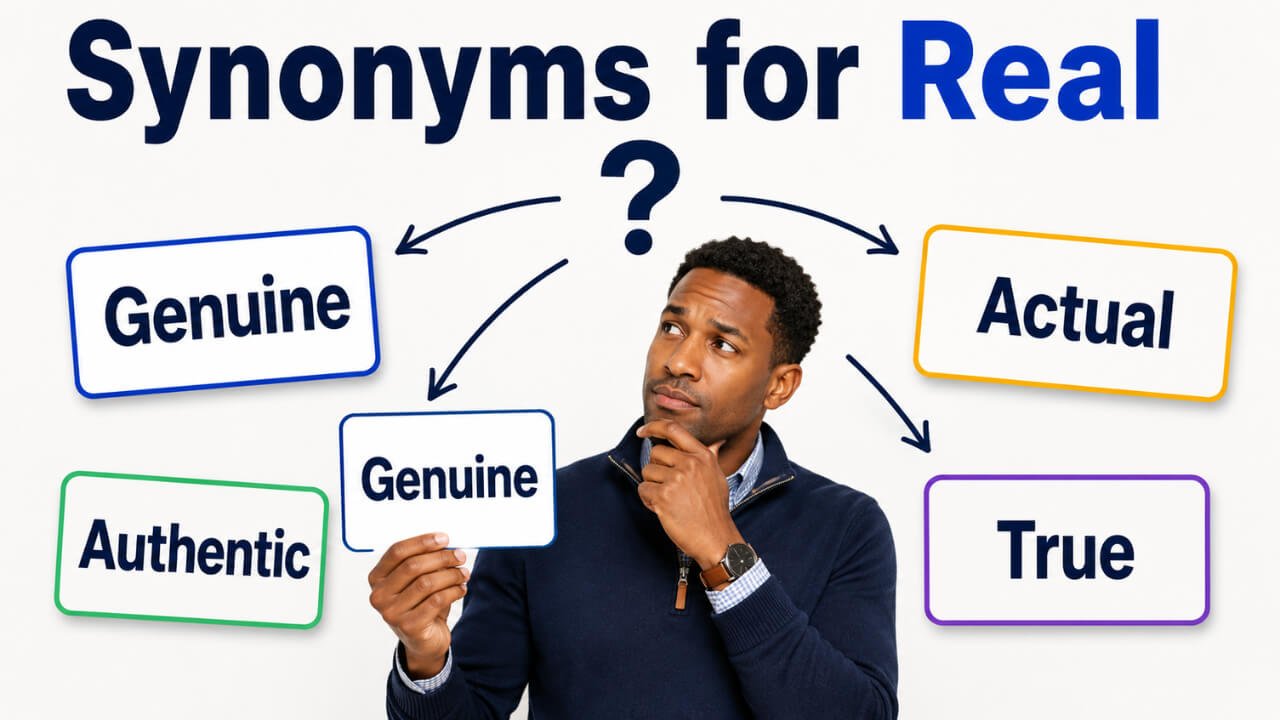
Quick Answer: Common synonyms for real include genuine, authentic, actual, true, factual, sincere, legitimate, tangible, realistic, and substantial. Genuine and authentic are best for original objects, honest feelings, and trustworthy people. Actual suits facts, events, and situations that truly exist. True and factual work well for correct information. Realistic describes something believable or similar to life, while substantial emphasizes serious importance, size, or value. The best synonym depends on whether real refers to truth, existence, authenticity, appearance, emotion, or significance.
Pronunciation and Word Details
Word: Real.
Pronunciation: /riːl/
Part of Speech: Adjective, with informal uses as an adverb and noun.
Meaning: Existing in fact, genuine rather than artificial, or true rather than imagined.
US Pronunciation:
UK Pronunciation:
What Does “Real” Mean?
Real means existing in fact, being genuine, or representing something truthfully. It is mainly used as an adjective to describe people, objects, events, feelings, problems, and information.
The word can describe something that physically exists rather than something imaginary. It can also show that an object is original rather than artificial, an emotion is sincere rather than pretended, or a statement is true rather than false.
Actual Existence: The threat was real and required immediate action.
Authenticity: The necklace contains real gold.
Truth: That is the real reason for her decision.
Sincere Emotion: His concern for the children was real.
Realistic Appearance: The painting looked remarkably real.
Serious Importance: Traffic congestion has become a real problem.
Meaning, Tone, and Context of “Real”
Real is a common, neutral, and highly flexible word. It appears in casual speech, formal writing, academic discussion, news reports, descriptions, and everyday conversations.
In casual speech, real often means genuine, sincere, or serious. Someone might describe a person as a real friend or a situation as a real challenge.
In formal writing, actual, factual, authentic, legitimate, or substantial may communicate the intended meaning more precisely. These alternatives can make reports, essays, and professional communication clearer.
Real can also carry an emotional tone. Real love suggests sincerity, while real danger creates urgency. A real achievement emphasizes importance and value.
When used to describe art, images, performances, or stories, real may mean lifelike, realistic, believable, or convincing.
When and How to Use “Real”
For Genuine Objects
Use real when an object is original, natural, or authentic rather than artificial or copied.
Example: The table is made from real wood.
For Actual Situations
Use real when an event, condition, or problem truly exists.
Example: Water shortages are a real concern in the region.
For Truthful Information
Use real when discussing facts, reasons, identities, or events that are correct.
Example: Nobody knew the real cause of the accident.
For Sincere Feelings
Use real when an emotion, intention, or relationship is honest and not pretended.
Example: Her gratitude for their support was real.
For Believable Appearances
Use real when something looks natural, accurate, or similar to life.
Example: The artificial flowers looked surprisingly real.
For Serious Importance
Use real when emphasizing that something is meaningful, significant, or deserving of attention.
Example: Rising expenses have become a real difficulty for the family.
For Informal Emphasis
Real is sometimes used informally before an adjective to mean very.
Example: The final examination was real difficult.
In standard formal English, really is usually more appropriate.
Better Example: The final examination was really difficult.
Best Synonyms for Real
Genuine
Synonym: Truly what something claims to be.
Example: Her genuine concern made everyone feel supported.
Authentic
Synonym: Original, trustworthy, and not copied or artificial.
Example: The museum displayed an authentic historical document.
Actual
Synonym: Existing or happening in fact.
Example: The actual cost was higher than the original estimate.
True
Synonym: Correct, factual, or consistent with reality.
Example: The witness gave a true account of the event.
Factual
Synonym: Based on verified facts rather than imagination.
Example: The report provides a factual description of the incident.
Sincere
Synonym: Honest and free from false emotion or pretence.
Example: He offered a sincere apology for his mistake.
Legitimate
Synonym: Genuine, lawful, reasonable, or officially acceptable.
Example: The customer raised a legitimate concern about the product.
Tangible
Synonym: Real enough to be touched, measured, or clearly noticed.
Example: The training produced tangible improvements in performance.
Realistic
Synonym: Believable, practical, or closely resembling real life.
Example: The team created a realistic plan for completing the project.
Substantial
Synonym: Real, important, considerable, or meaningful in size.
Example: The business experienced substantial growth this year.
50 Synonyms for Real with Short Meanings
- Genuine: Truly what something claims to be.
- Authentic: Original and not false or copied.
- Actual: Existing or happening in fact.
- True: Correct and consistent with reality.
- Factual: Based on facts rather than imagination.
- Truthful: Expressing or representing the truth.
- Sincere: Honest in feelings and intentions.
- Honest: Free from lies, deception, or pretence.
- Legitimate: Genuine, lawful, or properly accepted.
- Valid: Reasonable, acceptable, or legally effective.
- Original: Not copied, imitated, or reproduced.
- Natural: Existing without artificial alteration.
- Veritable: Used to emphasize that something is truly so.
- Bona Fide: Genuine and made without deception.
- Certified: Officially confirmed as genuine or correct.
- Confirmed: Proven or established as true.
- Proven: Demonstrated to be true or effective.
- Existing: Present or currently found in reality.
- Existent: Having actual being or existence.
- Tangible: Physical or clearly noticeable.
- Concrete: Definite, specific, and based in reality.
- Physical: Existing as a material object.
- Material: Connected with physical objects or substance.
- Substantial: Considerable, meaningful, or important.
- Solid: Reliable, definite, or strongly established.
- Practical: Suitable for real situations and needs.
- Realistic: Believable or suited to actual conditions.
- Lifelike: Closely resembling a living person or object.
- Believable: Convincing enough to be accepted as true.
- Credible: Trustworthy and likely to be true.
- Convincing: Able to make something seem true or believable.
- Accurate: Correct and free from significant errors.
- Exact: Completely correct in every detail.
- Correct: Free from mistakes or false information.
- Faithful: Accurately representing an original.
- Earnest: Serious and sincere in intention.
- Heartfelt: Deeply and genuinely felt.
- Unfeigned: Sincere and not pretended.
- Candid: Honest and direct in expression.
- Frank: Open, truthful, and straightforward.
- Serious: Important and deserving careful attention.
- Meaningful: Having real purpose, importance, or value.
- Significant: Important enough to have an effect.
- Considerable: Large or important enough to be noticed.
- Essential: Basic, necessary, or fundamentally important.
- Intrinsic: Belonging naturally to the true nature of something.
- Fundamental: Forming an important and basic part.
- Proper: Genuine, complete, or suitable for its purpose.
- Lawful: Permitted and recognized by law.
- Verifiable: Capable of being checked and proven true.
Read Also:
Synonyms for Upset

Synonyms for Real by Context
When Real Means Genuine or Authentic
Genuine, authentic, original, natural, bona fide, and legitimate are useful when describing something that is not artificial, copied, or fraudulent.
Genuine is the strongest general replacement. Authentic often describes documents, experiences, art, food, or historical objects. Original emphasizes that something is not a copy.
Example With Genuine: The expert confirmed that the gemstone was genuine.
Example With Authentic: The restaurant serves authentic regional food.
Example With Original: The gallery owns the original painting.
Example With Natural: The product contains natural ingredients.
When Real Means Actual or Existing
Actual, existing, existent, concrete, physical, and tangible describe something that exists in reality rather than only in imagination.
Actual works well when contrasting facts with expectations or appearances. Tangible emphasizes something that can be touched, measured, or clearly recognized.
Example With Actual: The actual number of visitors exceeded the estimate.
Example With Existing: The new policy does not affect existing agreements.
Example With Concrete: The investigation produced concrete evidence.
Example With Tangible: The community saw tangible benefits from the project.
When Real Means True or Factual
True, factual, truthful, accurate, correct, confirmed, proven, and verifiable are suitable when real refers to information, claims, events, or explanations.
Factual is useful in reports and academic writing. Accurate emphasizes freedom from errors. Verifiable means that evidence can confirm the information.
Example With True: The statement turned out to be true.
Example With Factual: The article offers a factual summary of the case.
Example With Accurate: The map provides an accurate representation of the area.
Example With Verifiable: Every claim should be supported by verifiable evidence.
When Real Means Sincere
Sincere, honest, heartfelt, earnest, unfeigned, candid, and frank describe feelings, intentions, reactions, or communication that are not false or pretended.
Sincere is the best general choice for emotions and apologies. Heartfelt suggests deep feeling, while candid and frank describe open communication.
Example With Sincere: She expressed sincere appreciation for their kindness.
Example With Heartfelt: He delivered a heartfelt message to his family.
Example With Earnest: They made an earnest effort to solve the problem.
Example With Candid: The director gave a candid explanation of the failure.
When Real Means Realistic or Believable
Realistic, lifelike, believable, credible, convincing, faithful, and practical describe something that resembles reality or works under actual conditions.
Realistic suits plans, expectations, stories, images, and performances. Lifelike focuses on appearance. Practical relates to usefulness in ordinary situations.
Example With Realistic: The company established a realistic sales target.
Example With Lifelike: The sculpture was remarkably lifelike.
Example With Believable: The actor gave a believable performance.
Example With Practical: We need a practical solution that works within the budget.
When Real Means Serious or Substantial
Serious, substantial, significant, considerable, solid, meaningful, essential, and fundamental work when real emphasizes importance, size, effect, or value.
Substantial often describes amounts, evidence, progress, or changes. Serious is appropriate for problems, risks, and concerns.
Example With Serious: Pollution presents a serious threat to public health.
Example With Substantial: The changes produced substantial savings.
Example With Significant: The research revealed a significant difference.
Example With Meaningful: The program created meaningful opportunities for students.
Another Word for Real
Genuine is often the best single replacement for real when discussing authenticity, sincerity, or originality. However, actual is better for events and situations, true for facts, realistic for appearance, and substantial for importance.
Original: She showed real concern for the injured child.
Better Option: She showed genuine concern for the injured child.
Original: The real cost was not included in the estimate.
Better Option: The actual cost was not included in the estimate.
Original: The story is based on real events.
Better Option: The story is based on true events.
Original: The image looked completely real.
Better Option: The image looked completely lifelike.
When Not to Use “Real”
Avoid real when a more precise word can explain whether something is authentic, factual, sincere, physical, realistic, or important. Real is broad, so repeated use may make writing sound vague.
Weak: The report explains the real situation.
Better: The report explains the actual situation.
Weak: She gave a real apology.
Better: She gave a sincere apology.
Weak: The painting looked real.
Better: The painting looked lifelike.
Weak: The organization made real progress.
Better: The organization made substantial progress.
Do not use real instead of really in standard formal writing when modifying an adjective or adverb.
Weak: The final question was real difficult.
Better: The final question was really difficult.
Avoid describing opinions as real facts unless they can be supported by evidence.
Weak: His personal belief is a real fact.
Better: His personal belief is an opinion rather than a verified fact.
Words Commonly Confused With Real
Real vs Really: Real is mainly an adjective that describes a noun. Really is an adverb that modifies a verb, adjective, or another adverb.
Example With Real: They faced a real difficulty.
Example With Really: The task was really difficult.
Real vs Actual: Real emphasizes existence, truth, or authenticity. Actual often contrasts what happened with what was expected, reported, or assumed.
Real vs True: Real describes existence or authenticity. True describes correctness, accuracy, or agreement with facts.
Real vs Authentic: Real is a broad term. Authentic specifically means original, trustworthy, and not copied or false.
Real vs Genuine: Genuine emphasizes that a person, feeling, or object is sincere and not fake. Real can also describe existence and serious importance.
Real vs Realistic: Real means something actually exists. Realistic means something appears believable or is practical, even when it is fictional.
Real vs Factual: Real can describe objects, emotions, and situations. Factual specifically describes information based on facts.
Real vs Legitimate: Real indicates truth or existence. Legitimate adds the idea of legal, reasonable, official, or acceptable status.
Which Synonym Should You Choose?
Choose genuine when describing sincere emotions, trustworthy people, or objects that are not fake.
Choose authentic when discussing original documents, historical objects, cultural experiences, art, or food.
Choose actual when comparing reality with an expectation, appearance, estimate, or report.
Choose true when discussing correct statements, events, stories, or information.
Choose factual in reports, essays, educational material, and formal explanations based on evidence.
Choose sincere when describing apologies, gratitude, concern, intentions, or personal feelings.
Choose legitimate when describing valid concerns, lawful activities, acceptable claims, or official purposes.
Choose tangible when results, benefits, evidence, or improvements can be clearly noticed or measured.
Choose realistic when describing practical goals, believable stories, natural images, or reasonable expectations.
Choose lifelike when an image, model, figure, painting, or performance closely resembles life.
Choose accurate when facts, measurements, descriptions, or results are correct.
Choose substantial when discussing an important amount, serious effect, major improvement, or meaningful difference.
Choose serious when describing danger, illness, risk, concern, or a problem requiring attention.
Choose concrete when writing about specific evidence, plans, examples, or results.
Choose heartfelt when an emotion or message is deep and sincerely expressed.
Real Life Examples of “Real” in Sentences
Original: The experts confirmed that the artwork was real.
Better Option: The experts confirmed that the artwork was authentic.
Original: The real price was much higher than expected.
Better Option: The actual price was much higher than expected.
Original: She showed real kindness during the crisis.
Better Option: She showed genuine kindness during the crisis.
Original: The report is based on real information.
Better Option: The report is based on factual information.
Original: The artificial fruit looked real from a distance.
Better Option: The artificial fruit looked lifelike from a distance.
Original: Unemployment remains a real concern for the community.
Better Option: Unemployment remains a serious concern for the community.
Original: The project created real improvements in the neighborhood.
Better Option: The project created tangible improvements in the neighborhood.
Original: We need a real plan for reducing expenses.
Better Option: We need a practical plan for reducing expenses.
Original: His real feelings became clear during the conversation.
Better Option: His sincere feelings became clear during the conversation.
Original: The investigation found real evidence of misconduct.
Better Option: The investigation found concrete evidence of misconduct.
Synonym Groups and Usage Differences
Authenticity Group
Genuine, authentic, original, natural, bona fide, and legitimate describe something that is not false, copied, or artificial.
Genuine is broad and natural. Authentic emphasizes trustworthy origins. Original means the first version rather than a reproduction.
Example: The collector purchased an authentic manuscript.
Truth Group
True, factual, truthful, accurate, correct, confirmed, proven, and verifiable describe information that agrees with facts.
True is the broadest option. Factual suits formal writing, while accurate focuses on correctness and detail.
Example: Investigators provided a factual account of what happened.
Existence Group
Actual, existing, existent, concrete, physical, material, and tangible describe something that exists outside imagination.
Actual often contrasts reality with an assumption. Physical and material refer to objects, while tangible can describe both physical items and measurable results.
Example: The committee requested concrete evidence before making a decision.
Sincerity Group
Sincere, honest, earnest, heartfelt, unfeigned, candid, and frank describe feelings or communication without deception.
Sincere and heartfelt focus on emotion. Candid and frank focus on open speech.
Example: She offered a sincere explanation for her absence.
Realism Group
Realistic, lifelike, believable, credible, convincing, faithful, and practical describe accurate representation or suitability for actual conditions.
Lifelike is mainly visual. Believable and convincing describe stories or performances. Practical describes useful ideas and plans.
Example: The novel presents a believable description of family life.
Importance Group
Serious, substantial, significant, considerable, solid, meaningful, essential, and fundamental describe something with genuine importance or effect.
Serious often describes problems and risks. Substantial and considerable describe amounts, while fundamental describes a basic principle or element.
Example: The policy had a significant effect on local businesses.
Antonyms of Real
The opposite of real changes according to whether the word refers to existence, authenticity, truth, sincerity, appearance, or importance.
Fake: Made to appear genuine but not authentic.
False: Incorrect, untrue, or deliberately misleading.
Artificial: Produced by people rather than occurring naturally.
Imaginary: Existing only in the mind or imagination.
Fictional: Created for a story rather than based on fact.
Unreal: Not existing in reality or appearing unbelievable.
Counterfeit: Made to imitate something valuable or official.
Imitation: A copy designed to resemble an original.
Fraudulent: Intended to deceive or gain an unfair advantage.
Insincere: Not expressing genuine feelings or intentions.
Pretended: Presented falsely as real or sincere.
Inaccurate: Containing mistakes or incorrect information.
Invalid: Not acceptable, effective, or properly supported.
Intangible: Unable to be touched or physically measured.
Trivial: Having little importance or serious value.
Comparison: Real vs Related Words
Real vs Genuine
Real describes something that exists or is not imaginary. Genuine emphasizes authenticity and freedom from deception.
Example With Real: The danger was real.
Example With Genuine: Her concern was genuine.
Real vs Authentic
Real is broad and can describe existence, truth, emotion, or importance. Authentic usually describes something with trustworthy origins.
Example With Real: The story describes a real event.
Example With Authentic: The archive contains an authentic letter.
Real vs Actual
Real emphasizes that something exists. Actual often identifies the precise reality behind an expectation, appearance, or estimate.
Example With Real: They faced a real threat.
Example With Actual: The actual damage was less severe than expected.
Real vs True
Real often describes existence or authenticity. True describes something that agrees with facts.
Example With Real: The object is real.
Example With True: The statement is true.
Real vs Realistic
Real means existing in reality. Realistic means appearing believable or being suitable for real conditions.
Example With Real: The animal in the garden was real.
Example With Realistic: The animal in the painting looked realistic.
Real vs Sincere
Real can describe genuine emotions, but sincere is more precise when discussing honest feelings and intentions.
Example With Real: Her sadness was real.
Example With Sincere: She expressed sincere regret.
Real vs Factual
Real can describe people, objects, events, or feelings. Factual specifically refers to information supported by facts.
Example With Real: The investigation examined a real incident.
Example With Factual: The investigation produced a factual report.
Common Phrases and Expressions With Real
Real Life: Life as it is actually experienced.
Real World: Ordinary life outside an imagined, protected, or theoretical setting.
Real Reason: The true cause behind an action or event.
Real Meaning: The actual idea or message being communicated.
Real Problem: A genuine and serious difficulty.
Real Danger: A threat that truly exists.
Real Value: The genuine importance or practical worth of something.
Real Name: A person’s actual name rather than an assumed one.
Real Time: Information or activity occurring without a noticeable delay.
Real Deal: An informal expression for a genuine person or thing.
For Real: An informal expression meaning genuinely or seriously.
Keep It Real: Remain honest, natural, and true to oneself.
Common Mistakes to Avoid
A common mistake is using real when a more precise synonym would communicate the intended meaning better. Genuine suits emotions, actual suits facts, authentic suits original objects, and realistic suits believable appearances.
Writers also confuse real and really. Real normally describes a noun, while really modifies a verb, adjective, or adverb.
Incorrect: The weather became real cold.
Correct: The weather became really cold.
Avoid assuming real and realistic mean the same thing. A realistic object may look genuine even though it does not actually exist.
Do not use true when discussing physical existence unless the sentence concerns factual accuracy. Similarly, do not use authentic for every real situation because authentic mainly concerns origin and genuineness.
Repetition can also weaken writing. Instead of describing every concern, problem, emotion, or result as real, choose serious, sincere, tangible, substantial, or actual where appropriate.
Avoid vague phrases such as real facts. Facts are already understood to be true when properly verified. Use verified facts, accurate information, or factual evidence instead.
Conclusion
Understanding synonyms for real helps you express authenticity, existence, truth, sincerity, realism, and importance more precisely. Genuine and authentic suit original objects and honest emotions, while actual describes what truly exists or happened. True and factual work best for correct information. Realistic and lifelike describe believable appearances, while tangible and substantial emphasize measurable results or serious value. Consider the sentence’s meaning before selecting an alternative. A precise synonym makes descriptions, essays, reports, stories, and everyday communication clearer and more effective.
FAQs About Synonyms for Real
What Is the Best Synonym for Real?
Genuine is a strong general synonym when real means authentic or sincere. Actual is better when referring to events, facts, prices, or situations.
What Is Another Word for Real in Formal Writing?
Actual, factual, authentic, legitimate, tangible, and substantial are useful formal alternatives. The correct choice depends on the intended meaning.
What Is a Synonym for a Real Person?
Genuine, sincere, honest, authentic, and trustworthy can describe a person whose behavior and emotions are honest.
What Is Another Word for Real Evidence?
Concrete evidence, factual evidence, tangible evidence, credible evidence, and verifiable evidence are clear alternatives.
What Is the Difference Between Real and Really?
Real is usually an adjective, as in a real problem. Really is an adverb, as in a really difficult problem.
Is Authentic the Same as Real?
Authentic is a synonym when real means original or genuine. It does not normally replace real when discussing existence, seriousness, or realistic appearance.
What Is the Opposite of Real?
Common opposites include fake, false, artificial, imaginary, fictional, counterfeit, unreal, and insincere. The best antonym depends on the context.
