
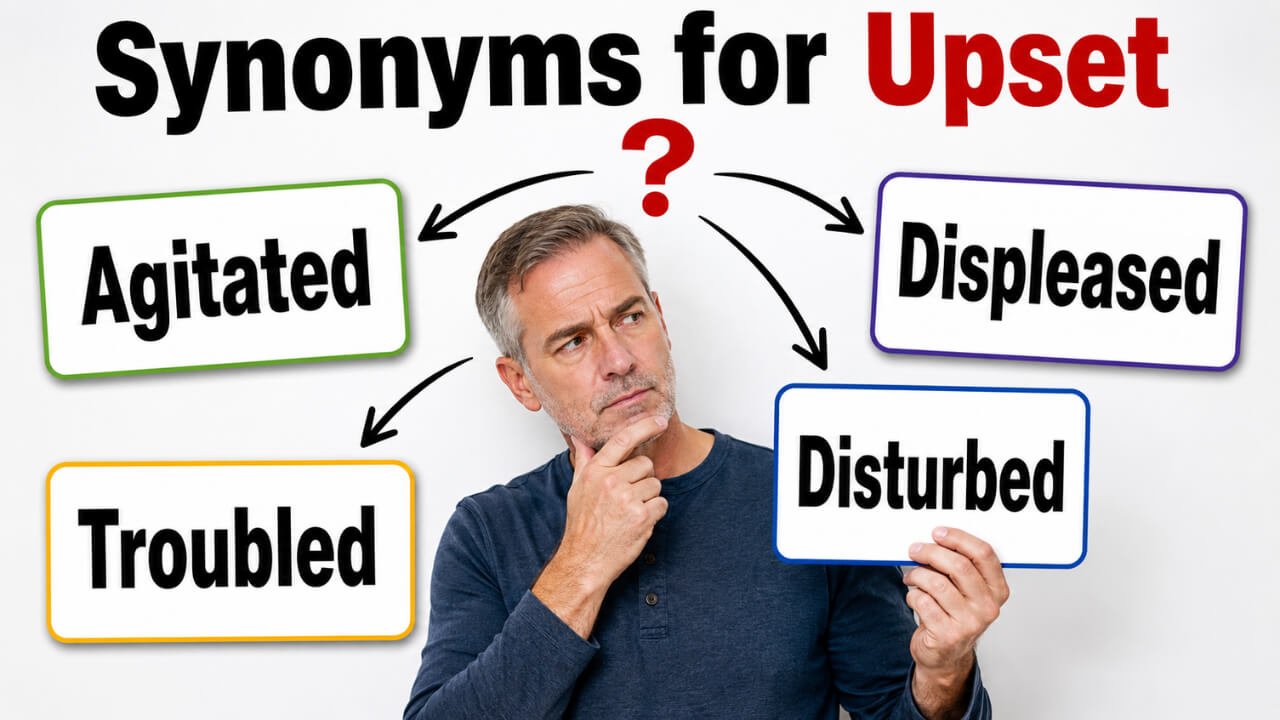
Quick Answer: The best synonyms for upset include distressed, troubled, unhappy, saddened, annoyed, angry, worried, disturbed, unsettled, and agitated. Use distressed for strong emotional pain, unhappy for general sadness, annoyed for mild anger, and worried for concern about a problem. Disturbed and unsettled work well when someone loses peace or emotional balance. Upset can also mean to disrupt a plan, make someone physically ill, or unexpectedly defeat an opponent, so the best alternative always depends on context.
Pronunciation and Word Details
Word: Upset.
Pronunciation: /ʌpˈset/.
Part of Speech: Adjective, verb, and noun.
Meaning: Emotionally unhappy, worried, or angry, or to disturb, disrupt, overturn, or cause illness.
US Pronunciation:
UK Pronunciation:
What Does “Upset” Mean?
Upset means emotionally unhappy, worried, disappointed, angry, or disturbed. It can describe a person’s emotional condition or the action that caused that reaction.
As an adjective, upset describes someone who feels emotionally troubled.
Example: She was upset after hearing the disappointing news.
As a verb, upset means to make someone unhappy, worried, or angry.
Example: His careless comment upset several people.
Upset can also mean to interrupt a plan, disturb a normal process, overturn an object, cause stomach discomfort, or unexpectedly defeat a stronger competitor.
Emotional Meaning: The argument left him upset.
Disruption Meaning: The delay upset the entire schedule.
Physical Meaning: The rich meal upset her stomach.
Overturning Meaning: He accidentally upset the glass.
Competition Meaning: The less experienced team upset the favorite.
Meaning, Tone, and Context of “Upset”
Upset is a common, neutral, and conversational word. It is widely used in everyday speech because it can describe sadness, anger, worry, disappointment, or emotional discomfort without identifying one exact feeling.
The word may sound gentle when compared with stronger alternatives such as devastated, furious, or heartbroken. Saying someone is upset often leaves the exact intensity unclear.
In formal writing, more precise words may be better. Distressed, concerned, disappointed, disrupted, and overturned can communicate the intended meaning more accurately.
Upset can also be polite and indirect. A person may say, “I am upset about what happened,” instead of using a stronger emotional word.
Casual Tone: She seemed upset after the meeting.
Neutral Tone: The change upset several customers.
Emotional Tone: He was deeply upset by the loss.
Formal Tone: The incident distressed the affected families.
Practical Tone: The power failure disrupted production.
When and How to Use “Upset”
For Sadness: Use upset when someone feels unhappy because of bad news, loss, disappointment, or rejection.
Example: She felt upset when her application was rejected.
For Anger: Use upset when someone is annoyed or angry but the exact level of anger is unclear.
Example: He was upset about the unfair decision.
For Worry: Use upset when someone feels emotionally troubled or concerned.
Example: The missing documents made her upset.
For Disappointment: Use upset when expectations are not met.
Example: The children were upset when the event was cancelled.
For Emotional Disturbance: Use upset when an event removes someone’s sense of calm or security.
Example: The sudden argument upset everyone in the room.
For Disruption: Use upset when a plan, routine, system, or balance is disturbed.
Example: Heavy rain upset the travel schedule.
For Physical Illness: Use upset when food, medicine, stress, or another cause creates stomach discomfort.
Example: Spicy food can upset his stomach.
For Overturning: Use upset when an object is accidentally knocked over or turned from its normal position.
Example: Her elbow upset the cup of tea.
For an Unexpected Victory: Use upset when a weaker competitor defeats a stronger or more favored opponent.
Example: The new player upset the defending champion.
Best Synonyms for Upset
Distressed
Synonym: Distressed means deeply worried, emotionally hurt, or troubled.
Example: The family was distressed by the sudden emergency.
Troubled
Synonym: Troubled means worried, disturbed, or emotionally burdened.
Example: He looked troubled after reading the report.
Unhappy
Synonym: Unhappy means feeling sad, dissatisfied, or displeased.
Example: She was unhappy with the final decision.
Saddened
Synonym: Saddened means made to feel sorrow or disappointment.
Example: The news saddened everyone who knew him.
Annoyed
Synonym: Annoyed means mildly angry or irritated.
Example: He was annoyed by the repeated interruptions.
Angry
Synonym: Angry means feeling strong displeasure or hostility.
Example: The customer became angry after receiving no explanation.
Worried
Synonym: Worried means anxious or concerned about a possible problem.
Example: She was worried about the test results.
Disturbed
Synonym: Disturbed means emotionally unsettled or mentally troubled.
Example: The violent scene disturbed many viewers.
Unsettled
Synonym: Unsettled means unable to feel calm, secure, or certain.
Example: The unexpected message left him unsettled.
Agitated
Synonym: Agitated means visibly nervous, upset, or emotionally excited.
Example: She became agitated during the difficult conversation.
50 Synonyms for Upset with Short Meanings
- Distressed: Deeply worried, hurt, or emotionally troubled.
- Troubled: Concerned, disturbed, or emotionally burdened.
- Unhappy: Sad, dissatisfied, or displeased.
- Saddened: Made to feel sorrow or disappointment.
- Annoyed: Mildly angry or irritated.
- Angry: Feeling strong displeasure.
- Worried: Concerned about a possible problem.
- Disturbed: Emotionally or mentally unsettled.
- Unsettled: Unable to feel calm or secure.
- Agitated: Nervous, excited, or emotionally disturbed.
- Disappointed: Unhappy because expectations were not met.
- Heartbroken: Experiencing intense emotional pain or sadness.
- Devastated: Extremely shocked, saddened, or emotionally damaged.
- Hurt: Emotionally wounded or offended.
- Offended: Upset by something insulting or disrespectful.
- Irritated: Slightly angry or impatient.
- Frustrated: Annoyed because progress is blocked.
- Displeased: Unhappy or dissatisfied with something.
- Cross: Slightly angry or annoyed.
- Furious: Extremely angry.
- Enraged: Filled with intense anger.
- Resentful: Angry because of unfair treatment.
- Concerned: Worried or interested in a serious matter.
- Anxious: Nervous or worried about what may happen.
- Alarmed: Suddenly worried or frightened.
- Nervous: Uneasy, worried, or tense.
- Uneasy: Slightly worried or uncomfortable.
- Shaken: Emotionally disturbed by a difficult event.
- Distraught: Extremely worried, sad, or emotionally confused.
- Miserable: Very unhappy or uncomfortable.
- Depressed: Deeply sad or lacking hope and energy.
- Dejected: Sad because of failure or disappointment.
- Despondent: Without hope and deeply discouraged.
- Disheartened: Having lost confidence or enthusiasm.
- Overwhelmed: Unable to manage strong emotions or pressure.
- Rattled: Nervous or disturbed by something unexpected.
- Bothered: Worried, annoyed, or emotionally affected.
- Perturbed: Worried or disturbed by an unexpected problem.
- Disconcerted: Confused or unsettled by something surprising.
- Disrupted: Interrupted or prevented from continuing normally.
- Disturbed: Interrupted or thrown out of order.
- Disordered: Put into an untidy or confused state.
- Overturned: Turned upside down or knocked over.
- Toppled: Caused to fall or lose balance.
- Spilled: Caused liquid or contents to fall out.
- Nauseated: Made to feel physically sick.
- Sickened: Made ill or strongly disgusted.
- Unbalanced: Moved away from a stable or equal condition.
- Defeated: Beaten in a contest or competition.
- Surprised: Defeated unexpectedly despite being favored to win.
Read Also:
Synonyms for Affect
Synonyms for Upset by Context
When Upset Means Sad
When upset refers to sadness, useful alternatives include unhappy, saddened, heartbroken, devastated, miserable, dejected, despondent, and disheartened.
Unhappy is broad and mild. Saddened describes the result of hearing or experiencing something painful. Heartbroken and devastated express much stronger emotional suffering.
Example With Upset: She was upset after saying goodbye.
Example With Saddened: She was saddened after saying goodbye.
Example With Heartbroken: She was heartbroken after saying goodbye.
Example With Devastated: She was devastated by the final goodbye.
When Upset Means Angry
When upset refers to anger, choose annoyed, irritated, displeased, cross, angry, furious, enraged, or resentful.
Annoyed and irritated express mild anger. Furious and enraged describe extreme anger. Resentful is best when anger results from unfair treatment.
Example With Upset: He was upset about the rude response.
Example With Annoyed: He was annoyed by the rude response.
Example With Angry: He was angry about the rude response.
Example With Resentful: He became resentful after being treated unfairly.
When Upset Means Worried
When upset refers to worry, use concerned, anxious, alarmed, nervous, uneasy, troubled, distressed, or distraught.
Concerned is usually calm and formal. Anxious describes stronger nervousness. Distraught expresses extreme emotional worry or confusion.
Example With Upset: Her parents were upset about the delay.
Example With Concerned: Her parents were concerned about the delay.
Example With Anxious: Her parents were anxious about the delay.
Example With Distraught: Her parents became distraught when they received no update.
When Upset Means Emotionally Disturbed
Disturbed, unsettled, shaken, agitated, rattled, bothered, perturbed, and disconcerted describe a loss of emotional calm.
Shaken often follows a frightening or shocking experience. Rattled is more conversational. Perturbed and disconcerted are useful in formal writing.
Example With Upset: The incident left the staff upset.
Example With Shaken: The incident left the staff shaken.
Example With Unsettled: The incident left the staff unsettled.
Example With Disturbed: The incident deeply disturbed the staff.
When Upset Means to Disrupt
Use disrupt, disturb, disorder, interrupt, unsettle, unbalance, or throw off when upset refers to interfering with a plan, routine, system, or condition.
Disrupt is the strongest general replacement. Disturb suggests interference without complete stoppage. Throw off is suitable in casual language.
Example With Upset: The storm upset our travel plans.
Example With Disrupted: The storm disrupted our travel plans.
Example With Disturbed: The storm disturbed the normal schedule.
Example With Threw Off: The storm threw off our entire schedule.
When Upset Means to Overturn
Use overturn, topple, tip, knock over, spill, or unbalance when upset refers to moving an object from its normal position.
Overturn is formal and precise. Knock over is common in everyday speech. Spill is appropriate when the object contains liquid or loose material.
Example With Upset: He upset the vase.
Example With Overturned: He overturned the vase.
Example With Knocked Over: He knocked over the vase.
Example With Toppled: His movement toppled the vase.
When Upset Means to Cause Illness
Use nauseate, sicken, disturb, irritate, or disagree with when food, medicine, stress, or another factor causes physical discomfort.
Nauseate means to cause a feeling of sickness. Disagree with is a gentle conversational expression for food related discomfort.
Example With Upset: The medicine upset her stomach.
Example With Nauseated: The medicine nauseated her.
Example With Irritated: The medicine irritated her stomach.
Example With Disagreed With: The medicine disagreed with her stomach.
When Upset Means an Unexpected Victory
Use defeat, surprise, overcome, beat, or shock when a weaker competitor wins against a stronger favorite.
Defeat and beat are neutral. Surprise and shock emphasize that the result was unexpected.
Example With Upset: The young player upset the champion.
Example With Defeated: The young player defeated the champion.
Example With Surprised: The young player surprised the champion.
Example With Shocked: The young player shocked the audience by defeating the champion.
Another Word for Upset
Distressed is often the best single replacement for upset when the word describes strong emotional pain or worry. However, the ideal alternative depends on the exact feeling or action.
Use saddened for sorrow, annoyed for mild anger, worried for concern, disturbed for emotional discomfort, disrupted for interrupted plans, and overturned for an object that has fallen.
Original: She was upset by the disappointing news.
Better Option: She was distressed by the disappointing news.
Original: He was upset because the meeting started late.
Better Option: He was annoyed because the meeting started late.
Original: The storm upset the outdoor event.
Better Option: The storm disrupted the outdoor event.
Original: Her hand upset the glass.
Better Option: Her hand knocked over the glass.
When Not to Use “Upset”
Avoid using upset when the reader needs to understand the exact emotion. The word may mean sad, angry, worried, disappointed, or offended, so it can sound vague.
Choose a more specific synonym when the cause, intensity, or type of emotion matters.
Do not use upset repeatedly in nearby sentences. Replace it with distressed, annoyed, worried, disappointed, disturbed, or another suitable word.
Avoid using upset for formal processes when disrupt, alter, disturb, or overturn would be clearer.
Weak: She was upset about the result.
Better: She was disappointed by the result.
Weak: The customer was very upset.
Better: The customer was furious about the poor service.
Weak: The accident upset traffic.
Better: The accident disrupted traffic.
Weak: He upset the container.
Better: He overturned the container.
Weak: The meal upset her.
Better: The meal made her nauseated.
Words Commonly Confused With Upset
Upset vs Sad: Upset can include sadness, anger, worry, or disappointment. Sad refers specifically to unhappiness or sorrow.
Example With Upset: He was upset after the conversation.
Example With Sad: He felt sad after saying goodbye.
Upset vs Angry: Upset is broader and may describe several emotions. Angry specifically describes displeasure or hostility.
Example With Upset: She was upset by his behavior.
Example With Angry: She was angry about his disrespectful behavior.
Upset vs Distressed: Upset may be mild or strong. Distressed usually suggests deeper emotional pain, worry, or suffering.
Example With Upset: The news made her upset.
Example With Distressed: The emergency left her deeply distressed.
Upset vs Annoyed: Upset can involve sadness, worry, or anger. Annoyed specifically describes mild anger or irritation.
Example With Upset: He was upset by the interruption.
Example With Annoyed: He was annoyed by the repeated interruption.
Upset vs Disturbed: Upset commonly describes an emotional state. Disturbed suggests that a person’s calm, comfort, or mental peace has been affected.
Example With Upset: The message made her upset.
Example With Disturbed: The threatening message deeply disturbed her.
Upset vs Disappointed: Upset is general. Disappointed specifically describes unhappiness because hopes or expectations were not fulfilled.
Example With Upset: They were upset about the result.
Example With Disappointed: They were disappointed that the result did not meet their expectations.
Which Synonym Should You Choose?
Choose unhappy for general sadness or dissatisfaction.
Choose saddened when an event causes sorrow.
Choose heartbroken when the emotional pain is severe and personal.
Choose devastated when someone experiences extreme shock or sadness.
Choose annoyed or irritated for mild anger.
Choose angry for clear and direct displeasure.
Choose furious or enraged for extreme anger.
Choose disappointed when expectations are not met.
Choose worried or concerned when thinking about a possible problem.
Choose anxious when worry creates nervousness or tension.
Choose distressed when emotional pain or worry is strong.
Choose disturbed when someone’s emotional peace is affected.
Choose unsettled when someone feels uncertain or unable to relax.
Choose shaken when a shocking event causes emotional instability.
Choose disrupted when a plan, process, routine, or system is interrupted.
Choose overturned or toppled when an object is knocked from its normal position.
Choose nauseated or sickened when something causes physical illness.
Choose defeated when a competitor loses a contest.
Choose surprised or shocked when an unexpected victory occurs.
Real Life Examples of “Upset” in Sentences
Original: She was upset when the trip was cancelled.
Better Option: She was disappointed when the trip was cancelled.
Original: His rude comment upset me.
Better Option: His rude comment offended me.
Original: The news left the family upset.
Better Option: The news left the family distressed.
Original: He became upset after waiting for two hours.
Better Option: He became irritated after waiting for two hours.
Original: The argument upset the children.
Better Option: The argument disturbed the children.
Original: The power failure upset the production schedule.
Better Option: The power failure disrupted the production schedule.
Original: The smell upset her stomach.
Better Option: The smell nauseated her.
Original: She accidentally upset the bowl.
Better Option: She accidentally overturned the bowl.
Original: The young team upset the league leaders.
Better Option: The young team unexpectedly defeated the league leaders.
Original: The uncertain situation made him upset.
Better Option: The uncertain situation made him anxious.
Synonym Groups and Usage Differences
Sadness Group
Unhappy, saddened, miserable, dejected, despondent, heartbroken, devastated, and disheartened describe different levels of sadness.
Unhappy is general. Dejected and disheartened often follow failure. Heartbroken and devastated describe much stronger emotional suffering.
Example: She felt disheartened after her proposal was rejected.
Anger Group
Annoyed, irritated, displeased, cross, angry, furious, enraged, and resentful describe levels and types of anger.
Annoyed is mild, angry is direct, and furious is intense. Resentful describes lasting anger caused by unfair treatment.
Example: He became resentful after being repeatedly ignored.
Worry Group
Worried, concerned, anxious, alarmed, nervous, uneasy, troubled, and distressed express concern or fear.
Concerned is controlled and neutral. Anxious and alarmed suggest stronger worry. Distressed shows serious emotional suffering.
Example: Parents were concerned about the sudden change in plans.
Emotional Disturbance Group
Disturbed, unsettled, shaken, agitated, rattled, bothered, perturbed, and disconcerted describe a loss of calm or confidence.
Shaken often follows a serious event. Rattled is informal. Perturbed and disconcerted are more formal.
Example: The unexpected accusation left him disconcerted.
Disruption Group
Disrupt, disturb, interrupt, disorder, unbalance, and throw off describe interference with normal order or progress.
Disrupt often describes a serious interruption. Disturb may refer to a smaller interference. Throw off is common in conversation.
Example: A technical problem disrupted the entire presentation.
Overturning Group
Overturn, topple, tip, knock over, spill, and unbalance describe objects moving from a stable position.
Overturn and topple are precise. Knock over is more conversational. Spill focuses on contents falling out.
Example: A strong wind toppled the outdoor display.
Physical Illness Group
Nauseate, sicken, irritate, disturb, and disagree with describe physical discomfort.
Nauseate is direct and formal. Disagree with is a softer expression often used with food.
Example: The strong smell nauseated several passengers.
Competition Group
Defeat, beat, overcome, surprise, and shock can replace upset when an unexpected competitor wins.
Defeat is neutral. Surprise and shock highlight the unexpected nature of the result.
Example: The newcomer shocked the audience by defeating the experienced champion.
Antonyms of Upset
The opposite of upset depends on whether the word describes emotion, disruption, illness, overturning, or competition.
Calm: Free from worry, anger, or emotional disturbance.
Happy: Feeling pleasure, satisfaction, or joy.
Content: Peacefully satisfied with a situation.
Pleased: Happy or satisfied with an outcome.
Comforted: Made to feel less sad or worried.
Reassured: Given confidence that a situation is safe or manageable.
Relaxed: Free from tension, nervousness, or worry.
Untroubled: Not worried or emotionally disturbed.
Delighted: Extremely pleased or happy.
Encouraged: Given confidence, hope, or motivation.
Stabilized: Made steady, balanced, or secure.
Organized: Arranged clearly and properly.
Maintained: Kept in the same condition or order.
Settled: Made calm, stable, or resolved.
Righted: Returned to an upright or proper position.
Soothed: Made calmer or more comfortable.
Healed: Restored physically or emotionally.
Victorious: Having won a contest or competition.
Comparison: Upset vs Related Words
Upset vs Sad
Upset is broad and may include sadness, anger, worry, or disappointment. Sad specifically refers to sorrow or unhappiness.
Example With Upset: She was upset after the meeting.
Example With Sad: She felt sad after hearing the farewell message.
Upset vs Distressed
Upset can describe mild discomfort. Distressed usually suggests stronger emotional pain or worry.
Example With Upset: He was upset about the delay.
Example With Distressed: He was distressed by the serious emergency.
Upset vs Angry
Upset may refer to several emotions. Angry clearly identifies displeasure or hostility.
Example With Upset: She was upset by the decision.
Example With Angry: She was angry about the unfair decision.
Upset vs Annoyed
Upset may be emotional and serious. Annoyed usually describes mild irritation.
Example With Upset: He was upset when the plans changed.
Example With Annoyed: He was annoyed by the last minute change.
Upset vs Worried
Upset is general. Worried specifically means concerned about a possible problem or negative result.
Example With Upset: Her mother seemed upset.
Example With Worried: Her mother was worried about her safety.
Upset vs Disturbed
Upset describes emotional unhappiness or discomfort. Disturbed suggests that peace, concentration, or emotional balance has been interrupted.
Example With Upset: The story made him upset.
Example With Disturbed: The violent details disturbed him.
Upset vs Disrupted
Upset can describe feelings or practical interference. Disrupted specifically refers to an interrupted process, routine, service, or plan.
Example With Upset: Bad weather upset the schedule.
Example With Disrupted: Bad weather disrupted the schedule.
Common Phrases and Expressions With “Upset”
Feel Upset: To experience sadness, anger, worry, or disappointment.
Become Upset: To begin feeling emotionally troubled.
Deeply Upset: Strongly affected by emotional pain or worry.
Visibly Upset: Clearly showing sadness, anger, or distress.
Understandably Upset: Reasonably distressed because of a difficult situation.
Get Upset: To become emotional, angry, or worried.
Upset About Something: Emotionally troubled because of a particular issue.
Upset With Someone: Angry, disappointed, or unhappy with a person.
Upset the Balance: To disturb a stable or equal condition.
Upset the Schedule: To interrupt or change planned timing.
Upset the Stomach: To cause digestive discomfort or nausea.
Cause an Upset: To unexpectedly defeat a stronger competitor.
Common Mistakes to Avoid
A common mistake is using upset without making the exact emotion clear. Because the word can mean sad, angry, worried, disappointed, or offended, readers may misunderstand the intended feeling.
Vague: She was upset about the message.
Clearer: She was offended by the insulting message.
Do not use very upset when a stronger and more precise word would improve the sentence.
Weak: He was very upset after the loss.
Better: He was devastated after the loss.
Avoid confusing upset with angry. A person may be upset without feeling anger.
Incorrect Meaning: She was angry because she missed her family.
Better: She was sad because she missed her family.
Do not use upset for every type of interruption. In formal writing, disrupt is often more precise for schedules, systems, transport, services, or business operations.
Weak: The outage upset production.
Better: The outage disrupted production.
Remember that upset can function as an adjective, verb, or noun. Its spelling remains the same, but its grammatical role changes according to the sentence.
Adjective: She felt upset.
Verb: The news upset her.
Noun: The victory was a major upset.
Avoid unnatural combinations such as “upsetted.” The past form and past participle remain upset.
Incorrect: The result upsetted him.
Correct: The result upset him.
Conclusion
Understanding synonyms for upset helps you describe emotions and situations with greater accuracy. Use unhappy or saddened for sorrow, annoyed or angry for displeasure, and worried or anxious for concern. Distressed and devastated express stronger emotional pain, while disturbed and unsettled describe a loss of calm. For practical meanings, disrupt suits interrupted plans, overturn describes a fallen object, and nauseate refers to physical sickness. The best synonym depends on whether upset expresses sadness, anger, worry, disturbance, illness, disruption, or an unexpected victory.
FAQs About Synonyms for Upset
What Is the Best Synonym for Upset?
Distressed is a strong general synonym for emotional upset. However, unhappy, annoyed, worried, disappointed, or disturbed may be more accurate depending on the feeling.
What Is a Formal Synonym for Upset?
Distressed, perturbed, disconcerted, displeased, disturbed, and agitated are useful formal alternatives for emotional upset.
What Is a Synonym for Feeling Sad and Upset?
Unhappy, saddened, heartbroken, miserable, dejected, and devastated can describe sadness. Choose the word according to the emotional intensity.
What Is a Synonym for Angry and Upset?
Annoyed, irritated, displeased, angry, furious, enraged, and resentful are suitable alternatives when upset refers to anger.
What Is a Synonym for Worried and Upset?
Worried, concerned, anxious, troubled, uneasy, alarmed, and distressed describe emotional concern or fear.
What Does Upset Mean in a Competition?
In a competition, an upset is an unexpected victory in which a weaker or less favored competitor defeats a stronger opponent.
Can Upset Mean Physically Sick?
Yes. Upset can describe stomach discomfort caused by food, medicine, stress, or illness. Nauseated, sickened, and irritated are possible alternatives.
