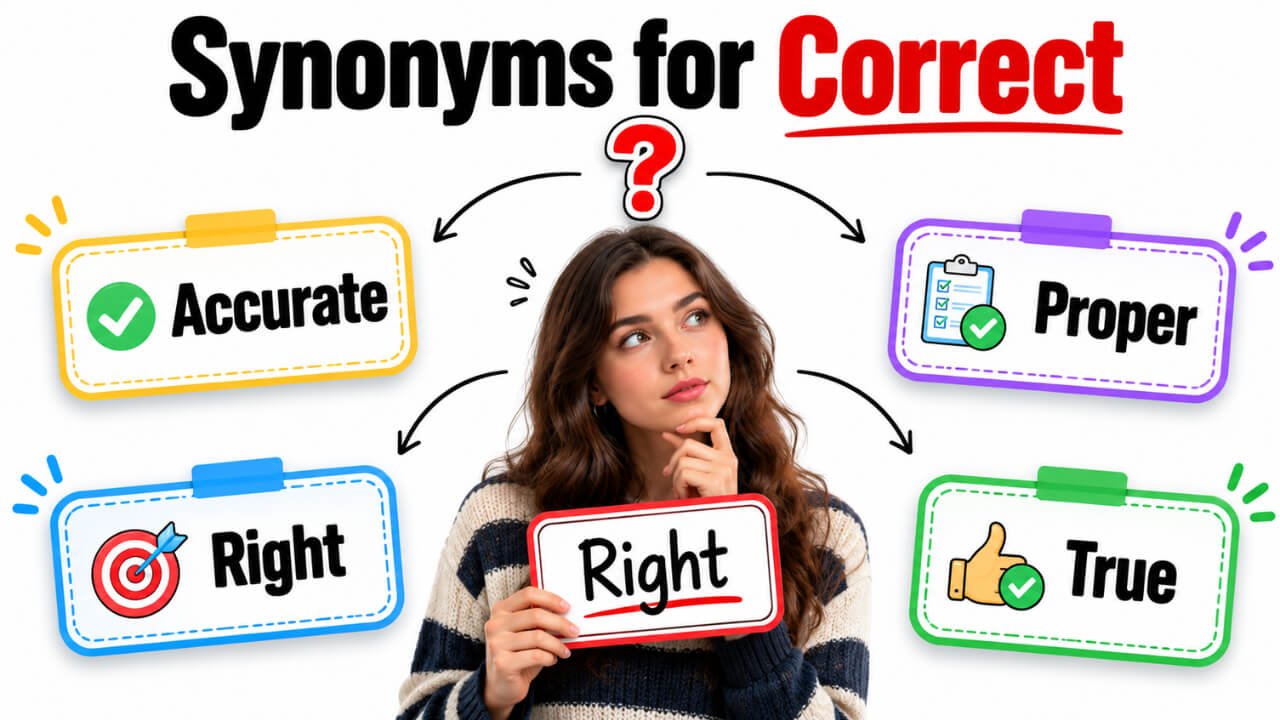
Quick Answer: The best synonyms for correct are accurate, right, true, exact, precise, valid, proper, appropriate, rectify, and revise. Use accurate for facts, calculations, and information. Choose right in everyday conversation and true when something agrees with reality. Exact and precise work well for measurements and specific details. Proper and appropriate describe acceptable behavior or methods. When correct is a verb, use rectify, revise, fix, or amend for removing mistakes and improving information.
Pronunciation and Word Details
Word: Correct
Pronunciation: /kəˈrekt/
Part of Speech: Adjective and verb
Meaning: Correct means free from mistakes, suitable according to rules, or to remove an error from something.
US Pronunciation:
UK Pronunciation:
What Does “Correct” Mean?
“Correct” means accurate, true, proper, or free from mistakes. As an adjective, it describes information, answers, actions, or methods that agree with facts, rules, or accepted standards.
Example: Her answer was correct.
As a verb, “correct” means to identify and remove a mistake.
Example: The teacher corrected the spelling error.
The word can also describe suitable behavior, proper positioning, accurate measurements, and valid conclusions.
Accuracy Context: The figures in the report are correct.
Behavior Context: He followed the correct procedure.
Position Context: Place the chair in the correct position.
Editing Context: Please correct the mistakes before submitting the document.
The intended meaning depends on whether “correct” describes truth, accuracy, suitability, conformity, or the act of fixing an error.
Meaning, Tone, and Context of “Correct”
“Correct” has a neutral and direct tone. It is common in casual conversation, formal writing, academic work, instructions, reports, examinations, business communication, and technical explanations.
When describing facts or answers, “correct” means true or accurate.
Example: Your calculation is correct.
When describing behavior or procedure, it means proper or acceptable.
Example: That is the correct way to complete the form.
When used as a verb, it means to fix, revise, or remove an error.
Example: She corrected the information immediately.
In formal writing, accurate, valid, appropriate, precise, and rectify may provide more specific meanings. In casual speech, right and fix often sound more natural.
“Correct” can sound firm when used to judge someone’s statement or behavior.
Example: That conclusion is not correct.
A softer alternative may be more suitable in polite communication.
Softer Example: That conclusion may need to be revised.
When and How to Use “Correct”
For an Accurate Answer
Use “correct” when an answer agrees with the expected facts, rules, or solution.
Explanation: It shows that the response contains no relevant mistake.
Example: Maria selected the correct answer.
For Factual Information
Use “correct” when information matches reality or can be verified.
Explanation: Accurate, true, and factual can also work in this context.
Example: Please confirm that the address is correct.
For Exact Numbers
Use “correct” when figures, totals, measurements, or calculations have been checked.
Explanation: Accurate or exact may be more precise when discussing numerical details.
Example: The final total is correct.
For Proper Behavior
Use “correct” when an action follows accepted manners, expectations, or rules.
Explanation: Proper and appropriate are useful alternatives in this meaning.
Example: She demonstrated the correct behavior during the ceremony.
For an Accepted Procedure
Use “correct” when describing the approved way to perform a task.
Explanation: Proper, standard, or established may provide greater detail.
Example: Follow the correct procedure when using the equipment.
For Suitable Word Choice
Use “correct” when a word, phrase, tense, or grammatical form fits the sentence.
Explanation: It shows that the language follows accepted grammar and meaning.
Example: Choose the correct verb for each sentence.
For Fixing a Mistake
Use “correct” as a verb when removing an error from writing, data, behavior, or an action.
Explanation: Fix, revise, amend, and rectify are useful verb alternatives.
Example: Please correct the spelling before publication.
For Adjusting Position
Use “correct” when bringing something into its proper place, direction, or alignment.
Explanation: Adjust, straighten, or realign may be more specific.
Example: The technician corrected the position of the camera.
Best Synonyms for Correct
Accurate
Synonym: Free from mistakes and consistent with facts.
Example: The report contains accurate information.
Right
Synonym: Correct according to facts, judgment, or accepted rules.
Example: You chose the right answer.
True
Synonym: Consistent with reality or actual facts.
Example: The statement is true.
Exact
Synonym: Completely accurate in every important detail.
Example: We need the exact measurements of the room.
Precise
Synonym: Clearly defined and carefully accurate.
Example: The instructions must be precise.
Valid
Synonym: Logically, legally, or officially acceptable.
Example: Her argument is valid.
Proper
Synonym: Suitable and correct according to rules or customs.
Example: Wear the proper clothing for the event.
Appropriate
Synonym: Suitable for a particular situation or purpose.
Example: His response was appropriate.
Rectify
Synonym: To correct a mistake, problem, or unfair situation.
Example: The company acted quickly to rectify the error.
Revise
Synonym: To change or correct written material.
Example: She revised the paragraph for clarity.
50 Synonyms for Correct with Short Meanings
- Accurate: Free from mistakes or incorrect details.
- Right: True, suitable, or correct in a situation.
- True: Consistent with reality or fact.
- Exact: Completely accurate in every detail.
- Precise: Clearly stated and carefully accurate.
- Factual: Based on real and verifiable information.
- Truthful: Expressing or representing the truth.
- Valid: Acceptable according to logic, rules, or law.
- Sound: Based on reliable reasoning or judgment.
- Reliable: Consistently accurate and dependable.
- Proper: Correct according to rules or accepted behavior.
- Appropriate: Suitable for a particular situation.
- Suitable: Right for a specific purpose or need.
- Fitting: Appropriate for the occasion or circumstances.
- Acceptable: Good enough to meet a required standard.
- Standard: Following the usual or approved form.
- Conventional: Following commonly accepted practices.
- Legitimate: Lawful, reasonable, or properly accepted.
- Authentic: Genuine and accurately represented.
- Genuine: Real and not false or misleading.
- Just: Fair and morally right.
- Fair: Reasonable, equal, and appropriate.
- Faultless: Containing no errors or defects.
- Flawless: Completely free from faults.
- Perfect: Having no errors or weaknesses.
- Impeccable: Meeting an extremely high standard.
- Error Free: Containing no mistakes.
- Verified: Checked and confirmed as accurate.
- Confirmed: Established as true or definite.
- Orthodox: Following accepted beliefs or established methods.
- Amend: To make a change that improves accuracy.
- Revise: To review and change something for improvement.
- Rectify: To remove an error or solve a problem.
- Fix: To repair or correct something.
- Repair: To restore something to proper condition.
- Adjust: To make a small change for accuracy or suitability.
- Edit: To correct and improve written material.
- Proofread: To examine writing for mistakes.
- Improve: To make something better or more accurate.
- Remedy: To correct an undesirable situation.
- Redress: To correct an unfair or harmful situation.
- Reform: To change something in order to improve it.
- Update: To add current or corrected information.
- Modify: To change part of something.
- Alter: To make something different.
- Change: To replace or adjust something.
- Set Right: To correct a mistake or difficult situation.
- Put Right: To repair or correct something that is wrong.
- Straighten: To place something in its proper position.
- Resolve: To find an answer or solution to a problem.
Read Also:
Synonyms for Approach
Synonyms for Correct by Context
When Correct Means Accurate
Accurate, exact, precise, reliable, verified, and error free work when information, calculations, measurements, or descriptions contain no mistakes.
Accurate: Best for facts, data, reports, and descriptions.
Example: The article provides accurate historical information.
Exact: Best for specific numbers, locations, quantities, and details.
Example: Tell me the exact time of the appointment.
Precise: Best when careful detail and clear limits are important.
Example: The researcher recorded precise measurements.
Verified: Best for information that has been checked.
Example: Only verified information was included in the report.
When Correct Means True
True, factual, truthful, authentic, genuine, confirmed, and sound relate to truth or reality.
True: Describes something that agrees with reality.
Example: Her statement was true.
Factual: Describes information supported by facts.
Example: The summary is clear and factual.
Truthful: Describes an honest statement or person.
Example: He gave a truthful account of the event.
Confirmed: Describes information established as true.
Example: The appointment has been confirmed.
When Correct Means Proper
Proper, standard, conventional, orthodox, and acceptable describe something that follows rules, customs, or established practices.
Proper: Best for rules, behavior, clothing, and procedures.
Example: Use the proper equipment for the task.
Standard: Best for an approved or usual form.
Example: Follow the standard method of measurement.
Conventional: Best for traditional or commonly accepted practices.
Example: They selected a conventional design.
Acceptable: Best when something meets basic requirements.
Example: The final result was acceptable.
When Correct Means Suitable
Appropriate, suitable, fitting, right, fair, and just describe something that fits a particular need or situation.
Appropriate: Best for behavior, language, clothing, and responses.
Example: That comment was not appropriate for the meeting.
Suitable: Best for practical needs and purposes.
Example: This room is suitable for small meetings.
Fitting: Best for an occasion, mood, or circumstance.
Example: Her speech was a fitting conclusion to the event.
Right: A natural everyday option for a suitable choice.
Example: This is the right tool for the job.
When Correct Means Without Faults
Faultless, flawless, perfect, impeccable, and error free emphasize the absence of mistakes.
Faultless: Describes work or performance with no noticeable errors.
Example: Her explanation was faultless.
Flawless: Suggests complete smoothness and excellence.
Example: The singer gave a flawless performance.
Impeccable: Describes extremely high quality or standards.
Example: His professional conduct was impeccable.
Error Free: Directly states that something contains no mistakes.
Example: The final document should be error free.
When Correct Means Fix a Mistake
Fix, amend, revise, rectify, edit, proofread, remedy, adjust, and update describe changing something that is wrong.
Fix: A common and informal verb for correcting a problem.
Example: Can you fix the incorrect date?
Amend: A formal word for making a correction or improvement.
Example: The committee amended the policy.
Revise: Best for changing written work, plans, or ideas.
Example: Revise the introduction before submission.
Rectify: Best for formally correcting a mistake or unfair situation.
Example: Immediate action was taken to rectify the problem.
Proofread: Best for checking written material for spelling, punctuation, and grammar mistakes.
Example: Proofread the letter before sending it.
Another Word for Correct
“Accurate” is usually the best replacement when correct describes facts, figures, answers, or information. “Right” is more natural in everyday conversation, while proper and appropriate work for behavior and procedures. When correct is a verb, fix is the simplest replacement, while rectify or amend may suit formal writing.
Original: The information in the report is correct.
Better Option: The information in the report is accurate.
Original: She selected the correct answer.
Better Option: She selected the right answer.
Original: Please follow the correct procedure.
Better Option: Please follow the proper procedure.
Original: We must correct the mistake immediately.
Better Option: We must rectify the mistake immediately.
When Not to Use “Correct”
When Accuracy Needs Greater Detail
Use exact or precise when describing highly specific numbers, measurements, or instructions.
Weak: Give me the correct length of the table.
Better: Give me the exact length of the table.
When Discussing Verified Facts
Accurate or factual may sound more precise than correct in reports and research.
Weak: The document contains correct information.
Better: The document contains accurate information.
When Describing Suitable Behavior
Appropriate or proper may communicate the intended meaning more clearly.
Weak: His language was not correct for the ceremony.
Better: His language was not appropriate for the ceremony.
When Referring to Editing
Revise, edit, or proofread can explain the required action more clearly.
Weak: Correct the article before publication.
Better: Edit and proofread the article before publication.
When the Tone Sounds Too Direct
Telling someone that they are not correct can sound harsh. A softer sentence may be more respectful.
Weak: Your opinion is not correct.
Better: Your interpretation may not reflect all the available information.
When Repetition Reduces Clarity
Using correct several times in one sentence makes the writing dull and vague.
Weak: Correct the correct answer by following the correct process.
Better: Revise the answer by following the proper process.
Words Commonly Confused With Correct
Correct vs Accurate: Correct means free from error or accepted as right. Accurate emphasizes closeness to the true facts, value, or measurement.
Correct vs Right: Correct is common in formal and neutral writing. Right is often more conversational and can also refer to morality, direction, or entitlement.
Correct vs True: Correct describes an answer, method, or decision that contains no mistake. True means consistent with reality or fact.
Correct vs Exact: Correct means not wrong. Exact means completely specific and identical in every required detail.
Correct vs Precise: Correct indicates accuracy. Precise emphasizes careful detail, narrow limits, and clear expression.
Correct vs Proper: Correct can describe facts and answers. Proper usually describes accepted behavior, procedures, clothing, or methods.
Correct vs Appropriate: Correct focuses on accuracy or rules. Appropriate focuses on suitability for a particular situation.
Correct vs Valid: Correct means free from error. Valid means logically, legally, or officially acceptable.
Correct vs Fix: Correct is more formal and can be an adjective or verb. Fix is usually an informal verb describing the repair of a mistake or problem.
Which Synonym Should You Choose?
Choose accurate when writing about facts, reports, data, calculations, or descriptions.
Choose right for natural conversation, answers, decisions, and choices.
Choose true when a statement agrees with reality.
Choose exact for numbers, times, addresses, measurements, or highly specific details.
Choose precise when clear wording, careful measurements, or narrow distinctions are important.
Choose valid for arguments, documents, reasons, tickets, claims, and official approval.
Choose proper for procedures, manners, clothing, equipment, and accepted methods.
Choose appropriate for behavior, tone, language, responses, and situational suitability.
Choose suitable when something meets a practical need.
Choose verified when information has been checked and confirmed.
Choose fix in casual speech when correcting a simple mistake or problem.
Choose revise when improving written work, ideas, plans, or documents.
Choose amend for formal changes to policies, statements, agreements, or records.
Choose rectify when correcting a serious mistake, problem, or unfair situation.
Choose proofread when checking writing for spelling, grammar, and punctuation errors.
Real Life Examples of “Correct” in Sentences
Original: Please enter the correct address.
Better Option: Please enter the accurate address.
Original: You selected the correct answer.
Better Option: You selected the right answer.
Original: Her description of the event was correct.
Better Option: Her description of the event was factual.
Original: We need the correct measurement.
Better Option: We need the exact measurement.
Original: Follow the correct procedure when operating the machine.
Better Option: Follow the proper procedure when operating the machine.
Original: His clothing was correct for the formal event.
Better Option: His clothing was appropriate for the formal event.
Original: The researcher used the correct terminology.
Better Option: The researcher used precise terminology.
Original: Please correct the spelling mistakes.
Better Option: Please fix the spelling mistakes.
Original: She corrected the final paragraph.
Better Option: She revised the final paragraph.
Original: The organization promised to correct the unfair decision.
Better Option: The organization promised to rectify the unfair decision.
Synonym Groups and Usage Differences
Accuracy Group
Accurate, exact, precise, reliable, verified, and error free describe information or work without mistakes.
Accurate is the broadest option. Exact emphasizes complete detail, while precise suggests careful measurement or wording.
Example: The technician recorded precise and accurate results.
Truth Group
True, factual, truthful, authentic, genuine, confirmed, and sound relate to reality, honesty, and dependable information.
True describes agreement with reality. Factual emphasizes evidence, while truthful refers to honesty.
Example: The witness provided a truthful and factual statement.
Suitability Group
Appropriate, suitable, fitting, right, proper, fair, and just describe something that fits a situation or standard.
Appropriate is common for behavior and language. Suitable focuses on practical usefulness, while fitting often relates to an occasion.
Example: Her response was appropriate for the situation.
Quality Group
Faultless, flawless, perfect, impeccable, and error free describe extremely high standards.
Flawless and perfect make strong claims, so they should be used only when there are genuinely no important weaknesses.
Example: The team delivered a flawless presentation.
Accepted Standards Group
Proper, standard, conventional, orthodox, legitimate, valid, and acceptable relate to rules, traditions, or official approval.
Proper describes accepted conduct or methods. Valid is useful for logical, legal, and official contexts.
Example: The application is valid because it follows the proper procedure.
Correction Group
Amend, revise, rectify, fix, edit, proofread, remedy, adjust, update, and modify describe different ways of correcting something.
Fix is general and conversational. Revise and edit fit written content, while rectify is more formal and often addresses serious mistakes.
Example: The editor revised the text and corrected several factual errors.
Antonyms of Correct
The opposite of correct changes according to whether the word describes accuracy, truth, suitability, or an action.
Incorrect: Containing a mistake or not matching the accepted answer.
Wrong: Not true, suitable, or morally right.
Inaccurate: Not completely correct in facts or details.
False: Not true or based on reality.
Untrue: Contrary to facts or truth.
Mistaken: Based on an incorrect belief or understanding.
Invalid: Not logically, legally, or officially acceptable.
Improper: Not suitable or accepted according to rules.
Inappropriate: Unsuitable for a particular situation.
Unsuitable: Not right for the intended purpose.
Faulty: Containing a defect, weakness, or error.
Flawed: Having mistakes or imperfections.
Defective: Not working correctly because of a fault.
Unreliable: Not consistently accurate or dependable.
Unfair: Not reasonable, equal, or just.
Comparison: Correct vs Related Words
Correct vs Accurate
Correct means not wrong. Accurate means closely matching the true facts, measurement, or description.
Example With Correct: She gave the correct answer.
Example With Accurate: She gave an accurate description of the building.
Correct vs Right
Correct is neutral and often more formal. Right is common in everyday speech and can also describe morality or direction.
Example With Correct: Your calculation is correct.
Example With Right: You made the right decision.
Correct vs True
Correct usually evaluates an answer, method, or statement. True describes something that agrees with reality.
Example With Correct: The answer to question five is correct.
Example With True: The story is based on true events.
Correct vs Exact
Correct means free from error. Exact means completely specific and matching every relevant detail.
Example With Correct: The total is correct.
Example With Exact: The exact total is 475.
Correct vs Precise
Correct indicates that something is not mistaken. Precise emphasizes careful detail and clear boundaries.
Example With Correct: The instructions are correct.
Example With Precise: The instructions are precise and easy to follow.
Correct vs Proper
Correct works well for answers and facts. Proper is more natural for behavior, equipment, clothing, and procedures.
Example With Correct: Her answer was correct.
Example With Proper: She followed the proper safety procedure.
Correct vs Appropriate
Correct often depends on facts or rules. Appropriate depends on the needs and expectations of a particular situation.
Example With Correct: The calculation is correct.
Example With Appropriate: His tone was appropriate for the meeting.
Correct vs Rectify
Correct can be an adjective or verb. Rectify is a formal verb used for removing an error, problem, or unfair condition.
Example With Correct: Please correct the date.
Example With Rectify: The office took action to rectify the billing error.
Common Phrases and Expressions With Correct
Correct Answer: A response that agrees with the expected facts or solution.
Correct Information: Details that are accurate and free from mistakes.
Correct Spelling: The accepted arrangement of letters in a word.
Correct Pronunciation: The accepted way of saying a word.
Correct Grammar: Language that follows accepted grammatical rules.
Correct Procedure: The proper series of steps for completing a task.
Correct Position: The proper place, direction, or alignment.
Correct Course: The appropriate direction or plan of action.
Correct a Mistake: To identify and remove an error.
Politely Correct Someone: To explain a mistake without sounding rude or disrespectful.
Common Mistakes to Avoid
Confusing Correct With Exact
Something can be correct without providing exact detail.
Incorrect Choice: The correct time is around eight o’clock.
Better Choice: The approximate time is around eight o’clock.
Exact Version: The exact time is 8:05.
Using Accurate for Behavior
Accurate usually describes information, measurements, and descriptions. Appropriate or proper works better for behavior.
Unnatural: His behavior was accurate.
Natural: His behavior was appropriate.
Using Proper for Factual Claims
Proper does not usually describe whether information is true.
Unnatural: The report contains proper facts.
Natural: The report contains accurate facts.
Confusing Edit With Proofread
Editing improves meaning, organization, and clarity. Proofreading focuses mainly on surface mistakes such as spelling, punctuation, and grammar.
Editing Example: She edited the paragraph to improve its structure.
Proofreading Example: She proofread the paragraph for spelling errors.
Overusing Correct
Repeating correct can make writing sound mechanical. Select accurate, right, exact, proper, appropriate, or valid when those words provide clearer meaning.
Correcting People Too Directly
Statements such as “You are wrong” or “That is incorrect” can sound harsh. Use respectful language when the situation requires tact.
Direct: Your answer is incorrect.
Polite: Your answer may need another review.
Forgetting the Part of Speech
“Correct” can function as an adjective or a verb.
Adjective Example: That is the correct answer.
Verb Example: Please correct the answer.
Conclusion
The best synonyms for correct depend on whether you are describing accuracy, truth, suitability, or the act of fixing a mistake. Accurate, right, true, exact, and precise work well for facts and answers. Proper, appropriate, and suitable describe accepted behavior or methods. When correct functions as a verb, choose fix, revise, amend, edit, or rectify. Understanding these synonyms for correct helps you select clearer words for conversation, essays, reports, instructions, and professional communication.
FAQs About Synonyms for Correct
What Is the Best Synonym for Correct?
Accurate is the best general synonym when correct refers to facts, information, calculations, or descriptions. Right is often more natural in casual speech.
Is Correct the Same as Accurate?
They are closely related, but not always identical. Correct means not wrong, while accurate emphasizes closeness to the true facts, value, or measurement.
What Is a Formal Synonym for Correct?
Accurate, valid, precise, appropriate, rectify, and amend are useful formal alternatives. The best choice depends on whether correct is an adjective or verb.
What Is Another Word for a Correct Answer?
Right answer, accurate answer, valid response, and true statement may work. Right answer is the most natural everyday alternative.
What Is Another Word for Correcting a Mistake?
Fix, rectify, amend, revise, remedy, and repair can replace correcting. Rectify is formal, while fix is more conversational.
Can Proper Replace Correct?
Proper can replace correct when discussing procedures, behavior, clothing, manners, or accepted methods. It does not normally replace correct when describing facts or calculations.
What Is the Difference Between Correct and Exact?
Correct means free from error. Exact means completely specific and accurate in every relevant detail.
