
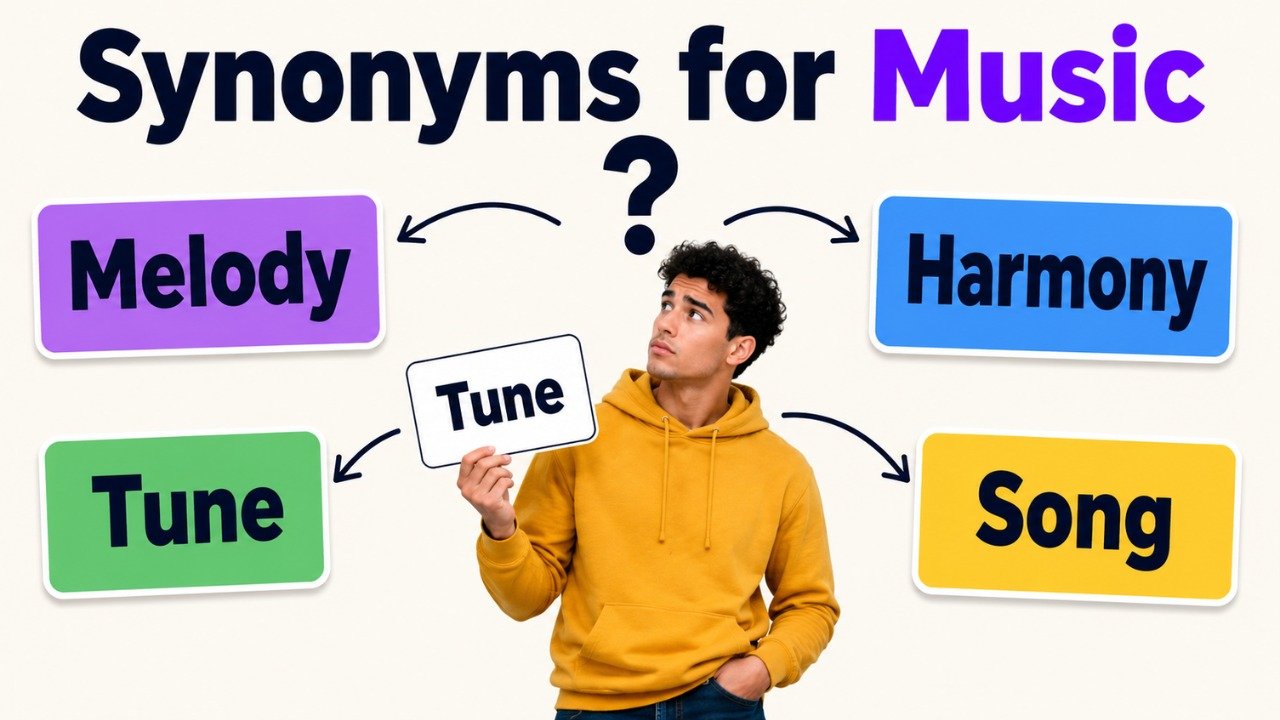
Quick Answer: Synonyms for music include melody, tune, song, harmony, rhythm, composition, sound, score, arrangement, and soundtrack. Use melody when talking about a pleasing line of notes, tune for a simple memorable piece, song for music with words, harmony for blended notes, rhythm for beat and movement, composition for a written musical work, and soundtrack for music connected with a scene, event, or production.
Pronunciation and Word Details
Word: Music.
Pronunciation: /ˈmjuː.zɪk/.
Part of Speech: Noun.
Meaning: Music means organized sound made with melody, rhythm, harmony, voice, or instruments to express feeling, beauty, mood, or meaning.
US Pronunciation:
UK Pronunciation:
What Does “Music” Mean?
Music means organized sound created through voice, instruments, rhythm, melody, harmony, or beat. It is a noun and can describe an art form, a song, a tune, a performance, a sound pattern, or a written composition.
The word works in many sentence contexts. You can listen to music, write music, play music, study music, enjoy music, or perform music. In everyday speech, music can mean songs or tunes. In formal writing, it may refer to an artistic discipline, structured sound, or a composed work.
Meaning, Tone, and Context of “Music”
Music is a neutral and positive word in most contexts. It can sound emotional when describing feelings, artistic when discussing beauty, technical when discussing rhythm and harmony, and academic when used in music theory or performance study.
The word is common in daily conversation, creative writing, education, performance, culture, entertainment, and art. Music can describe simple sounds, serious compositions, live performances, background sound, vocal works, instrumental works, and rhythmic expression. Its tone becomes richer when replaced with a more specific synonym like melody, harmony, score, or composition.
When and How to Use “Music”
For Sound And Art: Use music when describing organized sound as an art form.
Example: Music can express emotions that words sometimes cannot explain.
For Songs: Use music when talking about songs people listen to, sing, or enjoy.
Example: She listens to music while studying.
For Performance: Use music when describing sound created by singers or players.
Example: The music filled the hall with warmth.
For Mood: Use music when sound creates a feeling, atmosphere, or emotion.
Example: Soft music made the evening feel peaceful.
For Study Or Skill: Use music when referring to learning, writing, reading, or performing musical works.
Example: He studied music for many years.
Best Synonyms for Music
Melody: A pleasing sequence of musical notes.
Example: The melody stayed in my mind all day.
Tune: A simple musical pattern that is easy to remember.
Example: She hummed a cheerful tune while cooking.
Song: A piece of music, usually with words.
Example: That song has a gentle and hopeful sound.
Harmony: Notes that blend together in a pleasing way.
Example: The harmony made the performance feel full and rich.
Rhythm: The beat or pattern of movement in music.
Example: The rhythm made everyone want to move.
Composition: A complete piece of music that has been written or created.
Example: The composer finished a beautiful composition.
Score: Written music used by singers, players, or performers.
Example: The orchestra followed the score carefully.
Arrangement: A version of a musical piece prepared for certain voices or instruments.
Example: The choir sang a fresh arrangement of the old tune.
Soundtrack: Music connected with a scene, story, event, or production.
Example: The soundtrack added emotion to the final scene.
Symphony: A long musical work, usually written for an orchestra.
Example: The symphony opened with a powerful melody.
50 Synonyms for Music with Short Meanings
- Melody: A pleasing line of musical notes.
- Tune: A simple and memorable musical pattern.
- Song: Music usually written with words.
- Harmony: Blended notes that sound pleasing together.
- Rhythm: The beat or movement pattern in music.
- Beat: The steady pulse in a musical piece.
- Composition: A written or created musical work.
- Score: Written music for performance.
- Arrangement: A prepared version of a musical piece.
- Soundtrack: Music used with a story, scene, or event.
- Symphony: A long musical work for orchestra.
- Piece: A single musical work.
- Work: A created musical piece.
- Number: A song or musical item in a performance.
- Air: A simple song like melody.
- Strain: A passage or flow of music.
- Theme: A main musical idea.
- Motif: A short repeated musical idea.
- Refrain: A repeated part of a song.
- Chorus: A repeated song section or group singing part.
- Verse: A section of a song with changing words.
- Ballad: A song that often tells a story.
- Anthem: A strong song of praise, pride, or unity.
- Hymn: A serious song often used for worship or reflection.
- Chant: Repeated rhythmic singing or speaking.
- Lullaby: A soft song used to calm or comfort.
- Serenade: A gentle musical performance for someone.
- Aria: A solo vocal piece in a larger musical work.
- Opera: A dramatic work sung with music.
- Concerto: A musical work for solo instrument and orchestra.
- Sonata: A structured musical work for one or more instruments.
- Overture: An opening musical piece.
- Interlude: A short musical passage between parts.
- Prelude: An introductory musical piece.
- Cadence: A musical ending or rhythmic flow.
- Accompaniment: Supporting music behind a main voice or instrument.
- Backing: Supporting sound behind a main musical part.
- Instrumental: Music played without singing.
- Vocals: Sung parts of music.
- Lyrics: Words written for a song.
- Chords: Groups of notes played together.
- Notes: Individual musical sounds.
- Tones: Musical sounds with pitch or quality.
- Sound: Heard vibration used in music.
- Audio: Recorded or produced sound.
- Acoustics: Sound quality in a space or performance.
- Resonance: Richness or depth of musical sound.
- Orchestration: The way music is written for instruments.
- Instrumentation: The choice of instruments in music.
- Musicality: The quality of sounding musical or expressive.
Read Also:
Synonyms for Random

Synonyms for Music by Context
When Music Means Melody
When music means a pleasing line of notes, use melody, tune, air, strain, theme, or motif. These words are useful when describing sound that is memorable, beautiful, or easy to recognize.
Example: The music was soft and graceful.
Better Option: The melody was soft and graceful.
Example: I cannot forget that music.
Better Option: I cannot forget that tune.
When Music Means Song
When music means a song people sing or hear, use song, number, ballad, anthem, chorus, verse, or refrain. These words work well for vocal pieces, performances, and everyday listening.
Example: She played beautiful music at the event.
Better Option: She played a beautiful song at the event.
Example: The music told a sad story.
Better Option: The ballad told a sad story.
When Music Means Composition
When music means a written or created work, use composition, score, piece, work, arrangement, symphony, concerto, or sonata. These choices are stronger in formal, academic, and performance contexts.
Example: The students studied the music carefully.
Better Option: The students studied the score carefully.
Example: He wrote new music for the orchestra.
Better Option: He wrote a new composition for the orchestra.
When Music Means Rhythm Or Beat
When music means movement, pulse, or timing, use rhythm, beat, cadence, tempo, or pulse. These words are best when describing the part of music that creates motion or energy.
Example: The music made the room feel alive.
Better Option: The rhythm made the room feel alive.
Example: The music was fast and exciting.
Better Option: The beat was fast and exciting.
When Music Means Pleasant Sound
When music means beautiful or pleasing sound, use harmony, resonance, tone, sound, musicality, or acoustics. These words help describe the quality, richness, or emotional effect of sound.
Example: The music of the choir was gentle.
Better Option: The harmony of the choir was gentle.
Example: The music in the hall felt warm.
Better Option: The acoustics in the hall felt warm.
Another Word for Music
Another word for music is melody when you mean a pleasing series of notes. However, the best alternative depends on context. Use song for music with words, rhythm for beat, composition for a created work, and score for written music.
Original: The music sounded peaceful.
Better Option: The melody sounded peaceful.
Original: She wrote music for the concert.
Better Option: She wrote a composition for the concert.
Original: The music had a strong beat.
Better Option: The rhythm had a strong beat.
Original: He read the music before playing.
Better Option: He read the score before playing.
When Not to Use “Music”
Do not use music when a more specific word gives a clearer meaning. Music can be too broad if you mean a song, melody, beat, score, harmony, or soundtrack. It may also sound vague in formal writing when discussing a precise musical element.
Weak: The music in the song was catchy.
Better: The melody in the song was catchy.
Weak: The music was written on the page.
Better: The score was written on the page.
Weak: The music moved quickly.
Better: The rhythm moved quickly.
Weak: The music behind the scene was emotional.
Better: The soundtrack behind the scene was emotional.
Words Commonly Confused With Music
Music vs Song: Music is the broad art of organized sound. A song is one type of music, usually with words.
Music vs Melody: Music can include rhythm, harmony, voice, and instruments. Melody is the main line of notes that listeners often remember.
Music vs Tune: Music is a broad term. A tune is usually a simple, memorable melody.
Music vs Sound: Sound is anything heard. Music is organized sound made with artistic or expressive purpose.
Music vs Rhythm: Music includes many parts. Rhythm is the beat, pulse, or timing pattern within music.
Music vs Noise: Music is usually organized and meaningful. Noise is often unwanted, harsh, or disordered sound.
Music vs Score: Music can be heard or performed. A score is the written form of a musical work.
Which Synonym Should You Choose?
Choose melody when writing about a beautiful or memorable line of notes.
Choose tune for casual speech when the music is simple, catchy, or easy to hum.
Choose song when the music includes lyrics or singing.
Choose rhythm when focusing on beat, timing, movement, or energy.
Choose harmony when describing blended notes, vocal layers, or pleasing sound.
Choose composition for formal writing about a created musical work.
Choose score when discussing written music for singers, players, or performers.
Choose arrangement when describing a version of a musical work made for certain voices or instruments.
Choose soundtrack when writing about music connected with a scene, story, event, or atmosphere.
Choose symphony, concerto, sonata, aria, or opera when you need a more specific musical form.
Real Life Examples of “Music” in Sentences
Original: The music was soft and relaxing.
Better Option: The melody was soft and relaxing.
Original: She played music on the piano.
Better Option: She played a gentle tune on the piano.
Original: The music had a steady movement.
Better Option: The rhythm had a steady movement.
Original: The film used emotional music.
Better Option: The film used an emotional soundtrack.
Original: He wrote music for the orchestra.
Better Option: He wrote a composition for the orchestra.
Original: The singer followed the music carefully.
Better Option: The singer followed the score carefully.
Original: The music sounded rich and full.
Better Option: The harmony sounded rich and full.
Original: The band opened with lively music.
Better Option: The band opened with a lively number.
Original: The music stayed in my head.
Better Option: The tune stayed in my head.
Original: The music created a peaceful mood.
Better Option: The sound created a peaceful mood.
Synonym Groups and Usage Differences
Melody Group
Melody, tune, air, strain, theme, and motif all focus on the line of notes in music. These words are useful when the sound is memorable, repeated, or easy to recognize.
Example: The melody gave the piece its gentle beauty.
Song Group
Song, ballad, anthem, lullaby, chant, chorus, refrain, and verse relate to vocal music or music with words. Use these words when people sing, repeat lines, or express meaning through lyrics.
Example: The lullaby helped the child feel calm.
Composition Group
Composition, score, piece, work, arrangement, symphony, sonata, and concerto are useful for formal musical works. These words fit writing about study, performance, creation, or structure.
Example: The composition showed careful control of rhythm and harmony.
Rhythm Group
Rhythm, beat, cadence, pulse, and tempo describe movement, timing, and energy. Use these words when the main idea is speed, flow, or repeated motion.
Example: The beat gave the song its energy.
Sound Quality Group
Harmony, tone, resonance, acoustics, sound, and musicality describe how music feels to the ear. These words are useful for beauty, depth, warmth, and expression.
Example: The resonance made the room feel full and alive.
Antonyms of Music
Silence: Complete absence of sound.
Noise: Unwanted or unpleasant sound.
Discord: Lack of harmony or agreement in sound.
Dissonance: Harsh or tense combination of notes.
Cacophony: A loud and unpleasant mixture of sounds.
Quietness: A state with little sound.
Stillness: Calmness without movement or sound.
Harshness: Rough or unpleasant sound quality.
Clamor: Loud and confusing noise.
Racket: Loud, annoying, or disorderly noise.
Mute Sound: Sound that is softened or silenced.
Unmusical Sound: Sound that lacks musical quality.
Comparison Music vs Related Words
Music vs Song
Music is a broad term for organized sound. A song is a specific piece of music that usually includes words and singing.
Example With Music: Music can change the mood of a room.
Example With Song: Her favorite song has meaningful lyrics.
Music vs Melody
Music can include melody, rhythm, harmony, and instruments. Melody is the main musical line that listeners often remember.
Example With Music: The music was calm and graceful.
Example With Melody: The melody was easy to hum.
Music vs Tune
Music is general and can refer to any musical sound or art form. Tune is more casual and often means a short, memorable melody.
Example With Music: He enjoys classical music.
Example With Tune: She whistled a happy tune.
Music vs Rhythm
Music is the complete organized sound. Rhythm is the beat or timing that gives music movement.
Example With Music: The music sounded bright and joyful.
Example With Rhythm: The rhythm made the song feel lively.
Music vs Score
Music can be heard, played, sung, or written. A score is the written form used by performers.
Example With Music: The music began softly.
Example With Score: The conductor marked the score.
Common Phrases and Expressions With Music
Soft Music: Gentle sound that feels calm or quiet.
Live Music: Music performed in front of listeners.
Background Music: Music played softly behind an activity or scene.
Classical Music: Formal music often written for instruments or orchestra.
Instrumental Music: Music without singing.
Vocal Music: Music that uses the human voice.
Sheet Music: Written music printed or displayed for performance.
Music Theory: The study of how music is built and understood.
Mood Music: Music chosen to create a feeling or atmosphere.
Music To My Ears: Something pleasant or welcome to hear.
Common Mistakes to Avoid
A common mistake is using music when a more exact word would make the sentence clearer. If you mean words and singing, use song. If you mean the written page, use score. If you mean the main line of notes, use melody. If you mean the beat, use rhythm.
Another mistake is confusing music with sound. Not every sound is music. Music usually has order, expression, rhythm, melody, or artistic purpose. Also avoid repeating music too many times in one paragraph. Use synonyms like tune, composition, harmony, or soundtrack when they fit the meaning.
Conclusion
Synonyms for music help you describe sound, art, rhythm, song, performance, and emotion with better precision. Use melody for beautiful notes, tune for a memorable sound, song for music with words, harmony for blended notes, rhythm for beat, composition for a written work, and soundtrack for mood or scene based sound. Music is a strong general word, but choosing the right synonym makes your writing clearer, richer, and more expressive.
FAQs About Synonyms for Music
What is the best synonym for music?
The best synonym for music is melody when you mean a pleasing line of notes. For music with words, song is often the best choice.
What is another word for music in formal writing?
Composition, score, arrangement, and musical work are good formal alternatives. The best word depends on whether you mean written music, performed music, or a created piece.
What is a simple synonym for music?
Tune and song are simple synonyms for music. Tune works well for a memorable melody, while song works well when there are lyrics.
Is melody the same as music?
No. Melody is one part of music. Music can also include rhythm, harmony, beat, voice, instruments, and structure.
What is a better word than music for a written piece?
Score is better when you mean written music. Composition is better when you mean a complete musical work created by someone.
What is the opposite of music?
The opposite of music can be silence, noise, discord, dissonance, or cacophony, depending on the meaning.
Can sound be a synonym for music?
Sound can be a close alternative in some contexts, but it is broader than music. Music is usually organized sound with rhythm, melody, or expression.
