
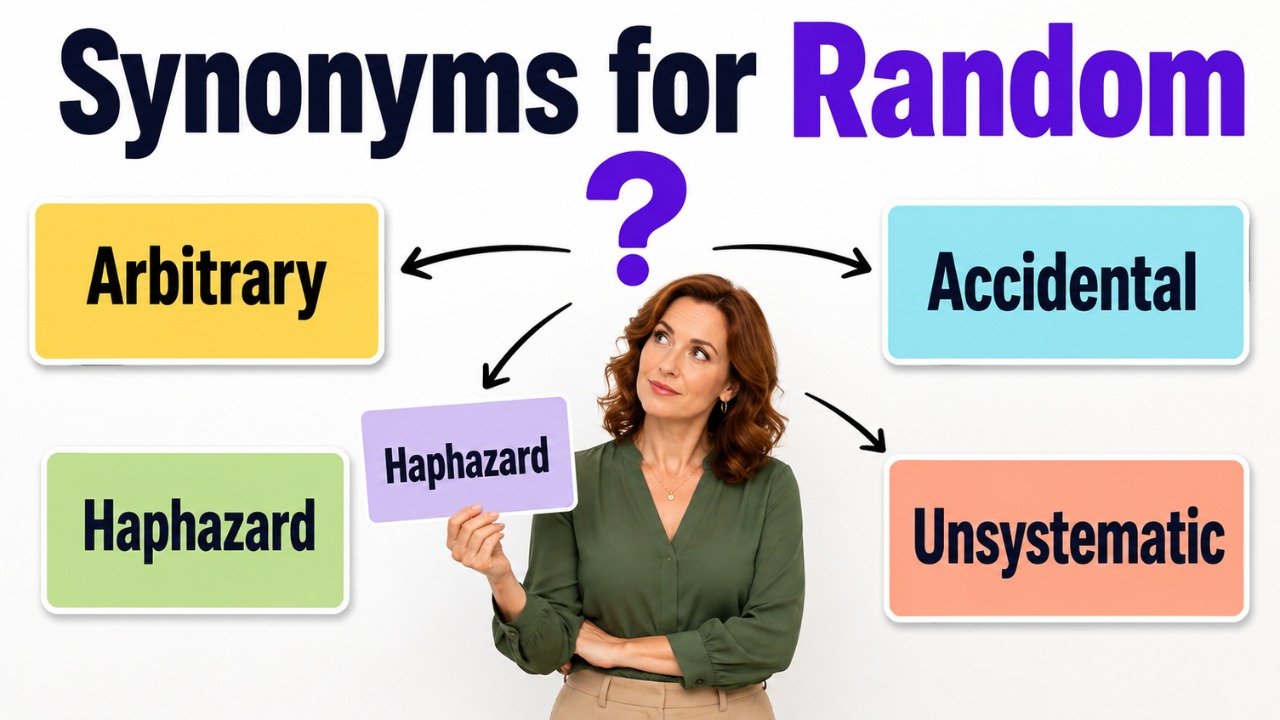
Quick Answer: Synonyms for random include arbitrary, accidental, chance, haphazard, unplanned, unsystematic, unpredictable, irregular, indiscriminate, and casual. Use arbitrary when something is chosen without a clear reason, accidental when something happens by mistake, chance when something happens without planning, haphazard when something lacks order, and unpredictable when the result cannot be known before it happens.
Pronunciation and Word Details
Word: Random.
Pronunciation: /ˈræn.dəm/.
Part of Speech: Adjective.
Meaning: Random means happening, chosen, or done without a clear plan, pattern, order, or purpose.
US Pronunciation:
UK Pronunciation:
What Does “Random” Mean?
Random means done, chosen, or happening without a clear plan, pattern, or predictable order. It is mostly used as an adjective, as in a random number, random question, random person, or random event.
The word can describe choices, actions, thoughts, results, data, names, comments, or events. In formal writing, random often means selected by chance. In casual speech, random can also mean strange, unexpected, unrelated, or surprising.
Meaning, Tone, and Context of “Random”
Random is usually a neutral word, but its tone depends on how it is used. In academic, scientific, or technical writing, random means based on chance and not influenced by personal choice. In everyday conversation, random often means odd, surprising, unrelated, or not expected.
The word is common in grammar, vocabulary, statistics, research, games, technology, daily speech, and creative writing. Random can sound clear and useful when describing chance, but it can sound vague if the writer means careless, strange, accidental, or disorganized.
When and How to Use “Random”
For Chance: Use random when something is selected or happens without planning.
Example: The teacher picked a random name from the list.
For Lack of Order: Use random when things are not arranged in a clear sequence.
Example: The books were placed in a random order on the shelf.
For Surprise: Use random when something feels unexpected or unrelated.
Example: He asked a random question during the meeting.
For Unplanned Action: Use random when something happens without preparation.
Example: They made a random stop at a small cafe.
For Fair Selection: Use random when every option has an equal chance.
Example: The winners were chosen by a random draw.
Best Synonyms for Random
Arbitrary: Chosen without a clear reason or fixed rule.
Example: The manager made an arbitrary decision about the seating plan.
Accidental: Happening by mistake or without intention.
Example: Their meeting was accidental, but it changed everything.
Chance: Happening without planning or design.
Example: It was a chance encounter at the station.
Haphazard: Done without order, care, or planning.
Example: The files were stored in a haphazard way.
Unplanned: Not arranged or prepared before it happens.
Example: We took an unplanned trip to the countryside.
Unsystematic: Not following a method, system, or organized process.
Example: His notes were unsystematic and hard to follow.
Unpredictable: Not easy to know or guess before it happens.
Example: The weather has been unpredictable all week.
Irregular: Not following a normal pattern or fixed order.
Example: The machine made irregular sounds.
Indiscriminate: Done without careful choice or judgment.
Example: The company avoided indiscriminate spending.
Casual: Done without much planning, seriousness, or formality.
Example: She made a casual remark about the idea.
50 Synonyms for Random with Short Meanings
- Arbitrary: Chosen without a clear reason.
- Accidental: Happening by mistake or chance.
- Chance: Happening without planning.
- Haphazard: Lacking order or careful planning.
- Unplanned: Not arranged in advance.
- Unsystematic: Not following a method.
- Unpredictable: Hard to know before it happens.
- Irregular: Not following a normal pattern.
- Indiscriminate: Done without careful selection.
- Casual: Not planned or formal.
- Aimless: Without a clear purpose.
- Unintended: Not meant to happen.
- Unexpected: Not expected or predicted.
- Fortuitous: Happening by lucky chance.
- Coincidental: Happening at the same time by chance.
- Erratic: Changing in an uneven or uncertain way.
- Scattered: Spread without order.
- Disordered: Not arranged properly.
- Confused: Mixed or unclear.
- Mixed: Made of different things without one clear type.
- Unarranged: Not put into order.
- Unordered: Not organized in sequence.
- Unsorted: Not separated or organized.
- Rough: Not carefully finished or organized.
- Loose: Not fixed, strict, or exact.
- Stray: Separate from the main group.
- Odd: Strange or unusual.
- Strange: Unusual or unexpected.
- Unrelated: Not connected to the topic.
- Disconnected: Not linked in a clear way.
- Sporadic: Happening at irregular times.
- Occasional: Happening from time to time.
- Rare: Not happening often.
- Inconsistent: Not staying the same.
- Variable: Able to change.
- Wandering: Moving without a fixed direction.
- Drifting: Moving without control or purpose.
- Purposeless: Without a clear purpose.
- Unfixed: Not settled or decided.
- Undirected: Not guided toward a goal.
- Impulsive: Done suddenly without much thought.
- Spontaneous: Done naturally without planning.
- Unpremeditated: Not thought out before action.
- Hit or miss: Sometimes successful and sometimes not.
- Scattershot: Spread widely without careful aim.
- Patchy: Uneven or incomplete.
- Jumbled: Mixed together without order.
- Chaotic: Very disordered or confused.
- Randomized: Arranged or selected by chance.
- By chance: Happening without plan or intention.
Read Also:
Synonyms for Destruction

Synonyms for Random by Context
When Random Means Chosen By Chance
Random can mean selected without personal choice, bias, or planning. In this context, the best synonyms are chance, arbitrary, randomized, accidental, and fortuitous.
Example: The names were selected at random.
Better Option: The names were selected by chance.
Example: The system created a random order.
Better Option: The system created a randomized order.
When Random Means Without Order
Random can describe things that have no clear arrangement, structure, or sequence. Strong synonyms include haphazard, unsystematic, unordered, scattered, jumbled, and disordered.
Example: The papers were in a random pile.
Better Option: The papers were in a haphazard pile.
Example: The ideas appeared in a random order.
Better Option: The ideas appeared in an unsystematic order.
When Random Means Unexpected
In conversation, random often means surprising, sudden, or not expected. Good synonyms include unexpected, odd, strange, spontaneous, and surprising.
Example: She made a random comment during dinner.
Better Option: She made an unexpected comment during dinner.
Example: That was a random thing to say.
Better Option: That was an odd thing to say.
When Random Means Unrelated
Random can also mean not connected to the subject being discussed. Useful synonyms include unrelated, disconnected, stray, loose, and off topic.
Example: He added a random detail to the story.
Better Option: He added an unrelated detail to the story.
Example: The sentence included a random idea.
Better Option: The sentence included a disconnected idea.
When Random Means Without Purpose
Random sometimes means aimless or not guided by a clear goal. Good choices include aimless, purposeless, undirected, wandering, and drifting.
Example: We took a random walk through the town.
Better Option: We took an aimless walk through the town.
Example: His random thoughts kept changing.
Better Option: His wandering thoughts kept changing.
Another Word for Random
Another word for random is arbitrary when you mean chosen without a clear reason. However, the best replacement depends on the sentence. Use chance for events, haphazard for disorder, unexpected for surprise, and unrelated for comments that do not fit the topic.
Original: The teacher asked a random question.
Better Option: The teacher asked an unexpected question.
Original: The files were in random order.
Better Option: The files were in haphazard order.
Original: They chose a random winner.
Better Option: They chose a winner by chance.
Original: He made a random decision.
Better Option: He made an arbitrary decision.
When Not to Use “Random”
Do not use random when a more specific word gives a clearer meaning. Random can sound weak if you mean careless, strange, accidental, unfair, messy, or unrelated. It can also sound too casual in formal writing when precise words like arbitrary, chance, unsystematic, or unpredictable would work better.
Weak: The report had random data.
Better: The report had unsystematic data.
Weak: She gave a random answer.
Better: She gave an unrelated answer.
Weak: The rule felt random.
Better: The rule felt arbitrary.
Weak: We had a random meeting.
Better: We had a chance meeting.
Words Commonly Confused With Random
Random vs Arbitrary: Random means based on chance or without a clear pattern. Arbitrary means chosen without a clear reason, rule, or fair explanation.
Random vs Accidental: Random can describe chance selection or lack of order. Accidental means something happened by mistake or without intention.
Random vs Haphazard: Random can be neutral, especially in selection. Haphazard usually suggests careless arrangement or poor organization.
Random vs Unpredictable: Random focuses on lack of pattern or planned choice. Unpredictable focuses on being hard to guess in advance.
Random vs Casual: Random can mean unplanned or unrelated. Casual means relaxed, informal, or not serious.
Random vs Strange: Random may mean unexpected or unrelated. Strange means unusual, odd, or difficult to understand.
Which Synonym Should You Choose?
Choose arbitrary when writing about a decision, rule, or choice made without a clear reason.
Choose chance when writing about an event that happened without planning.
Choose accidental when something happens by mistake or without intention.
Choose haphazard when describing messy order, careless work, or poor arrangement.
Choose unsystematic when writing about research, notes, data, or methods that lack structure.
Choose unpredictable when the result cannot be guessed before it happens.
Choose unrelated when a comment, detail, or idea does not connect to the topic.
Choose spontaneous when something happens naturally and without planning, but in a positive or lively way.
Choose odd or strange when random means unusual in casual speech.
Real Life Examples of “Random” in Sentences
Original: A random person helped me carry the box.
Better Option: A stranger helped me carry the box.
Original: The app showed random pictures.
Better Option: The app showed pictures in an unpredictable order.
Original: She made a random joke in class.
Better Option: She made an unexpected joke in class.
Original: The manager made a random choice.
Better Option: The manager made an arbitrary choice.
Original: We found a random cafe on the way home.
Better Option: We found a chance cafe on the way home.
Original: His notes looked random.
Better Option: His notes looked haphazard.
Original: The team used random names for the test.
Better Option: The team used randomized names for the test.
Original: That random detail confused the reader.
Better Option: That unrelated detail confused the reader.
Original: The lights flashed in a random pattern.
Better Option: The lights flashed in an irregular pattern.
Original: She had a random idea before sleeping.
Better Option: She had a spontaneous idea before sleeping.
Synonym Groups and Usage Differences
Chance Group
This group is best when random means something happens without planning or intention. Words like chance, accidental, fortuitous, and coincidental fit this meaning.
Example: Their meeting was a chance event.
Disorder Group
This group works when random means messy, unorganized, or not arranged in a clear order. Words like haphazard, scattered, jumbled, disordered, and unsorted are useful here.
Example: The room had a haphazard arrangement of chairs.
Selection Group
This group is useful when random means chosen without bias or fixed order. Words like arbitrary, randomized, indiscriminate, and chance fit formal or technical contexts.
Example: The survey used a randomized list of participants.
Surprise Group
This group fits casual situations where random means unexpected, odd, or strange. Words like unexpected, odd, strange, spontaneous, and surprising are natural choices.
Example: His unexpected question changed the conversation.
Purpose Group
This group works when random means aimless or without direction. Words like aimless, purposeless, undirected, wandering, and drifting are better than random in descriptive writing.
Example: They took an aimless walk after dinner.
Antonyms of Random
Planned: Arranged before it happens.
Organized: Put in a clear order.
Systematic: Following a method or structure.
Intentional: Done on purpose.
Deliberate: Done carefully and knowingly.
Predictable: Easy to guess or expect.
Regular: Following a fixed pattern.
Ordered: Arranged in sequence.
Purposeful: Done with a clear aim.
Specific: Clearly identified or exact.
Connected: Related to the main subject.
Controlled: Guided by rules or direction.
Comparison Random vs Related Words
Random vs Arbitrary
Random often means selected by chance or without a pattern. Arbitrary means chosen without a fair, clear, or logical reason.
Example With Random: The computer picked a random number.
Example With Arbitrary: The rule seemed arbitrary and unfair.
Random vs Accidental
Random can describe chance, disorder, or unpredictability. Accidental means not done on purpose.
Example With Random: The list appeared in a random order.
Example With Accidental: The damage was accidental.
Random vs Haphazard
Random may be neutral when used for fair selection. Haphazard usually suggests careless or messy arrangement.
Example With Random: A random winner was selected.
Example With Haphazard: The tools were kept in a haphazard pile.
Random vs Unpredictable
Random focuses on no clear pattern or planned choice. Unpredictable focuses on not knowing what will happen next.
Example With Random: The numbers appeared in random order.
Example With Unpredictable: His mood was unpredictable.
Random vs Irregular
Random means lacking plan, order, or pattern. Irregular means not following a steady or normal pattern.
Example With Random: The teacher chose a random topic.
Example With Irregular: The heartbeat became irregular.
Common Phrases and Expressions With Random
Random Choice: A choice made without a fixed plan or reason.
Random Number: A number selected without a predictable pattern.
Random Person: An unknown or unspecified person.
Random Question: A question that feels unexpected or unrelated.
Random Order: An order without a clear sequence.
Random Sample: A group chosen by chance for fair study or review.
Random Act: An action done without planning.
Random Thought: A sudden idea that appears without warning.
Random Event: Something that happens without a planned cause.
At Random: Done by chance rather than by a fixed method.
Common Mistakes to Avoid
One common mistake is using random too often when a stronger synonym would be clearer. For example, random decision may mean arbitrary decision, random meeting may mean chance meeting, and random notes may mean haphazard notes.
Another mistake is using random for anything strange. Strange, odd, unexpected, and unrelated may be better depending on the sentence. In formal writing, avoid using random too casually. Choose precise words when discussing data, research, methods, order, or selection.
Also avoid confusing random with accidental. Accidental means not intended, while random often means without pattern, plan, or clear selection.
Conclusion
Synonyms for random help you describe chance, disorder, surprise, lack of purpose, and unclear connection with more accuracy. Use arbitrary for choices without clear reason, chance for unplanned events, haphazard for messy order, unexpected for surprising comments, and unrelated for ideas that do not fit the topic. Random is useful, but stronger synonyms often make your writing clearer, more natural, and more specific for readers.
FAQs About Synonyms for Random
What is the best synonym for random?
The best synonym for random is arbitrary when something is chosen without a clear reason. For chance events, use chance or accidental.
What is another word for random in formal writing?
A good formal word for random is arbitrary, randomized, unsystematic, or unpredictable. The best choice depends on the meaning.
What is a casual synonym for random?
Casual synonyms for random include odd, strange, unexpected, and out of nowhere. These work well in everyday conversation.
Is random the same as accidental?
No. Random means without a plan, pattern, or predictable order. Accidental means something happened by mistake or without intention.
What is a better word than random for messy order?
Haphazard is often better than random when describing messy order. You can also use jumbled, scattered, disordered, or unsorted.
What is the opposite of random?
The opposite of random can be planned, organized, systematic, intentional, regular, predictable, or specific.
Can random mean strange?
Yes. In casual speech, random can mean strange, unexpected, or unrelated. In formal writing, it is better to use a more exact word.
