
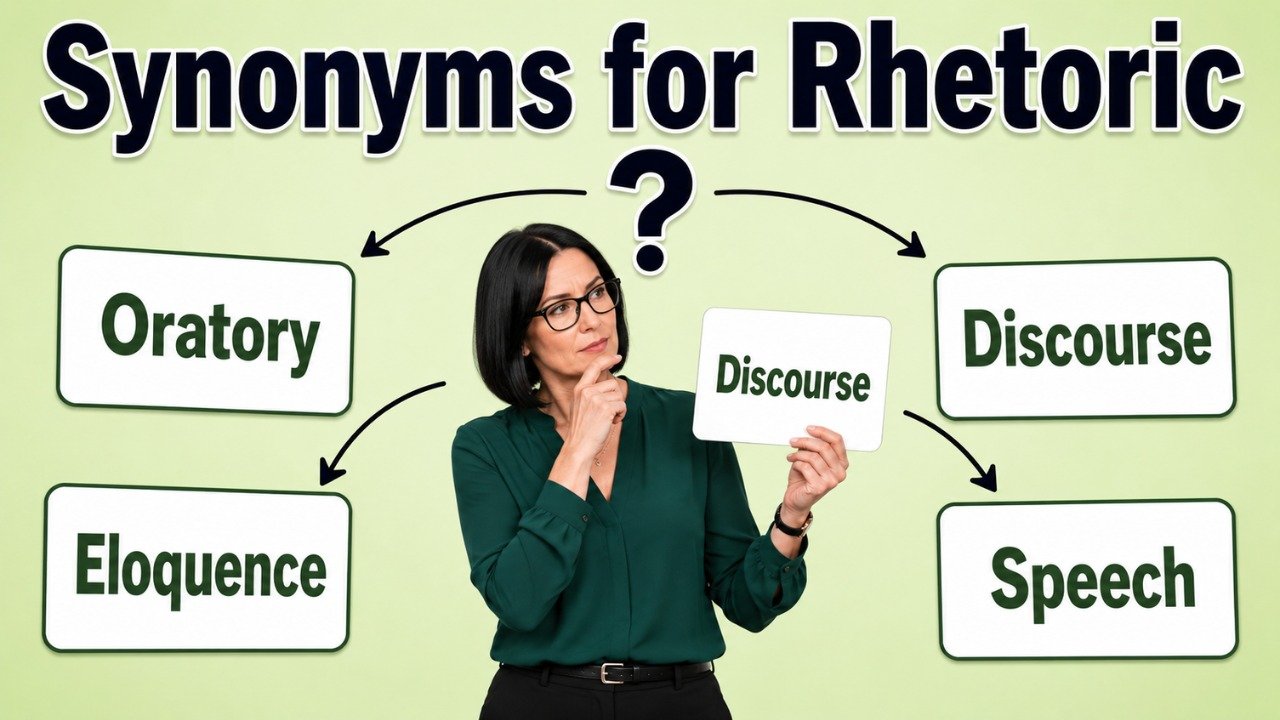
Quick Answer: Common synonyms for rhetoric include oratory, eloquence, persuasion, discourse, argumentation, speechcraft, expression, language, bombast, and grandiloquence. The best synonyms for rhetoric depend on context. Use oratory for formal public speaking, eloquence for graceful and effective expression, persuasion when influencing opinions, argumentation for reasoned debate, discourse for formal discussion, and bombast when rhetoric sounds exaggerated or overly impressive.
Pronunciation and Word Details
Word: Rhetoric.
Pronunciation: /ˈretərɪk/
Part of Speech: Noun.
Meaning: The art or use of language designed to persuade, influence, impress, or communicate ideas effectively.
US Pronunciation:
UK Pronunciation:
What Does “Rhetoric” Mean?
Rhetoric means the skill or practice of using language effectively, especially to persuade, influence, or impress an audience.
As a noun, rhetoric can describe the art of persuasive speaking and writing. It may also refer to the particular language someone uses when discussing an issue.
In academic contexts, rhetoric often means the study of how language, arguments, style, and structure influence an audience. In public speaking, it can refer to persuasive techniques used by a speaker.
The word can also have a negative meaning. When someone describes a statement as rhetoric, they may mean that it sounds impressive or persuasive but lacks practical substance.
Formal Context: The professor examined the rhetoric used in the historical speech.
Persuasive Context: Her rhetoric encouraged the audience to reconsider the proposal.
Negative Context: Critics dismissed the promises as empty rhetoric.
Meaning, Tone, and Context of “Rhetoric”
Rhetoric is generally a formal or academic word, although it also appears frequently in everyday discussions about speeches, debates, arguments, and public communication.
Its tone depends heavily on context.
Academic Tone: Rhetoric can neutrally describe techniques used to communicate and persuade.
Formal Tone: It may refer to carefully constructed language in speeches, essays, debates, and presentations.
Persuasive Tone: Rhetoric can describe language designed to influence thoughts, emotions, or behavior.
Critical Tone: The word can suggest exaggerated, manipulative, or empty language.
Literary Tone: Rhetoric may refer to stylistic devices that make writing more memorable or convincing.
Because the word has both neutral and negative uses, readers should consider the surrounding sentence before choosing a synonym.
When and How to Use “Rhetoric”
For Persuasive Communication
Use rhetoric when discussing language intended to influence an audience.
Example: The speaker used emotional rhetoric to strengthen the argument.
For Public Speaking
Use rhetoric when referring to techniques used in speeches or formal presentations.
Example: His command of rhetoric made the presentation memorable.
For Academic Analysis
Use rhetoric when studying how language, structure, tone, and reasoning shape communication.
Example: The essay analyzes the rhetoric of several historical speeches.
For Political or Public Language
Rhetoric can describe the language used in public debates, campaigns, movements, or controversies.
Example: The debate became dominated by aggressive rhetoric.
For Exaggerated Language
Use rhetoric critically when words sound impressive but lack meaningful action or evidence.
Example: Employees wanted concrete changes rather than corporate rhetoric.
For Literary Style
Rhetoric can refer to techniques that make writing more expressive or persuasive.
Example: The author uses rhetorical techniques to create urgency.
Best Synonyms for Rhetoric
Oratory: The skill or practice of formal public speaking.
Example: Her powerful oratory held the audience’s attention.
Eloquence: Fluent, graceful, and persuasive expression.
Example: His eloquence made a complicated idea easy to understand.
Persuasion: Communication intended to influence someone’s beliefs or actions.
Example: The message relied on persuasion rather than pressure.
Discourse: Formal or serious communication about a subject.
Example: The issue became part of a broader public discourse.
Argumentation: The structured use of reasons and evidence to support a position.
Example: Strong argumentation made the essay more convincing.
Speechcraft: The skill of preparing and delivering effective speeches.
Example: Years of practice improved her speechcraft.
Expression: The communication of ideas, thoughts, or feelings through language.
Example: His expression was direct and emotionally powerful.
Oratory Style: A manner of speaking designed for formal audiences.
Example: The leader’s oratory style relied on repetition and vivid imagery.
Bombast: Language that sounds overly grand, exaggerated, or self important.
Example: The speech contained more bombast than practical detail.
Grandiloquence: An elaborate and overly impressive style of speaking or writing.
Example: The author’s grandiloquence made the simple argument sound dramatic.
50 Synonyms for Rhetoric with Short Meanings
- Oratory: Skilled formal public speaking.
- Eloquence: Fluent and persuasive expression.
- Persuasion: Language used to influence others.
- Discourse: Formal discussion or communication.
- Argumentation: Reasoned presentation of arguments.
- Speechcraft: Skill in preparing effective speeches.
- Expression: Communication of thoughts or feelings.
- Language: Words used to communicate ideas.
- Diction: Choice and use of words.
- Delivery: Manner of presenting spoken ideas.
- Address: A formal speech to an audience.
- Speech: Spoken communication before listeners.
- Elocution: Clear and expressive speaking.
- Declamation: Formal and forceful public speaking.
- Persuasiveness: Ability to influence opinions.
- Advocacy: Public support for a position or cause.
- Reasoning: Logical presentation of thought.
- Argument: A position supported by reasons.
- Debate: Structured discussion of opposing views.
- Appeal: An attempt to persuade or influence.
- Exposition: Clear explanation of an idea.
- Presentation: Organized communication of information.
- Communication: Exchange or expression of ideas.
- Expressionism: Strong emphasis on expressive communication.
- Phraseology: Particular manner of using phrases.
- Wording: Specific choice of words.
- Style: Distinctive manner of expression.
- Verbiage: Excessive or particular use of words.
- Wordiness: Use of more words than necessary.
- Bombast: Pompous or exaggerated language.
- Grandiloquence: Elaborately impressive language.
- Pomposity: Excessively self important expression.
- Magniloquence: Lofty or impressive speech.
- Flourish: Decorative or impressive expression.
- Ornamentation: Decorative use of language.
- Propaganda: Persuasive communication promoting a viewpoint.
- Messaging: Strategic communication of ideas.
- Narrative: Organized presentation of an idea or viewpoint.
- Framing: Presenting information from a particular perspective.
- Reasoned Appeal: Persuasion based on logic or evidence.
- Emotional Appeal: Persuasion based on feelings.
- Verbal Artistry: Skillful creative use of language.
- Public Speaking: Speaking formally before an audience.
- Rhetorical Style: A particular method of persuasive expression.
- Persuasive Language: Words designed to influence.
- Formal Speech: Structured communication to an audience.
- Verbal Expression: Communication through spoken words.
- Literary Expression: Artistic use of written language.
- Debating Style: Manner of presenting arguments in debate.
- Persuasive Discourse: Formal communication intended to influence.
Read Also:
Synonyms for Cheerful

Synonyms for Rhetoric by Context
When Rhetoric Means Persuasive Language
Useful alternatives include persuasion, persuasive language, appeal, advocacy, argumentation, and persuasive discourse.
Example: The campaign relied heavily on emotional persuasion.
Example: Her persuasive language encouraged listeners to support the proposal.
Example: His appeal focused on fairness and shared responsibility.
When Rhetoric Means Public Speaking
Useful synonyms include oratory, speechcraft, elocution, declamation, public speaking, and address.
Example: His oratory became known for its clarity and energy.
Example: Strong speechcraft helped her communicate complicated ideas effectively.
Example: The formal address lasted nearly an hour.
When Rhetoric Means Formal Discussion
Discourse, argumentation, debate, reasoning, presentation, and exposition may work well.
Example: The subject has generated considerable academic discourse.
Example: Careful argumentation strengthened the research paper.
Example: The debate focused on competing interpretations of the evidence.
When Rhetoric Means Impressive but Empty Language
Bombast, grandiloquence, pomposity, verbiage, and magniloquence may be more precise.
Example: The audience quickly grew tired of the speaker’s bombast.
Example: Grandiloquence could not hide the lack of practical details.
Example: The report avoided unnecessary verbiage and focused on results.
When Rhetoric Means Communication Style
Expression, style, diction, phraseology, wording, delivery, and framing can work depending on the sentence.
Example: Her careful diction gave the speech a serious tone.
Example: The framing of the issue influenced how readers understood it.
Example: His delivery made the argument sound more urgent.
Another Word for Rhetoric
The best single replacement for rhetoric is often oratory when the word refers to formal persuasive speaking. However, the best alternative depends on the intended meaning.
Use persuasion when the focus is influence, discourse when the focus is formal discussion, argumentation when reasoning is central, and bombast when the language sounds exaggerated or empty.
Original: The speaker’s rhetoric impressed the audience.
Better Option: The speaker’s oratory impressed the audience.
Original: The article uses rhetoric to influence readers.
Better Option: The article uses persuasion to influence readers.
Original: Their rhetoric lacked practical solutions.
Better Option: Their bombast lacked practical solutions.
Original: The essay examines scientific rhetoric.
Better Option: The essay examines scientific discourse.
When Not to Use “Rhetoric”
Rhetoric can sound too broad when you need to describe a specific type of communication.
Avoid it when a more precise word would make the meaning immediately clear.
If you are describing an actual speech, speech or address may be better.
If you mean logical reasoning, argumentation is usually more specific.
If you mean elegant speaking, eloquence may communicate the idea more accurately.
If you mean exaggerated language, bombast may be stronger.
Weak: Her rhetoric was beautiful.
Better: Her eloquence made the speech memorable.
Weak: The report contained strong rhetoric about the data.
Better: The report contained strong argumentation supported by the data.
Weak: He gave an hour of rhetoric to the audience.
Better: He gave an hour long address to the audience.
Weak: The statement was only rhetoric.
Better: The statement was mostly bombast without practical proposals.
Words Commonly Confused With Rhetoric
Rhetoric vs Oratory: Rhetoric is the broader art of persuasive language, while oratory specifically refers to skilled public speaking.
Rhetoric vs Eloquence: Rhetoric focuses on effective or persuasive language. Eloquence emphasizes fluent, graceful, and powerful expression.
Rhetoric vs Persuasion: Rhetoric includes techniques for influencing an audience, while persuasion describes the broader process of convincing someone.
Rhetoric vs Discourse: Rhetoric focuses on how language influences an audience. Discourse refers more broadly to communication or discussion about a topic.
Rhetoric vs Argumentation: Rhetoric may include emotion, style, repetition, imagery, and logic. Argumentation focuses primarily on reasons, claims, and evidence.
Rhetoric vs Propaganda: Rhetoric is a general communication technique and can be neutral. Propaganda is communication deliberately designed to promote a particular viewpoint.
Rhetoric vs Bombast: Rhetoric can be effective and meaningful. Bombast specifically describes inflated or excessively grand language.
Which Synonym Should You Choose?
Choose oratory when describing skilled formal public speaking.
Choose eloquence when the emphasis is graceful, fluent, or moving expression.
Choose persuasion when someone is trying to influence another person’s opinion or behavior.
Choose argumentation when discussing structured reasoning, evidence, essays, or debates.
Choose discourse for academic, intellectual, or formal discussion.
Choose speechcraft when focusing on the skill involved in creating and delivering speeches.
Choose diction when discussing the specific words a speaker or writer chooses.
Choose framing when explaining how information is presented from a particular perspective.
Choose bombast when language sounds exaggerated, pompous, or lacking in substance.
Choose grandiloquence when the language is unusually elaborate or intended to sound impressive.
Real Life Examples of “Rhetoric” in Sentences
Original: The speaker’s rhetoric inspired the audience.
Better Option: The speaker’s oratory inspired the audience.
Original: The article uses rhetoric to convince readers.
Better Option: The article uses persuasive language to convince readers.
Original: His rhetoric was elegant and memorable.
Better Option: His eloquence was elegant and memorable.
Original: The class studied rhetoric in historical speeches.
Better Option: The class studied persuasive techniques in historical speeches.
Original: The debate included aggressive rhetoric from both sides.
Better Option: The debate included aggressive language from both sides.
Original: Her rhetoric relied heavily on facts and logic.
Better Option: Her argumentation relied heavily on facts and logic.
Original: The proposal contained a great deal of rhetoric but little evidence.
Better Option: The proposal contained a great deal of bombast but little evidence.
Original: Scholars examined the rhetoric surrounding the cultural debate.
Better Option: Scholars examined the discourse surrounding the cultural debate.
Original: His rhetoric changed how the audience viewed the issue.
Better Option: His framing changed how the audience viewed the issue.
Original: Effective rhetoric can make complicated ideas more persuasive.
Better Option: Effective speechcraft can make complicated ideas more persuasive.
Synonym Groups and Usage Differences
Persuasion Group
Persuasion, appeal, advocacy, persuasive language, and persuasive discourse focus on influencing opinions or actions.
Example: The advertisement relied on emotional persuasion.
Public Speaking Group
Oratory, speechcraft, elocution, declamation, address, and public speaking relate to spoken communication before an audience.
Example: Her oratory improved dramatically through regular practice.
Reasoning Group
Argumentation, reasoning, argument, and debate emphasize claims, evidence, logic, and discussion.
Example: Careful argumentation strengthened the essay.
Formal Discussion Group
Discourse, exposition, presentation, and communication describe organized discussion or explanation of ideas.
Example: The topic became part of a wider academic discourse.
Language Style Group
Diction, wording, phraseology, style, expression, and delivery describe how ideas are communicated.
Example: The author’s precise diction creates a serious tone.
Exaggerated Language Group
Bombast, grandiloquence, magniloquence, pomposity, and verbiage describe language that may sound excessively elaborate or impressive.
Example: The speech was weakened by unnecessary bombast.
Antonyms of Rhetoric
There is no single opposite of rhetoric because the word has several meanings. Useful antonyms depend on whether rhetoric refers to persuasion, elaborate language, or speech without action.
Plainness: Simple language without elaborate expression.
Directness: Clear communication without unnecessary persuasion or decoration.
Simplicity: Straightforward expression with little stylistic complexity.
Brevity: Communication using few words.
Silence: Absence of spoken expression.
Action: Practical behavior rather than persuasive language.
Substance: Meaningful content rather than impressive wording.
Fact: Verifiable information rather than persuasive presentation.
Literalness: Direct expression without figurative or decorative language.
Restraint: Controlled communication without exaggeration.
Comparison: Rhetoric vs Related Words
Rhetoric vs Oratory
Rhetoric is the broader art of using language persuasively. Oratory specifically refers to formal public speaking.
Example With Rhetoric: The essay examines the rhetoric used to influence public opinion.
Example With Oratory: Her powerful oratory impressed everyone in the hall.
Rhetoric vs Eloquence
Rhetoric concerns persuasive techniques and effective communication. Eloquence describes fluent, graceful, and expressive language.
Example With Rhetoric: His rhetoric appealed strongly to the audience’s emotions.
Example With Eloquence: His eloquence made even complicated ideas sound clear.
Rhetoric vs Persuasion
Rhetoric is a method or art of communication. Persuasion is the process or result of influencing someone.
Example With Rhetoric: The speaker used rhetoric carefully throughout the presentation.
Example With Persuasion: The speaker relied on persuasion to gain support.
Rhetoric vs Argumentation
Rhetoric can involve emotion, style, imagery, repetition, and logic. Argumentation is primarily concerned with claims, evidence, and reasoning.
Example With Rhetoric: Her rhetoric created a strong emotional response.
Example With Argumentation: Her argumentation was supported by detailed evidence.
Rhetoric vs Discourse
Rhetoric focuses on persuasive or effective language. Discourse is a broader term for serious communication or discussion.
Example With Rhetoric: Researchers studied the rhetoric used in public statements.
Example With Discourse: Researchers studied the broader public discourse surrounding the issue.
Rhetoric vs Bombast
Rhetoric can be thoughtful, effective, or persuasive. Bombast is specifically exaggerated or pompous language.
Example With Rhetoric: His rhetoric helped explain the importance of the proposal.
Example With Bombast: His bombast made a simple proposal sound unnecessarily dramatic.
Common Phrases and Expressions With Rhetoric
Political Rhetoric: Language used to persuade or influence people in political discussion.
Public Rhetoric: Persuasive language directed toward a broad audience.
Persuasive Rhetoric: Language deliberately designed to convince others.
Emotional Rhetoric: Language that appeals strongly to feelings.
Inflammatory Rhetoric: Strong language likely to create anger or conflict.
Empty Rhetoric: Impressive sounding language lacking meaningful substance or action.
Campaign Rhetoric: Persuasive language used during a public campaign.
Rhetorical Strategy: A planned method of using language to influence an audience.
Rhetorical Technique: A particular language device used for emphasis, persuasion, or effect.
Rhetorical Analysis: Examination of how language, structure, style, and appeals influence an audience.
Common Mistakes to Avoid
One common mistake is assuming that rhetoric always means dishonest or manipulative language. The word can be neutral and may simply describe effective persuasive communication.
Another mistake is using rhetoric when a more specific word would be clearer.
Use oratory for public speaking, eloquence for graceful expression, argumentation for structured reasoning, and bombast for exaggerated language.
Avoid repeating rhetoric too often in academic writing. Alternating it with accurate alternatives can improve clarity, but synonyms should not be substituted mechanically.
Do not confuse rhetoric with speech. A speech is a spoken presentation, while rhetoric describes the techniques or language used within that speech.
Avoid calling all persuasive communication propaganda. Propaganda has a more specific meaning and often involves communication designed to advance a particular viewpoint.
Also avoid using elaborate alternatives such as grandiloquence unless the sentence actually refers to excessively ornate language.
Conclusion
Understanding synonyms for rhetoric makes it easier to choose language that matches your exact meaning. Use oratory for skilled public speaking, eloquence for graceful expression, persuasion for influencing others, argumentation for structured reasoning, and discourse for formal discussion. When rhetoric sounds exaggerated or lacking in substance, bombast or grandiloquence may be more accurate. The strongest choice always depends on whether you are describing persuasion, speaking skill, communication style, academic discussion, or unnecessarily impressive language.
FAQs About Synonyms for Rhetoric
What is the best synonym for rhetoric?
The best general synonym is oratory when rhetoric refers to persuasive public speaking. Persuasion, discourse, or argumentation may be better in other contexts.
What is another word for rhetoric in writing?
Useful alternatives include persuasive language, discourse, expression, argumentation, diction, and style, depending on the sentence.
Is rhetoric the same as persuasion?
Not exactly. Rhetoric is the art or technique of effective communication, while persuasion is the process of influencing someone’s beliefs or actions.
Is rhetoric a negative word?
Not always. Rhetoric can neutrally describe persuasive communication. It becomes negative when used to suggest empty, exaggerated, or manipulative language.
What is a synonym for empty rhetoric?
Good alternatives include bombast, grandiloquence, verbiage, and pomposity when the language sounds impressive but lacks substance.
What is the difference between rhetoric and eloquence?
Rhetoric focuses on effective or persuasive communication. Eloquence specifically refers to fluent, graceful, and powerful expression.
What synonym for rhetoric works best in academic writing?
Discourse, argumentation, persuasive language, and rhetorical style are often useful in academic contexts because they identify the specific type of communication being discussed.
