
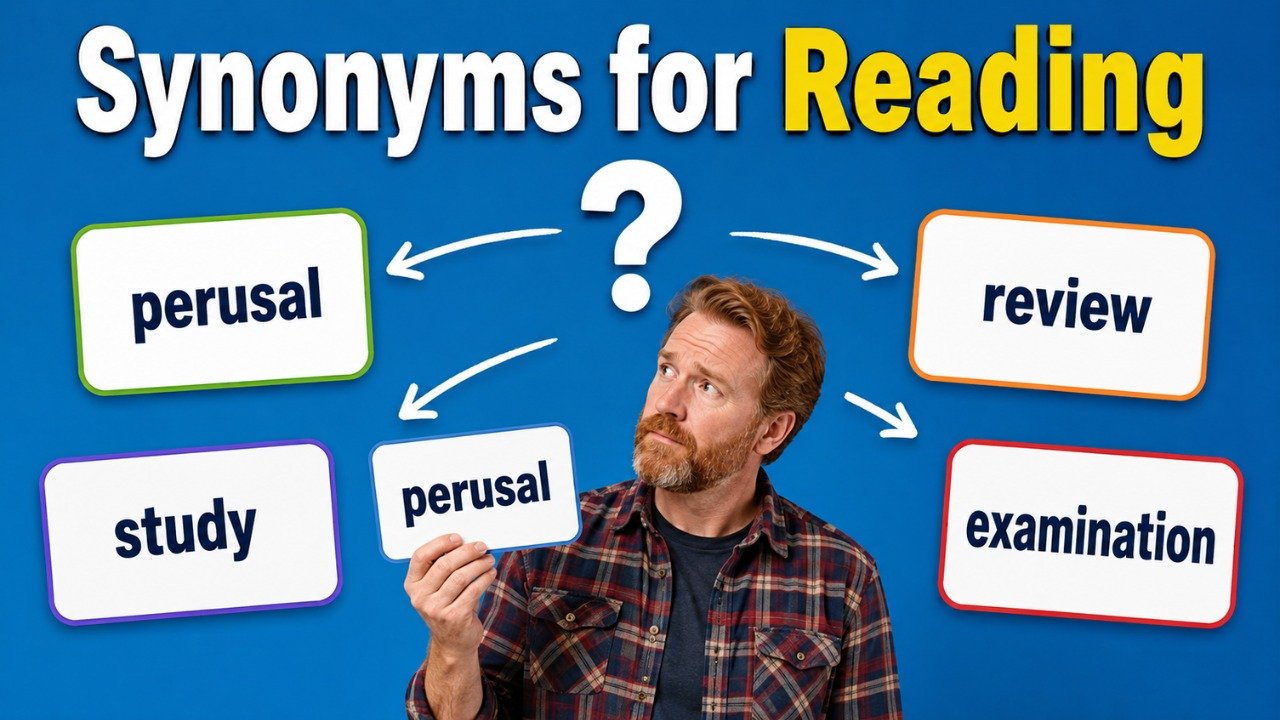
Quick Answer: Common synonyms for reading include perusal, study, review, examination, interpretation, comprehension, analysis, scanning, browsing, and recitation. The best synonyms for reading depend on what reading means in the sentence. Use perusal for careful consideration of written material, study for academic learning, review for checking information, interpretation for explaining meaning, scanning for quick searching, browsing for casual reading, comprehension for understanding, and recitation when written words are spoken aloud.
Pronunciation and Word Details
Word: Reading.
Pronunciation: /ˈriːdɪŋ/
Part of Speech: Noun and present participle of the verb read.
Meaning: The activity of looking at and understanding written words, or an interpretation, spoken presentation, or recorded measurement.
US Pronunciation:
UK Pronunciation:
What Does “Reading” Mean?
Reading means looking at written or printed words and understanding the ideas they communicate. As a noun, it commonly refers to the activity of understanding text. It can also describe a particular interpretation of something, a public presentation of written material, or a measurement shown by an instrument.
In an academic sentence, reading may mean studying books, articles, or other material. In everyday conversation, it can describe casually looking through a book or document. In analytical contexts, a reading can mean an interpretation of a situation, statement, or piece of literature.
The meaning therefore depends strongly on context.
Meaning, Tone, and Context of “Reading”
Reading is generally a neutral and widely used word. It works naturally in casual conversation, academic writing, education, professional communication, technical contexts, and literary discussion.
When it refers to studying written material, its tone is neutral or academic. When someone says they are doing some reading, the expression can sound casual and conversational.
In literature, law, criticism, and analysis, reading may mean an interpretation. For example, one person’s reading of a passage may differ from another person’s interpretation.
In technical contexts, a reading can mean the value displayed by a measuring device. In public speaking or literature, it may also refer to the oral presentation of written material.
When and How to Use “Reading”
For Studying Text: Use reading when someone is looking at written material to understand or learn from it.
Example: Her evening reading focused on modern history.
For Academic Work: Reading can describe assigned material that students are expected to study.
Example: The professor gave the class additional reading for the next lesson.
For Interpretation: Reading can mean a particular understanding of a text, statement, event, or situation.
Example: His reading of the poem emphasized its theme of loss.
For Casual Activity: Reading works naturally when talking about books, magazines, stories, or other written material.
Example: She enjoys reading before going to sleep.
For Quick Examination: Reading may refer generally to looking through a document, although scanning, skimming, or reviewing can be more precise.
Example: A quick reading of the report revealed several errors.
For Speaking Written Text: Reading can refer to presenting written words aloud.
Example: The author gave a reading of the opening chapter.
For Measurements: A reading can describe a number or value produced by an instrument.
Example: The temperature reading increased during the afternoon.
Best Synonyms for Reading
Perusal: Careful or attentive reading of written material.
Example: After a detailed perusal of the contract, she noticed an unclear condition.
Study: Careful reading undertaken to learn or understand something.
Example: His study of the chapter helped him prepare for the examination.
Review: Reading something again or examining it to check information.
Example: The report requires another review before submission.
Examination: Careful consideration of written material, evidence, or information.
Example: A close examination of the document revealed several inconsistencies.
Interpretation: An explanation or understanding of the meaning of something.
Example: Her interpretation of the final paragraph differed from mine.
Comprehension: The understanding gained from reading or listening.
Example: Regular practice can improve reading comprehension.
Analysis: Detailed examination of a text, idea, argument, or situation.
Example: His analysis of the novel focused on the main character’s decisions.
Scanning: Looking quickly through text to find particular information.
Example: Scanning the page helped her locate the date immediately.
Browsing: Looking through written material casually without studying every detail.
Example: He spent the afternoon browsing travel books.
Recitation: Speaking written or memorized material aloud.
Example: Her recitation of the passage was clear and expressive.
50 Synonyms for Reading with Short Meanings
- Perusal: Careful reading or examination of written material.
- Study: Detailed reading for learning or understanding.
- Review: Reading again to check or reconsider information.
- Examination: Careful inspection of text or information.
- Inspection: Close consideration of written details.
- Scrutiny: Very careful examination of information.
- Analysis: Detailed study of meaning, structure, or information.
- Interpretation: A particular understanding of meaning.
- Comprehension: Understanding gained from written material.
- Understanding: Knowledge of what a text communicates.
- Decoding: Converting written symbols into understandable language.
- Scanning: Quickly looking through text for specific information.
- Skimming: Reading quickly for the main ideas.
- Browsing: Casual examination of written material.
- Consultation: Looking at a written source for information.
- Reference: Using written material to obtain information.
- Research: Studying sources to discover or verify information.
- Learning: Gaining knowledge through study or reading.
- Going Through: Reading or examining material from beginning to end.
- Close Study: Careful attention to written details.
- Recitation: Speaking written or memorized words aloud.
- Narration: Spoken presentation of written or prepared material.
- Rendition: A particular presentation or interpretation of a text.
- Delivery: The manner in which written words are spoken aloud.
- Presentation: The communication of prepared material to others.
- Recital: A spoken presentation of prepared material.
- Declamation: Formal and expressive speaking of written material.
- Oral Interpretation: Spoken expression of a written text.
- Assessment: An informed judgment about meaning or conditions.
- Evaluation: Consideration used to determine meaning or quality.
- Appraisal: A careful judgment based on available information.
- Judgment: A conclusion formed from examining information.
- Impression: An understanding formed from available details.
- View: A particular way of understanding something.
- Opinion: A personal understanding or judgment.
- Take: An informal interpretation of something.
- Perception: A way of understanding information or circumstances.
- Inference: A conclusion drawn from information or evidence.
- Measurement: A numerical result obtained from an instrument.
- Indication: Information shown by a measuring device.
- Value: A number produced or displayed by measurement.
- Figure: A numerical amount obtained from measurement.
- Result: The value produced after measurement or testing.
- Display: Information shown on an instrument or device.
- Record: A documented result or measurement.
- Data Point: A single recorded measurement or value.
- Text Study: Careful examination of written material.
- Literary Study: Detailed examination of literary writing.
- Passage Study: Close examination of a particular section of text.
- Document Review: Careful reading and checking of a written document.
Read Also:
Synonyms for Features

Synonyms for Reading by Context
When Reading Means Careful Study
Perusal, study, examination, scrutiny, analysis, and review are useful when someone gives close attention to written material.
Example: A careful perusal of the instructions prevented several mistakes.
Study is especially suitable for education and learning, while scrutiny suggests unusually close attention.
When Reading Means Looking Quickly
Scanning, skimming, browsing, and going through work when the reader is not examining every word with equal attention.
Example: She began scanning the report for the figure she needed.
Scanning normally means searching for specific information. Skimming usually means looking for the main ideas. Browsing suggests relaxed or casual exploration.
When Reading Means Understanding
Comprehension, understanding, interpretation, perception, and inference focus on what someone understands from written or spoken information.
Example: His interpretation of the passage focused on the speaker’s uncertainty.
Interpretation is particularly useful when more than one understanding is possible.
When Reading Means Speaking Aloud
Recitation, narration, recital, delivery, rendition, and oral interpretation describe the spoken presentation of written material.
Example: Her recitation of the poem captured its serious tone.
When Reading Means a Measurement
Measurement, indication, value, figure, result, and data point work when reading refers to information produced by an instrument.
Example: The final temperature measurement was lower than the earlier reading.
Another Word for Reading
Perusal is one of the strongest alternatives to reading when the meaning is careful examination of written material. However, the best replacement depends on what the person is doing.
Use study for learning, review for checking information, interpretation for explaining meaning, and scanning for searching quickly.
Original: I completed a careful reading of the agreement.
Better Option: I completed a careful perusal of the agreement.
Original: Her reading of the poem was surprisingly different.
Better Option: Her interpretation of the poem was surprisingly different.
Original: I gave the report a quick reading.
Better Option: I gave the report a quick review.
Original: He was reading the document for one particular figure.
Better Option: He was scanning the document for one particular figure.
When Not to Use “Reading”
Reading is broad, so it can sometimes be less precise than another word. Avoid relying on it when the exact type of activity matters.
Weak: The researcher did a reading of the evidence.
Better: The researcher conducted an analysis of the evidence.
Analysis explains the depth of the activity more clearly.
Weak: She did a reading of the page to find his name.
Better: She scanned the page to find his name.
Scanning clearly communicates that she was searching quickly.
Weak: His reading of the instrument was 24 degrees.
Better: The instrument displayed a measurement of 24 degrees.
Measurement is clearer in technical contexts.
Weak: Her reading of the chapter lasted all evening because she was preparing for an examination.
Better: Her study of the chapter lasted all evening because she was preparing for an examination.
Study emphasizes learning more accurately.
Words Commonly Confused With Reading
Reading vs Studying: Reading means processing written words, while studying involves deliberate effort to learn, remember, or understand material in depth.
Reading vs Reviewing: Reading can happen for the first time, while reviewing often means examining information again or checking it carefully.
Reading vs Skimming: Reading is a general activity, while skimming means moving quickly through text to understand its main ideas.
Reading vs Scanning: Scanning means searching rapidly for a particular word, number, fact, or detail.
Reading vs Interpretation: Reading may refer to the physical and mental process of understanding text. Interpretation refers specifically to the meaning someone draws from it.
Reading vs Comprehension: Reading is the activity, while comprehension is the understanding achieved through that activity.
Reading vs Perusal: Perusal generally emphasizes attentive examination, while reading can be careful, casual, quick, or detailed.
Which Synonym Should You Choose?
Choose perusal when describing careful attention to a document, agreement, letter, or written statement.
Choose study when reading is connected with education, learning, preparation, or detailed understanding.
Choose review when information is being checked, reconsidered, or examined again.
Choose analysis for essays, reports, research, criticism, and detailed examination of ideas.
Choose interpretation when discussing the meaning someone gives to a poem, statement, event, or situation.
Choose comprehension when the focus is understanding rather than the act of looking at words.
Choose skimming when someone reads quickly for general meaning.
Choose scanning when someone searches written material for a particular detail.
Choose browsing for relaxed or casual reading.
Choose recitation when written or memorized words are spoken aloud.
Real Life Examples of “Reading” in Sentences
Original: She spent the morning reading the research paper carefully.
Better Option: She spent the morning studying the research paper carefully.
Original: After reading the contract, he requested a change.
Better Option: After reviewing the contract, he requested a change.
Original: Her reading of the story focuses on family relationships.
Better Option: Her interpretation of the story focuses on family relationships.
Original: I was reading the page quickly to find the address.
Better Option: I was scanning the page to find the address.
Original: He spent an hour reading articles without looking at every detail.
Better Option: He spent an hour browsing articles without looking at every detail.
Original: A careful reading of the evidence changed her opinion.
Better Option: A careful examination of the evidence changed her opinion.
Original: His reading of the speech was confident and expressive.
Better Option: His delivery of the speech was confident and expressive.
Original: The first reading from the instrument appeared unusually high.
Better Option: The first measurement from the instrument appeared unusually high.
Original: Reading the chapter again helped me remember the details.
Better Option: Reviewing the chapter helped me remember the details.
Original: Her reading of the situation was correct.
Better Option: Her assessment of the situation was correct.
Synonym Groups and Usage Differences
Study Group
Study, examination, scrutiny, analysis, and close study emphasize careful attention and learning.
Study is especially natural in educational contexts.
Example: Careful study of the chapter revealed several important themes.
Quick Reading Group
Scanning, skimming, browsing, and going through describe faster or less detailed forms of reading.
Example: Skimming the article gave him a general understanding of its argument.
Interpretation Group
Interpretation, understanding, perception, view, assessment, and take describe what someone believes information means.
Example: My interpretation of the final scene differs from yours.
Spoken Reading Group
Recitation, narration, rendition, recital, delivery, and oral interpretation involve presenting words aloud.
Example: Her narration made the story easier for the audience to follow.
Measurement Group
Measurement, indication, value, figure, result, and data point replace reading when an instrument or test provides numerical information.
Example: The final measurement remained within the expected range.
Antonyms of Reading
The opposite of reading depends on the sense being used. There is no single antonym that works in every context.
Ignoring: Giving no attention to written information.
Overlooking: Failing to notice written information or details.
Misreading: Understanding written information incorrectly.
Misinterpreting: Giving something an incorrect meaning.
Misunderstanding: Failing to understand the intended meaning.
Skipping: Passing over written material without reading it.
Disregarding: Choosing not to consider information.
Writing: Producing written language rather than receiving it through reading.
Speaking: Producing spoken language rather than interpreting written language.
Guessing: Reaching a conclusion without carefully examining the available information.
Comparison: Reading vs Related Words
Reading vs Perusal
Reading is a general term. Perusal usually implies deliberate attention to written material.
Example With Reading: I finished reading the letter this morning.
Example With Perusal: After a careful perusal of the letter, I noticed an important condition.
Reading vs Study
Reading involves understanding written words. Study involves a stronger purpose of learning or mastering information.
Example With Reading: She spent thirty minutes reading the chapter.
Example With Study: She spent the evening studying the chapter for her examination.
Reading vs Review
Reading can describe any encounter with a text. Review often involves checking or reconsidering information.
Example With Reading: I am reading the report for the first time.
Example With Review: I will review the report before submitting my comments.
Reading vs Skimming
Reading does not specify speed or depth. Skimming specifically means reading rapidly for general meaning.
Example With Reading: He is reading the entire article carefully.
Example With Skimming: He is skimming the article to identify its main argument.
Reading vs Scanning
Scanning is more targeted than general reading because the reader searches for a particular detail.
Example With Reading: She was reading the entire schedule.
Example With Scanning: She was scanning the schedule for the departure time.
Reading vs Interpretation
Reading describes an activity, while interpretation describes an understanding produced from information.
Example With Reading: Her reading of the essay took twenty minutes.
Example With Interpretation: Her interpretation of the essay emphasized its political message.
Common Phrases and Expressions With Reading
Reading Material: Written content intended to be read.
Reading Comprehension: The ability to understand written information.
Reading Habit: A regular pattern of reading.
Reading Level: The level of difficulty at which a person can understand written material.
Reading Ability: A person’s skill in processing and understanding written words.
Reading Assignment: Material that someone is expected to read for study.
Reading Session: A period of time devoted to reading.
Reading List: A collection of books, articles, or texts recommended for reading.
Close Reading: Detailed examination of a text’s language, structure, and meaning.
First Reading: The first occasion on which someone reads or interprets a text.
Common Mistakes to Avoid
One common mistake is assuming that every synonym for reading can replace it in every sentence. Reading has several meanings, so the correct alternative depends on context.
Avoid using perusal for casual browsing when the sentence does not suggest careful attention. Do not use scanning when someone reads every sentence closely, because scanning usually involves searching for a particular detail.
Another mistake is confusing reading with comprehension. A person can technically read words without fully understanding them. Comprehension describes successful understanding.
Writers should also avoid repeating reading many times in the same paragraph. Use study, review, analysis, interpretation, scanning, or browsing when those words describe the activity more precisely.
In technical contexts, remember that reading can mean a measurement. In such sentences, value, measurement, figure, or indication may be clearer.
Conclusion
The best synonyms for reading depend on whether the word describes studying, checking, interpreting, searching, speaking aloud, or measuring. Perusal works well for careful examination, study for learning, review for checking information, analysis for detailed investigation, and interpretation for meaning. Skimming and scanning describe faster forms of reading, while recitation fits spoken presentation. Choosing a synonym that reflects the exact purpose of the activity makes sentences clearer, more natural, and more informative.
FAQs About Synonyms for Reading
What is the best synonym for reading?
Perusal is a strong synonym when reading means careful examination. Study, review, interpretation, and scanning may be better in other contexts.
What is another word for reading a book?
Study can work for educational reading, while perusal suits careful reading and browsing suits casual exploration.
What is a formal synonym for reading?
Perusal, examination, analysis, and review are useful formal alternatives, depending on the context.
What is a synonym for careful reading?
Perusal, scrutiny, close study, examination, and analysis can all describe careful reading.
What is a synonym for quick reading?
Skimming is best for quickly understanding main ideas. Scanning is better when searching for a particular fact or detail.
Is interpretation a synonym for reading?
Yes. Reading can mean interpretation when it describes someone’s understanding of a text, statement, event, or situation.
Can measurement be a synonym for reading?
Yes. When reading refers to a numerical value shown by an instrument, measurement, value, figure, or indication may be suitable alternatives.
