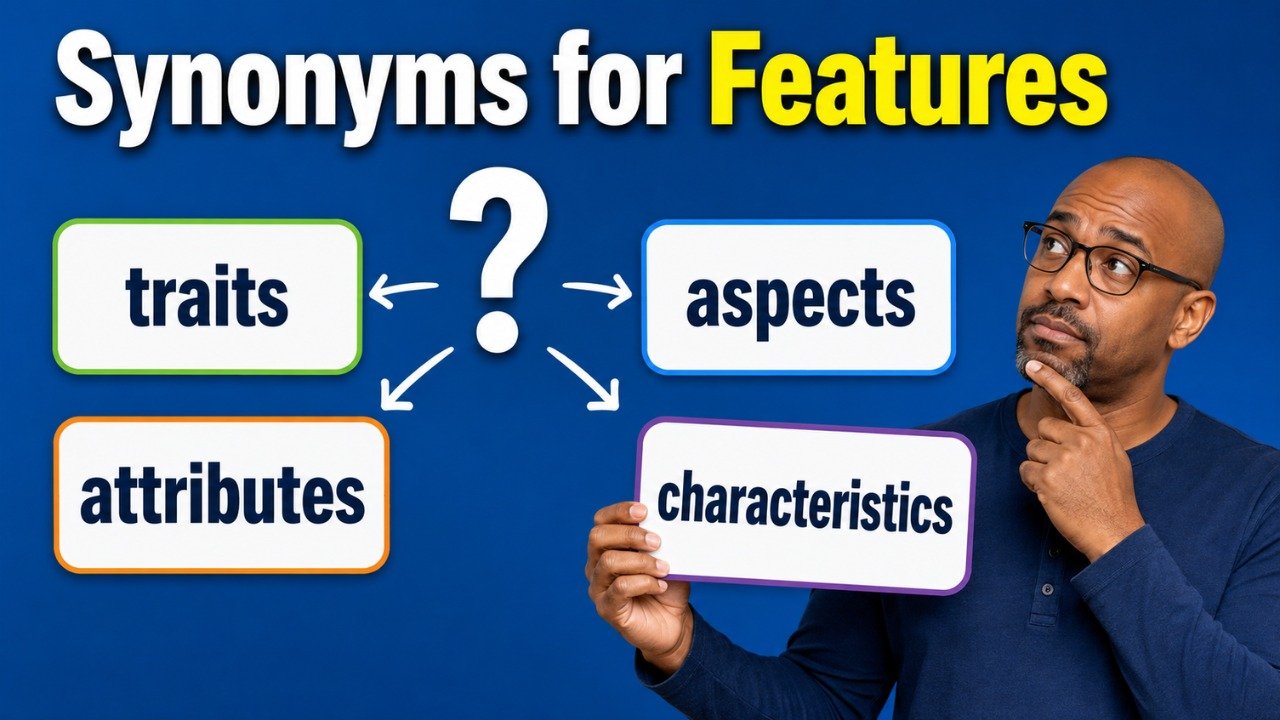
Quick Answer: Common synonyms for features include characteristics, attributes, traits, qualities, aspects, elements, components, functions, capabilities, and highlights. The best choice depends on context. Use characteristics or attributes in formal and academic writing, traits for people or living things, qualities for positive or descriptive properties, aspects for parts of a subject, functions for what something does, capabilities for what it can do, and highlights for especially notable features.
Pronunciation and Word Details
Word: Features.
Pronunciation: /ˈfiːtʃərz/
Part of Speech: Plural noun and third person singular verb.
Meaning: Distinctive qualities, parts, functions, or characteristics of something, or the act of including or presenting something prominently.
US Pronunciation:
UK Pronunciation:
What Does “Features” Mean?
Features means noticeable characteristics, qualities, parts, or functions that help describe or distinguish a person, object, product, place, system, or idea.
As a plural noun, features commonly refers to characteristics or important parts.
Example: The building has several unusual architectural features.
In this sentence, features means distinctive characteristics or elements of the building.
Features can also refer to a person’s physical appearance.
Example: Her facial features were clearly visible in the portrait.
In technology and product descriptions, features often means functions or capabilities.
Example: The device includes several useful security features.
Features can also function as a verb. In that use, it means includes, presents, highlights, or gives special attention to something.
Example: The exhibition features work from local artists.
Because features has several meanings, the most accurate synonym depends on whether you are describing characteristics, physical appearance, functions, components, or something being presented prominently.
Meaning, Tone, and Context of “Features”
Features is a neutral and highly versatile word. It works naturally in formal, academic, professional, technical, descriptive, and conversational writing.
Formal Context: Features can describe important characteristics, properties, or elements of a subject.
Academic Context: Researchers may discuss the features of a theory, language, environment, organism, or social system.
Technical Context: Features commonly refers to functions, capabilities, tools, or specifications within equipment, software, or systems.
Descriptive Context: The word can identify visual, physical, structural, or stylistic characteristics.
Conversational Context: People often use features when talking about useful functions or interesting parts of something.
Physical Appearance Context: Features can refer to parts of the face, such as the eyes, nose, mouth, or overall facial structure.
Promotional Context: When used as a verb, features can mean presents, showcases, includes, or highlights something important.
The tone of features is usually neutral. However, another synonym may sound more precise when the sentence concerns personality, appearance, technical abilities, or individual parts.
When and How to Use “Features”
For Characteristics: Use features to describe noticeable or distinguishing qualities.
Example: The house combines traditional features with modern design.
For Physical Appearance: Use features when referring to parts or characteristics of a person’s face.
Example: The child inherited several facial features from his mother.
For Product Functions: Use features to describe what a product, tool, or system can do.
Example: The camera includes several useful editing features.
For Technical Capabilities: Use features when discussing functions built into a system or application.
Example: The program offers several features that simplify data organization.
For Design Elements: Use features for noticeable parts of a building, room, object, or visual composition.
Example: Large windows are among the room’s most attractive features.
For Important Aspects: Use features when discussing significant parts of a topic or concept.
Example: The report examines the main features of the proposed system.
For Inclusion: As a verb, use features when something prominently includes a person, object, idea, or element.
Example: The book features several detailed illustrations.
For Emphasis: Features can mean highlights or gives special attention to something.
Example: The exhibition features regional artwork from different periods.
Best Synonyms for Features
Characteristics: Distinctive qualities that identify or describe something.
Example: The researcher studied the main characteristics of the material.
Attributes: Qualities or properties belonging to a person or thing.
Example: Reliability and patience are valuable attributes.
Traits: Distinguishing qualities, especially of a person, animal, or living thing.
Example: Curiosity is one of her strongest traits.
Qualities: Particular characteristics or properties of something.
Example: Strength and flexibility are important qualities of the material.
Aspects: Particular parts or sides of a subject or situation.
Example: The discussion covered several aspects of the problem.
Elements: Individual parts that contribute to a complete whole.
Example: The design combines traditional and modern elements.
Components: Parts that form a larger system or object.
Example: Engineers inspected the main components of the machine.
Functions: Purposes or actions that something is designed to perform.
Example: The device provides several useful functions.
Capabilities: Abilities or functions that a person, system, or object can perform.
Example: The new equipment has advanced imaging capabilities.
Highlights: The most noticeable, interesting, or important parts.
Example: The garden is one of the highlights of the property.
50 Synonyms for Features with Short Meanings
- Characteristics: Distinctive qualities that describe something.
- Attributes: Qualities or properties belonging to something.
- Traits: Recognizable qualities of a person or thing.
- Qualities: Particular properties or characteristics.
- Aspects: Individual sides or parts of a subject.
- Elements: Parts that contribute to a complete whole.
- Components: Individual parts of a larger system.
- Functions: Purposes or tasks something performs.
- Capabilities: Abilities or functions something possesses.
- Highlights: Especially noticeable or important parts.
- Properties: Qualities naturally belonging to something.
- Facets: Different aspects or sides of something.
- Details: Small or specific parts of a larger whole.
- Parts: Individual pieces of something larger.
- Characteristics: Distinguishing properties or qualities.
- Specifications: Defined technical details or requirements.
- Abilities: Things a person or system is capable of doing.
- Functions: Activities or purposes something performs.
- Advantages: Beneficial characteristics or qualities.
- Benefits: Useful or favorable qualities.
- Strengths: Particularly effective or positive qualities.
- Distinctives: Qualities that make something different or recognizable.
- Hallmarks: Characteristics strongly associated with something.
- Marks: Distinguishing signs or characteristics.
- Signs: Noticeable indications or characteristics.
- Indicators: Features that reveal a particular condition or quality.
- Properties: Particular characteristics of an object or material.
- Dimensions: Aspects or measurable sides of a subject.
- Sections: Individual divisions of a larger whole.
- Constituents: Parts that combine to form something.
- Ingredients: Elements that contribute to a complete result.
- Factors: Elements that influence a situation or result.
- Considerations: Important aspects that deserve attention.
- Details: Specific pieces of information or design.
- Amenities: Useful or desirable facilities and conveniences.
- Facilities: Services or physical resources provided for use.
- Tools: Functions or resources designed for a particular purpose.
- Options: Choices or available functions.
- Settings: Adjustable functions or configurations.
- Utilities: Useful functions designed for practical tasks.
- Resources: Available functions, materials, or forms of support.
- Offerings: Things provided or made available.
- Attractions: Particularly appealing or noticeable characteristics.
- Highlights: Especially interesting or impressive parts.
- Showcases: Presents prominently for attention.
- Includes: Contains as part of a whole.
- Presents: Introduces or displays something.
- Displays: Shows something visibly or prominently.
- Highlights: Gives particular attention to something.
- Spotlights: Draws special attention to something.
Read Also:
Synonyms for Emerging
Synonyms for Features by Context
When Features Means Characteristics
When features describes qualities that make something recognizable or distinctive, use characteristics, attributes, qualities, traits, properties, or hallmarks.
Example With Features: The region has several unique geographical features.
Example With Characteristics: The region has several unique geographical characteristics.
Characteristics is one of the strongest alternatives when describing general identifying qualities.
When Features Means Parts or Elements
When features refers to individual parts of a larger whole, suitable synonyms include elements, components, parts, facets, details, and constituents.
Example With Features: The building contains several decorative features.
Example With Elements: The building contains several decorative elements.
Elements works especially well in design, art, architecture, and composition.
When Features Means Functions
In technology, products, tools, and systems, features often means functions, capabilities, tools, options, utilities, or settings.
Example With Features: The system provides several useful features.
Example With Functions: The system provides several useful functions.
Functions is best when emphasizing what something actually does.
When Features Means Physical Characteristics
For appearance, especially facial appearance, features may be replaced by characteristics, traits, contours, details, or physical characteristics depending on the sentence.
Example With Features: His facial features became more distinct in the photograph.
Example With Characteristics: His facial characteristics became more distinct in the photograph.
Features remains one of the most natural words when specifically describing the face.
When Features Means Important Parts
When referring to particularly noticeable or valuable parts, use highlights, attractions, strengths, advantages, or benefits.
Example With Features: The outdoor terrace is one of the property’s best features.
Example With Highlights: The outdoor terrace is one of the property’s main highlights.
Highlights emphasizes what is especially noteworthy.
When Features Is Used as a Verb
When features means contains or gives prominent attention to something, use includes, presents, showcases, displays, highlights, or spotlights.
Example With Features: The collection features several colorful illustrations.
Example With Includes: The collection includes several colorful illustrations.
Includes is neutral, while showcases suggests that the item receives special attention.
Another Word for Features
Characteristics is one of the best general replacements for features when the word refers to distinguishing qualities. However, the best synonym depends on the sentence. Functions works better for technology, elements for design, traits for personality, and includes or showcases when features is used as a verb.
Original: The house has several traditional features.
Better Option: The house has several traditional characteristics.
Original: The program offers useful features for organizing files.
Better Option: The program offers useful functions for organizing files.
Original: The room contains several decorative features.
Better Option: The room contains several decorative elements.
Original: The exhibition features paintings from several periods.
Better Option: The exhibition showcases paintings from several periods.
When Not to Use “Features”
Features can become vague when a more specific word would explain exactly what you mean.
Avoid features when you are specifically describing personality.
Weak: Patience and honesty are her best features.
Better: Patience and honesty are her best qualities.
Avoid features when discussing technical actions performed by a system.
Weak: The program has several features for calculating results.
Better: The program has several functions for calculating results.
Avoid features when describing separate mechanical parts.
Weak: The machine contains several metal features.
Better: The machine contains several metal components.
Avoid repeating features throughout a product or technical description.
Weak: The system has useful features, security features, and communication features.
Better: The system provides useful functions, security tools, and communication capabilities.
Features is also less precise when you simply mean that something contains another item.
Weak: The book features a glossary at the end.
Better: The book includes a glossary at the end.
Choose a more exact synonym when the distinction between a characteristic, function, element, ability, or included item matters.
Words Commonly Confused With Features
Features vs Characteristics: Features often refers to noticeable or important qualities, while characteristics more broadly describes properties that identify or describe something.
Features vs Attributes: Attributes are qualities associated with someone or something. Features often emphasizes qualities that are particularly noticeable or functional.
Features vs Traits: Traits usually describe personal, biological, behavioral, or inherited characteristics. Features has a broader range of uses.
Features vs Functions: Functions describe what something does, while features can describe both what something does and what it contains.
Features vs Components: Components are actual parts of a system or object. Features may be functions, qualities, or design elements rather than separate physical parts.
Features vs Benefits: Features describe what something has or does. Benefits describe the advantages gained from those features.
Features vs Aspects: Aspects are different sides or parts of a subject. Features are usually more identifiable or distinctive qualities.
Features vs Properties: Properties are qualities inherent in a substance, object, or concept. Features may include visible characteristics, functions, or design details.
Which Synonym Should You Choose?
Choose characteristics when discussing broad identifying qualities in reports, essays, descriptions, or academic writing.
Choose attributes when referring to qualities that belong to a person, object, concept, or system.
Choose traits when discussing personality, behavior, biology, or inherited characteristics.
Choose qualities when emphasizing positive, negative, or descriptive properties.
Choose aspects when discussing different sides of a topic, problem, situation, or argument.
Choose elements when describing design, composition, structure, writing, art, or architecture.
Choose components when referring to separate parts of machines, systems, devices, or structures.
Choose functions when discussing what a tool, product, program, or system actually does.
Choose capabilities when emphasizing what someone or something is able to accomplish.
Choose specifications for measurable or technical details.
Choose highlights when discussing the most impressive or noticeable parts.
Choose includes in straightforward writing when features is being used as a verb to mean contains.
Choose showcases when something is intentionally presented prominently.
Choose highlights when a sentence emphasizes special attention or importance.
Real Life Examples of “Features” in Sentences
Original: The apartment has several attractive features.
Better Option: The apartment has several attractive qualities.
Original: The device includes several advanced features.
Better Option: The device includes several advanced capabilities.
Original: The report describes the main features of the economic system.
Better Option: The report describes the main characteristics of the economic system.
Original: The room combines modern and traditional features.
Better Option: The room combines modern and traditional elements.
Original: These features make the tool easier to use.
Better Option: These functions make the tool easier to use.
Original: Kindness and patience are admirable features of her personality.
Better Option: Kindness and patience are admirable traits of her personality.
Original: The machine has several safety features.
Better Option: The machine has several safety functions.
Original: The article features several practical examples.
Better Option: The article includes several practical examples.
Original: The exhibition features work from several different periods.
Better Option: The exhibition showcases work from several different periods.
Original: One of the garden’s best features is its shaded seating area.
Better Option: One of the garden’s main highlights is its shaded seating area.
Synonym Groups and Usage Differences
Characteristics Group
Characteristics, attributes, traits, qualities, properties, and hallmarks describe qualities that identify or distinguish something.
Characteristics is broad and neutral. Attributes often sounds more formal. Traits is especially useful for people and living things.
Example: Flexibility is an important characteristic of the material.
Parts and Structure Group
Elements, components, parts, constituents, facets, and sections refer to pieces or divisions of a larger whole.
Components usually suggests physical or functional parts. Elements is broader and works well for design and composition.
Example: The system consists of several interconnected components.
Functions and Ability Group
Functions, capabilities, abilities, tools, utilities, options, and settings describe what something can do.
Functions emphasizes purpose. Capabilities emphasizes potential or ability. Tools refers to specific resources used to perform tasks.
Example: The equipment has several advanced capabilities.
Notable Qualities Group
Highlights, strengths, attractions, advantages, and benefits focus on features that are especially useful, positive, or noticeable.
Highlights identifies the most interesting parts. Benefits focuses on the value gained from them.
Example: Energy efficiency is one of the design’s major benefits.
Inclusion and Presentation Group
Includes, presents, displays, showcases, highlights, and spotlights work when features is a verb.
Includes simply means contains. Showcases and spotlights imply stronger emphasis.
Example: The guide showcases several practical techniques.
Antonyms of Features
The opposite of features depends on how the word is being used. When features means distinguishing qualities, antonyms may describe absence, sameness, or lack of distinction. When it means includes or highlights, the opposite may involve excluding or hiding something.
Absence: The state of not having a particular quality or element.
Lack: The condition of being without something needed or expected.
Deficiency: An insufficient amount of an important quality or feature.
Shortcoming: A weakness or missing desirable quality.
Uniformity: Lack of noticeable variation or distinction.
Sameness: Absence of distinguishing differences.
Omission: Something intentionally or accidentally left out.
Exclusion: The act of leaving something out.
Concealment: The act of preventing something from being seen.
Suppression: The act of preventing something from being presented or expressed.
Hiding: Keeping something from attention or view.
Removing: Taking a component, quality, or element away.
Comparison: Features vs Related Words
Features vs Characteristics
Features often refers to noticeable, important, or useful qualities. Characteristics more generally describes properties that help identify something.
Example With Features: The building has several unusual features.
Example With Characteristics: The building has several unusual architectural characteristics.
Features vs Attributes
Attributes are qualities belonging to someone or something. Features may include qualities, functions, or physical elements.
Example With Features: The system has several security features.
Example With Attributes: Reliability is one of the system’s strongest attributes.
Features vs Traits
Traits commonly describes personal, behavioral, biological, or inherited qualities.
Example With Features: His facial features resemble those of his father.
Example With Traits: He inherited several personality traits from his father.
Features vs Functions
Functions describes what something is designed to do. Features can include functions as well as qualities, tools, options, and design elements.
Example With Features: The application provides several editing features.
Example With Functions: The application provides several editing functions.
Features vs Components
Components are individual parts that make up a larger system.
Example With Features: The machine includes several safety features.
Example With Components: The machine contains several replaceable components.
Features vs Benefits
Features describe qualities or functions. Benefits explain why those qualities or functions are useful.
Example With Features: Automatic saving is a useful feature.
Example With Benefits: Automatic saving provides the benefit of reducing accidental data loss.
Features vs Aspects
Aspects are different sides or parts of a subject, while features are usually identifiable characteristics.
Example With Features: The report explains the system’s main features.
Example With Aspects: The report examines several aspects of system performance.
Common Phrases and Expressions With Features
Main Features: The most important or noticeable characteristics.
Key Features: Essential or especially significant characteristics or functions.
Special Features: Unusual or additional qualities or functions.
Distinctive Features: Characteristics that make something recognizable or different.
Facial Features: Physical characteristics of a person’s face.
Design Features: Elements incorporated into the appearance or structure of something.
Safety Features: Functions or elements intended to improve protection.
Advanced Features: More sophisticated functions or capabilities.
Unique Features: Characteristics that distinguish something from others.
Notable Features: Qualities or elements that deserve particular attention.
Common Mistakes to Avoid
One common mistake is using features when a more precise noun would make the sentence clearer.
Vague: The system has many useful features.
Clearer: The system provides useful search functions, security tools, and customization options.
Another mistake is using features as an exact substitute for benefits. Features tell readers what something has or does, while benefits explain why those qualities are useful.
Unclear: One feature is easier organization.
Better: One benefit is easier organization.
Writers also sometimes confuse features with components.
Less Precise: The engine has many mechanical features.
More Precise: The engine contains many mechanical components.
Avoid using traits for technical functions merely because it is listed as a synonym for features.
Unnatural: The device has several useful traits.
Natural: The device has several useful functions.
Repetition is another common problem.
Repetitive: The product has security features, sharing features, and editing features.
Improved: The product provides security tools, sharing options, and editing functions.
Remember that features can also be a verb. In that context, noun synonyms such as characteristics or attributes will not work.
Incorrect: The article characteristics several case studies.
Correct: The article includes several case studies.
The best synonym depends on grammar as well as meaning.
Conclusion
Synonyms for features include characteristics, attributes, traits, qualities, aspects, elements, components, functions, capabilities, and highlights. Characteristics and attributes work well for general descriptions, traits suit personality and biology, elements and components describe parts, while functions and capabilities fit technical contexts. When features is a verb, includes, presents, showcases, and highlights are stronger choices. Selecting the right alternative helps readers understand whether you mean a quality, physical part, function, benefit, design element, or something being presented prominently.
FAQs About Synonyms for Features
What Is the Best Synonym for Features?
Characteristics is one of the best general synonyms for features. However, functions is better for technical abilities, traits for personality, and elements for parts of a design.
What Is Another Word for Features in a Product?
Functions, capabilities, options, tools, specifications, and attributes can replace features in product descriptions depending on what you are describing.
What Is Another Word for Key Features?
Main characteristics, important attributes, essential elements, major functions, and notable qualities are useful alternatives to key features.
Are Characteristics and Features the Same?
They are closely related, but not always identical. Characteristics describes qualities that identify something, while features can also refer to functions, physical parts, or design elements.
Can Traits Be Used Instead of Features?
Yes, especially when describing personality, behavior, biology, or inherited qualities. Traits is usually less natural for technology or mechanical systems.
What Is a Synonym for Features When Used as a Verb?
Includes, presents, showcases, displays, highlights, and spotlights are useful alternatives when features means to contain or present something prominently.
What Is the Difference Between Features and Benefits?
Features describe what something has or does. Benefits describe the useful results or advantages those features provide.
