
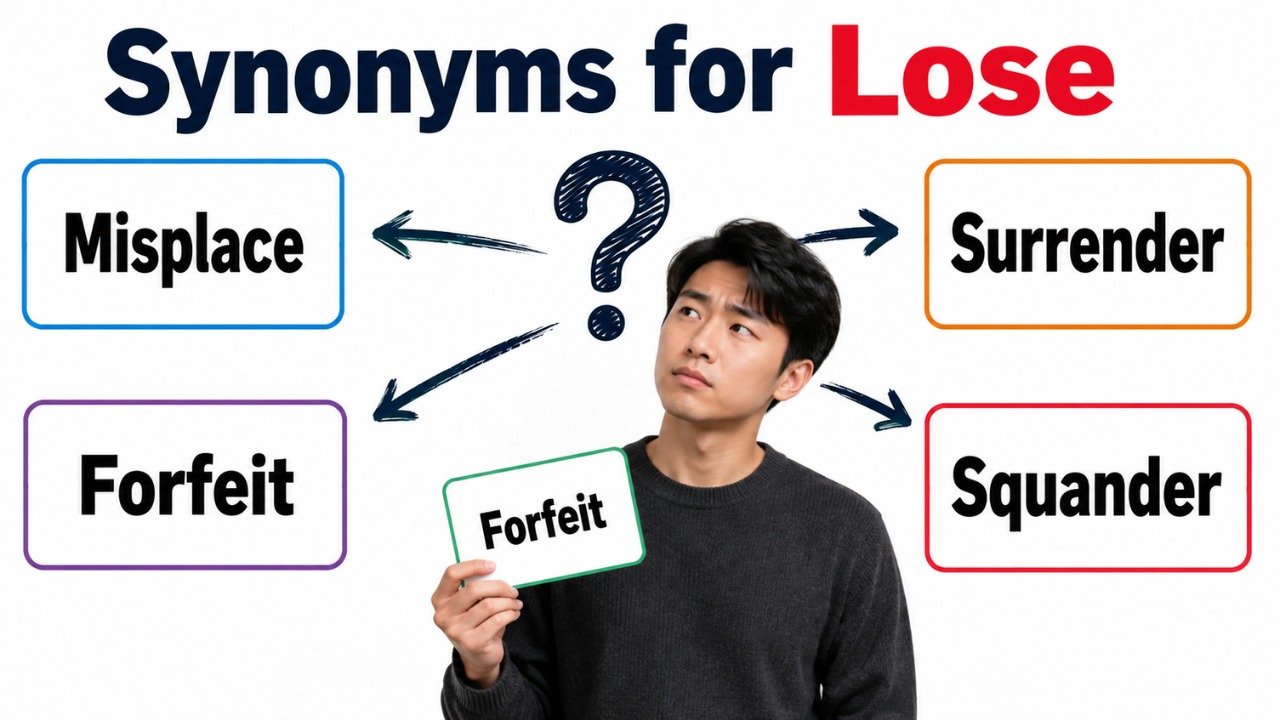
Quick Answer: The best synonyms for lose include misplace, forfeit, surrender, relinquish, drop, shed, waste, miss, fail, and sacrifice. Use misplace when you cannot find an object, forfeit when something is lost because of a rule or action, surrender when giving something up, shed for weight or hair, waste for using time or resources badly, miss for failing to catch or reach something, and fail when you do not succeed.
Pronunciation and Word Details
Word: Lose
Pronunciation: /luːz/
Part of Speech: Verb
Meaning: To stop having something, fail to keep or find it, be defeated, or experience a reduction in amount, value, or condition.
US Pronunciation:
UK Pronunciation:
What Does “Lose” Mean?
Lose means to stop having, keeping, finding, winning, or maintaining something.
It is a verb with several common meanings. A person can lose a key, lose a competition, lose money, lose patience, lose weight, lose an opportunity, or lose contact with someone.
When lose refers to an object, it often means that the person no longer knows where the object is.
When it refers to a competition, it means to be defeated.
When it refers to money, time, energy, weight, or another quantity, it means to experience a reduction or no longer possess the same amount.
Lose can also describe missed opportunities, weakened control, damaged relationships, or the disappearance of a quality.
Because the word has many meanings, the best synonym depends heavily on context.
Meaning, Tone, and Context of “Lose”
Lose has a neutral and very common tone. It appears naturally in casual conversation, formal writing, business communication, academic discussion, sports descriptions, personal situations, and instructions.
In everyday speech, lose is often the simplest and most natural choice.
In formal writing, more precise alternatives may improve clarity. Forfeit can describe losing a right or advantage, relinquish can describe giving up control, decline can describe losing value, and be defeated can describe losing a contest.
Lose can also carry emotional meaning. Losing a friend, losing trust, losing confidence, or losing hope can sound more serious than losing an ordinary object.
The word may describe something accidental, voluntary, unavoidable, or caused by failure. This difference helps determine which synonym fits best.
When and How to Use “Lose”
For Misplacing Objects: Use lose when an object can no longer be found.
Example: I do not want to lose my keys again.
For Defeat: Use lose when someone does not win a game, competition, argument, or contest.
Example: The team could lose the final if it makes too many mistakes.
For Money: Use lose when money decreases or disappears through spending, investment, damage, or error.
Example: He could lose money if the plan fails.
For Weight: Use lose when body weight decreases.
Example: She wants to lose a small amount of weight gradually.
For Opportunities: Use lose when a chance is missed or no longer available.
Example: We may lose the opportunity if we delay our decision.
For Control: Use lose when someone is no longer able to maintain control, patience, focus, or confidence.
Example: He began to lose patience during the long discussion.
For Possessions or Rights: Use lose when something is taken away or no longer belongs to someone.
Example: A person may lose access after violating the rules.
For Time: Lose can describe wasting or failing to use time effectively.
Example: We cannot afford to lose another hour.
Best Synonyms for Lose
Misplace: To put something somewhere and then be unable to find it.
Example: She misplaced her glasses before leaving the house.
Forfeit: To lose a right, privilege, advantage, or possession because of a rule or action.
Example: The player forfeited the prize after breaking the rules.
Surrender: To give up possession, control, or resistance.
Example: They surrendered control of the property.
Relinquish: To formally or voluntarily give up something.
Example: He relinquished his position at the end of the term.
Drop: To decrease in amount, level, value, or position.
Example: Sales dropped during the final month.
Shed: To lose weight, hair, skin, or another physical covering.
Example: The animal sheds its winter coat in spring.
Waste: To lose time, money, energy, or resources through poor use.
Example: Do not waste valuable time on unnecessary tasks.
Miss: To fail to catch, reach, attend, notice, or take advantage of something.
Example: She missed the opportunity to speak with him.
Fail: To be unsuccessful in achieving a desired result.
Example: The team failed to reach the final round.
Sacrifice: To give up something valuable for another purpose.
Example: He sacrificed free time to complete the project.
50 Synonyms for Lose with Short Meanings
- Misplace: Put something somewhere and be unable to find it.
- Mislay: Temporarily lose an object by forgetting where it was placed.
- Forfeit: Lose something because of a rule, mistake, or action.
- Surrender: Give up possession, control, or resistance.
- Relinquish: Voluntarily or formally give something up.
- Sacrifice: Give up something valuable for another purpose.
- Abandon: Leave something behind or stop trying to keep it.
- Give Up: Stop keeping, pursuing, or controlling something.
- Let Go Of: Release possession, control, or attachment.
- Part With: Give up or stop possessing something.
- Yield: Give up control, position, or advantage.
- Concede: Accept defeat or give up a claim.
- Succumb: Fail to resist pressure, difficulty, or an opponent.
- Fall: Be defeated or fail in a struggle.
- Be Defeated: Fail to win a contest or competition.
- Fail: Be unsuccessful in achieving a goal.
- Miss: Fail to catch, reach, attend, or obtain something.
- Waste: Use time, money, or resources badly.
- Squander: Waste something valuable through careless use.
- Drop: Decrease in amount, value, weight, or level.
- Shed: Lose weight, hair, skin, or another physical covering.
- Decrease: Become smaller in amount or quantity.
- Decline: Become lower in value, strength, number, or quality.
- Diminish: Become smaller, weaker, or less important.
- Reduce: Make an amount, quantity, or level smaller.
- Decrease By: Experience a measurable reduction.
- Fall By: Drop by a particular amount.
- Slip: Lose position, strength, quality, or advantage gradually.
- Dwindle: Become gradually smaller or fewer.
- Erode: Gradually lose strength, value, trust, or influence.
- Dissipate: Gradually disappear or lose strength.
- Use Up: Consume something until little or none remains.
- Deplete: Reduce a supply or resource significantly.
- Exhaust: Use something until it is completely or nearly gone.
- Spend: Use money, time, or energy.
- Be Deprived Of: Have something taken away or denied.
- Be Dispossessed Of: Be deprived of property or possession.
- Be Robbed Of: Lose something because it is taken unfairly.
- Be Stripped Of: Have a right, title, power, or possession removed.
- Leave Behind: Fail to take something when departing.
- Forget: Fail to remember or take something.
- Let Slip: Fail to keep or take advantage of something.
- Pass Up: Choose not to take an opportunity.
- Forego: Decide to do without something.
- Miss Out On: Fail to experience or obtain an opportunity.
- Release: Let go of possession, control, or responsibility.
- Cede: Formally give up territory, rights, or control.
- Discard: Get rid of something no longer wanted.
- Dispose Of: Remove or get rid of something.
- Forsake: Give up or leave something once valued.
Read Also:
Synonyms for Infinite

Synonyms for Lose by Context
When Lose Means Misplace
When lose refers to an object that cannot be found, misplace and mislay are the most precise alternatives.
Useful choices include misplace, mislay, forget, and leave behind.
Example: I think I lost my wallet.
Alternative: I think I misplaced my wallet.
Misplace is especially useful when the object probably still exists but its location is unknown.
When Lose Means Be Defeated
When lose refers to a game, competition, argument, or struggle, alternatives include be defeated, fall, fail, concede, succumb, and yield.
Example: The team lost the championship match.
Alternative: The team was defeated in the championship match.
Be defeated is more formal and direct than lose.
When Lose Means Give Something Up
When someone stops having control, possession, or a right, surrender, relinquish, cede, forfeit, and give up may be suitable.
Example: He lost control of the organization.
Alternative: He relinquished control of the organization.
Relinquish works especially well when the action is deliberate or formal.
When Lose Means Waste
When lose refers to time, money, resources, or opportunities used badly, waste and squander are strong alternatives.
Example: We lost several hours because of poor planning.
Alternative: We wasted several hours because of poor planning.
Squander is stronger and usually suggests carelessness.
When Lose Means Miss an Opportunity
When the meaning involves failing to obtain or use a chance, miss, pass up, let slip, and miss out on can work well.
Example: Do not lose this opportunity.
Alternative: Do not miss this opportunity.
Miss is one of the most natural alternatives in this context.
When Lose Means Decrease
When lose refers to value, strength, weight, quantity, or influence, alternatives include drop, decrease, decline, diminish, slip, and dwindle.
Example: The product may lose value over time.
Alternative: The product may decline in value over time.
When Lose Means Shed
When referring to body weight, hair, leaves, skin, or another physical covering, shed is often more precise.
Example: He wants to lose weight before the competition.
Alternative: He wants to shed some weight before the competition.
When Lose Means Be Deprived Of
When someone no longer has something because it was removed, taken, or denied, useful expressions include be deprived of, be stripped of, be dispossessed of, and be robbed of.
Example: He lost his right to participate.
Alternative: He was stripped of his right to participate.
Another Word for Lose
The best general replacement for lose depends on what is being lost.
Use misplace for an object, forfeit for a right or advantage, be defeated for a competition, waste for time or resources, miss for an opportunity, and decline for value or strength.
Original: I always lose my keys.
Better Option: I always misplace my keys.
Original: The team may lose the final.
Better Option: The team may be defeated in the final.
Original: Do not lose this opportunity.
Better Option: Do not miss this opportunity.
Original: The investment could lose value.
Better Option: The investment could decline in value.
When Not to Use “Lose”
Lose is broad, so it can sound vague when a more precise verb is available.
Weak: She lost her glasses somewhere in the house.
Better: She misplaced her glasses somewhere in the house.
Use forfeit when a person loses something because of a rule, penalty, or failure to meet a requirement.
Weak: He lost his eligibility after breaking the rules.
Better: He forfeited his eligibility after breaking the rules.
Avoid lose when the intended meaning is simply a decrease in a measurable value.
Weak: The shares lost value during the week.
Better: The shares declined in value during the week.
Use waste when the sentence clearly concerns inefficient use of time or resources.
Weak: We lost two hours because we failed to plan properly.
Better: We wasted two hours because we failed to plan properly.
Avoid repeating lose several times in one paragraph when different meanings are involved.
Weak: They lost money, lost time, lost confidence, and lost the match.
Better: They wasted money, lost valuable time, lost confidence, and were defeated in the match.
Words Commonly Confused With Lose
Lose vs Loose: Lose is a verb meaning to stop having something or fail to win. Loose is usually an adjective meaning not tight or firmly fixed.
Lose vs Miss: Lose often means no longer having something, while miss means failing to catch, reach, attend, notice, or take advantage of something.
Lose vs Forfeit: Lose is general. Forfeit specifically suggests that something is lost because of a rule, penalty, or action.
Lose vs Surrender: Lose can happen accidentally or unwillingly. Surrender usually means deliberately giving up control, possession, or resistance.
Lose vs Waste: Lose can describe many kinds of loss. Waste specifically means using time, money, energy, or resources badly.
Lose vs Misplace: Lose may suggest something is gone permanently or its location is unknown. Misplace usually suggests the object has simply been put somewhere and can probably be found.
Lose vs Shed: Shed is a more specific alternative for losing weight, hair, leaves, skin, or another physical covering.
Lose vs Decline: Lose can describe a reduction, while decline emphasizes a gradual or measurable fall in value, strength, number, or quality.
Which Synonym Should You Choose?
Choose misplace when an object cannot be found but is probably still nearby.
Choose mislay when something has been temporarily put in the wrong place.
Choose forfeit when someone loses a right, reward, advantage, or privilege because of a rule or action.
Choose surrender when someone deliberately gives up possession or control.
Choose relinquish in formal writing when someone voluntarily gives up authority, control, ownership, or a position.
Choose be defeated when describing a clear loss in a competition, contest, or battle.
Choose miss when someone fails to catch, attend, reach, notice, or benefit from something.
Choose waste when describing badly used time, money, energy, or resources.
Choose squander when the waste is especially careless or irresponsible.
Choose decline when describing a reduction in value, quality, strength, or performance.
Choose shed when discussing weight, hair, leaves, or another physical covering.
Choose sacrifice when someone willingly gives up something valuable for another goal.
Real Life Examples of “Lose” in Sentences
Original: I do not want to lose my phone again.
Better Option: I do not want to misplace my phone again.
Original: The team could lose the final match.
Better Option: The team could be defeated in the final match.
Original: She may lose her right to participate.
Better Option: She may forfeit her right to participate.
Original: We cannot lose another day on unnecessary delays.
Better Option: We cannot waste another day on unnecessary delays.
Original: Do not lose the chance to apply.
Better Option: Do not miss the chance to apply.
Original: The product began to lose value.
Better Option: The product began to decline in value.
Original: He wants to lose several kilograms.
Better Option: He wants to shed several kilograms.
Original: They lost control of the project.
Better Option: They relinquished control of the project.
Original: She lost a great deal of money through careless spending.
Better Option: She squandered a great deal of money through careless spending.
Original: He was afraid of losing his position.
Better Option: He was afraid of being deprived of his position.
Synonym Groups and Usage Differences
Misplacement Group
Misplace, mislay, forget, and leave behind describe situations in which an object cannot be found or was not taken along.
Example: She misplaced the document before the meeting.
Defeat Group
Be defeated, fail, fall, concede, succumb, and yield describe losing a contest, struggle, argument, or competitive situation.
Example: The team was defeated after a close match.
Surrender Group
Surrender, relinquish, cede, release, and give up focus on giving away control, possession, authority, or rights.
Example: He relinquished control of the department.
Waste Group
Waste, squander, use up, deplete, and exhaust relate to losing valuable resources through use or poor management.
Example: They squandered several opportunities through poor planning.
Opportunity Group
Miss, pass up, let slip, and miss out on describe failing to obtain or benefit from a chance.
Example: She did not want to miss the opportunity.
Reduction Group
Drop, decrease, decline, diminish, dwindle, and slip describe becoming smaller in value, amount, strength, or quality.
Example: Demand declined during the quieter months.
Physical Loss Group
Shed, drop, deplete, and reduce can describe losing weight, hair, material, or physical quantity.
Example: The tree sheds its leaves during the season.
Removal Group
Forfeit, be deprived of, be stripped of, be dispossessed of, and be robbed of describe having something removed or taken away.
Example: The participant forfeited the award after violating the conditions.
Antonyms of Lose
The opposite of lose changes according to whether the meaning involves possession, competition, opportunity, or quantity.
Find: Locate something that was missing.
Gain: Obtain or increase something valuable.
Win: Succeed in a competition or contest.
Keep: Continue to possess or maintain something.
Retain: Continue to have or hold something.
Acquire: Obtain something.
Obtain: Get something through effort or action.
Recover: Get back something that was lost.
Regain: Obtain possession, control, or ability again.
Save: Prevent something from being wasted or lost.
Preserve: Keep something safe or unchanged.
Maintain: Continue to keep something at the same level or condition.
Comparison: Lose vs Related Words
Lose vs Misplace
Lose is broader and can mean no longer possessing something. Misplace means putting something somewhere and temporarily forgetting its location.
Example With Lose: I hope I do not lose my passport.
Example With Misplace: I misplaced my passport somewhere in the house.
Lose vs Miss
Lose often means no longer having something. Miss usually means failing to catch, reach, attend, or take advantage of something.
Example With Lose: She could lose her position.
Example With Miss: She could miss the interview.
Lose vs Forfeit
Lose is a general verb. Forfeit specifically means losing something because of a rule, penalty, failure, or deliberate action.
Example With Lose: He may lose his place on the team.
Example With Forfeit: He may forfeit his place by failing to attend.
Lose vs Waste
Lose can happen accidentally, while waste usually suggests poor or inefficient use.
Example With Lose: We lost an hour because of the delay.
Example With Waste: We wasted an hour discussing an irrelevant issue.
Lose vs Surrender
Lose does not necessarily involve choice. Surrender generally involves deliberately giving up something.
Example With Lose: They lost control of the area.
Example With Surrender: They surrendered control of the area.
Lose vs Shed
Lose is broad, while shed is especially suitable for weight, hair, skin, leaves, or coverings.
Example With Lose: She hopes to lose some weight.
Example With Shed: She hopes to shed some weight.
Lose vs Decline
Lose can describe a reduction in value, but decline more clearly communicates downward movement.
Example With Lose: The property may lose value.
Example With Decline: The property may decline in value.
Common Phrases and Expressions With “Lose”
Lose Control: Stop being able to manage or direct something.
Lose Interest: Stop feeling curious or engaged.
Lose Patience: Become unable to remain calm while waiting or dealing with difficulty.
Lose Weight: Experience a reduction in body weight.
Lose Money: Experience a financial reduction or failure.
Lose Touch: Stop communicating regularly with someone.
Lose Sight Of: Stop seeing something or forget an important goal or idea.
Lose Confidence: Become less certain about yourself or something else.
Lose Hope: Stop believing that a positive result is possible.
Lose an Opportunity: Fail to take advantage of a useful chance.
Common Mistakes to Avoid
One of the most common mistakes is confusing lose with loose.
Lose is a verb.
Correct: Do not lose your ticket.
Loose usually describes something that is not tight.
Correct: The handle is loose.
Another mistake is using lose when a more precise synonym would make the sentence clearer.
Instead of saying someone lost a privilege because of a violation, forfeit may be more accurate.
Avoid using misplace for something definitely gone forever. Misplace usually suggests that the item still exists but cannot currently be found.
Do not use surrender for an accidental loss because surrender normally involves giving something up deliberately.
Be careful with waste and lose. Losing time can happen because of circumstances, while wasting time usually suggests poor use or unnecessary activity.
Avoid repeating lose too often in formal writing. Synonyms such as decline, miss, forfeit, surrender, misplace, shed, and waste can provide greater precision.
Always identify what is being lost before choosing a replacement.
Conclusion
Synonyms for lose include misplace, forfeit, surrender, relinquish, waste, miss, shed, decline, sacrifice, and be defeated. The strongest replacement depends on the context. Use misplace for missing objects, forfeit for rights or privileges, miss for opportunities, waste for time and resources, decline for falling value, and shed for weight or hair. Choosing a precise alternative makes sentences clearer because lose can describe many different types of absence, reduction, defeat, and separation.
FAQs About Synonyms for Lose
What Is the Best Synonym for Lose?
The best synonym depends on context. Misplace works for objects, forfeit for rights, miss for opportunities, and be defeated for competitions.
What Is a Formal Synonym for Lose?
Relinquish, forfeit, surrender, cede, decline, and be deprived of can serve as formal alternatives depending on the intended meaning.
What Is Another Word for Lose a Game?
Be defeated, fall, fail, succumb, or concede may work, although be defeated is the clearest general alternative.
What Is Another Word for Lose an Opportunity?
Miss, pass up, let slip, or miss out on can replace lose when referring to an opportunity.
What Is Another Word for Lose Money?
Waste, squander, forfeit, spend, or suffer a loss may be appropriate depending on how the money is lost.
What Is Another Word for Lose Weight?
Shed, drop, decrease, or reduce can work, although shed is one of the most natural direct alternatives.
What Is the Opposite of Lose?
Common opposites include find, gain, win, keep, retain, recover, acquire, and regain. The correct antonym depends on the meaning of lose.
