
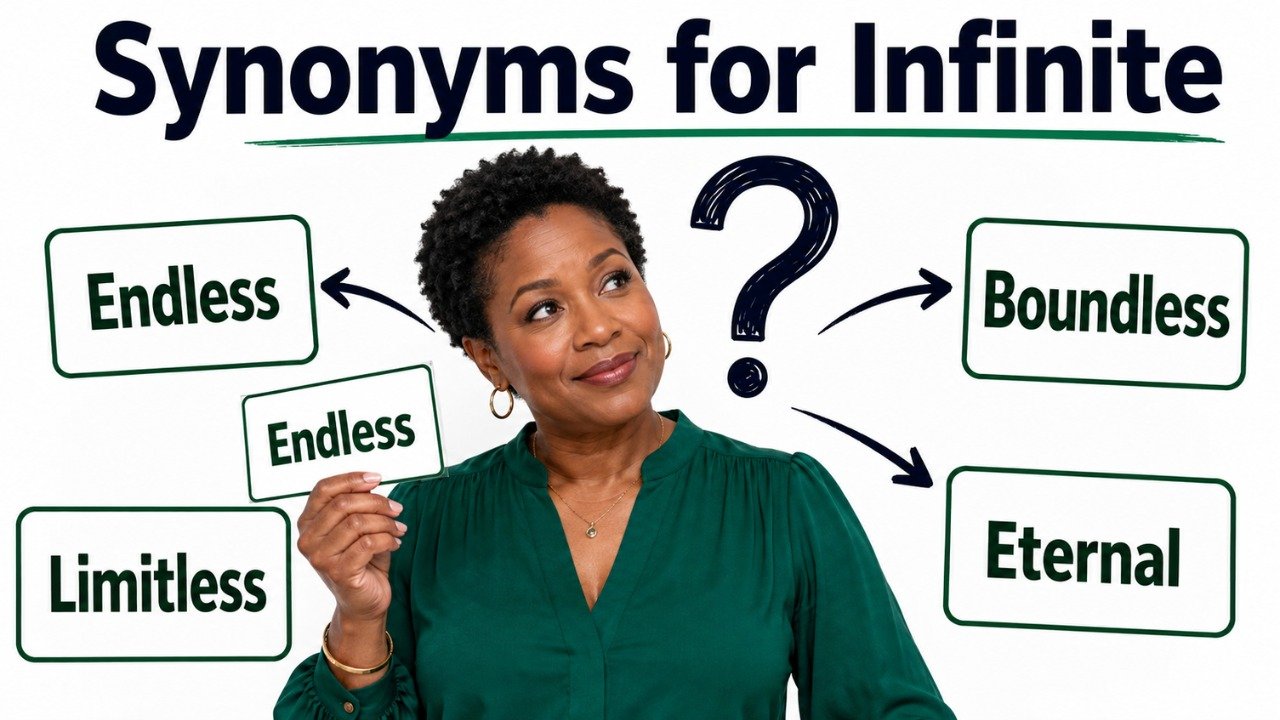
Quick Answer: The best synonyms for infinite include endless, limitless, boundless, eternal, immeasurable, unbounded, unlimited, inexhaustible, countless, and everlasting. Use endless for something with no apparent end, limitless for something without restrictions, boundless for vast qualities or possibilities, eternal for time that never ends, immeasurable for something too great to measure, and unbounded for mathematical, abstract, or formal contexts.
Pronunciation and Word Details
Word: Infinite
Pronunciation: /ˈɪnfɪnət/
Part of Speech: Adjective
Meaning: Having no end, boundary, limit, or measurable extent.
US Pronunciation:
UK Pronunciation:
What Does “Infinite” Mean?
Infinite means having no end, limit, boundary, or measurable extent.
It is mainly used as an adjective. The word can describe time, space, numbers, possibilities, quantities, patience, variety, complexity, or other things that seem impossible to limit.
In mathematics, infinite has a precise meaning connected with something that has no finite boundary or end.
In everyday language, the word is often used more loosely. Someone may speak of infinite patience, infinite possibilities, or infinite beauty even when the idea is not literally without limit.
The meaning therefore depends on context. Infinite may describe something truly without limit, something extremely large, or something that feels impossible to measure.
Meaning, Tone, and Context of “Infinite”
Infinite has a neutral to formal tone, but it can also sound expressive or dramatic in everyday language.
In academic and mathematical contexts, infinite has a precise technical meaning. It describes quantities, sequences, spaces, or processes that are not finite.
In descriptive writing, infinite can create a sense of vastness, depth, continuity, or possibility.
For example, infinite space suggests space without an identifiable boundary. Infinite patience suggests an unusually great amount of patience.
In casual conversation, speakers may prefer endless, unlimited, or countless because these words often sound more natural.
Infinite is also common in philosophical, scientific, literary, mathematical, and abstract discussions because it expresses the idea of something extending beyond ordinary limits.
When and How to Use “Infinite”
For Time: Use infinite when describing time with no end.
Example: The story imagines an infinite future.
For Space: Use infinite when referring to something extending without a known boundary.
Example: They looked into what seemed like infinite space.
For Quantity: Infinite can describe an amount with no finite limit.
Example: Mathematics allows us to discuss infinite sequences.
For Possibilities: Use infinite to emphasize that the number of possible choices seems unlimited.
Example: Creativity can open infinite possibilities.
For Patience or Capacity: Infinite can emphasize an extremely great amount of a quality.
Example: She seemed to have infinite patience with beginners.
For Mathematics: Infinite is appropriate when discussing values, sets, sequences, limits, or quantities without finite boundaries.
Example: The sequence contains an infinite number of terms.
For Emphasis: Use infinite figuratively when something feels too large to count or measure.
Example: The project seemed to involve infinite details.
For Abstract Ideas: Infinite works well with concepts such as knowledge, imagination, complexity, or potential.
Example: Human imagination appears to offer infinite possibilities.
Best Synonyms for Infinite
Endless: Having or seeming to have no end.
Example: They walked through an endless stretch of desert.
Limitless: Having no apparent restrictions or boundaries.
Example: Her imagination seemed limitless.
Boundless: Extremely great and without obvious limits.
Example: He showed boundless enthusiasm for the project.
Eternal: Continuing forever without ending.
Example: The poem explores the idea of eternal life.
Immeasurable: Too great or extensive to be measured.
Example: Her contribution had immeasurable value.
Unbounded: Having no fixed boundary or restriction.
Example: The theory considers an unbounded range of values.
Unlimited: Not restricted in amount, number, or extent.
Example: The program offers unlimited access to the materials.
Inexhaustible: So abundant that it does not seem capable of being used up.
Example: She appeared to have an inexhaustible supply of ideas.
Countless: Too numerous to count.
Example: Countless stars were visible in the night sky.
Everlasting: Continuing for a very long time or forever.
Example: The monument was intended to symbolize everlasting remembrance.
50 Synonyms for Infinite with Short Meanings
- Endless: Having no visible or apparent end.
- Limitless: Existing without clear restrictions or limits.
- Boundless: Extremely vast and without obvious boundaries.
- Eternal: Continuing forever.
- Immeasurable: Too large or great to measure.
- Unbounded: Having no fixed boundary or restriction.
- Unlimited: Not restricted in amount or extent.
- Inexhaustible: Impossible or difficult to use up completely.
- Countless: Too numerous to count.
- Everlasting: Lasting forever or for an extremely long time.
- Perpetual: Continuing without interruption or ending.
- Ceaseless: Continuing without stopping.
- Unending: Continuing without reaching an end.
- Interminable: Continuing for what seems like an excessively long time.
- Measureless: Too great or extensive to measure.
- Unfathomable: Too deep, great, or complex to fully understand or measure.
- Bottomless: Appearing to have no lowest point or limit.
- Numberless: Too numerous to count.
- Innumerable: Existing in extremely large numbers.
- Uncountable: Too numerous to be counted.
- Unrestricted: Not limited by rules or boundaries.
- Unconfined: Not restricted within boundaries.
- Unrestrained: Not controlled or limited.
- Vast: Extremely great in size, amount, or extent.
- Immense: Extremely large or great.
- Enormous: Very large in size, amount, or degree.
- Extensive: Covering a very large area, range, or amount.
- Expansive: Covering or extending over a wide range.
- Unceasing: Continuing without stopping.
- Continuous: Continuing without interruption.
- Constant: Continuing or occurring repeatedly without major change.
- Persistent: Continuing for a long time without stopping.
- Enduring: Lasting for a long period.
- Abiding: Continuing for a long time and remaining strong.
- Permanent: Intended or expected to last indefinitely.
- Timeless: Not limited to a particular period of time.
- Never Ending: Continuing without reaching an end.
- Without End: Continuing indefinitely.
- Without Limit: Having no fixed maximum or boundary.
- Beyond Measure: Too great to be measured accurately.
- Inc endless: Having no detectable conclusion.
- Indefinite: Having no clearly fixed limit or endpoint.
- Indeterminate: Not having a clearly established limit or quantity.
- Exhaustless: Not capable of being completely used up.
- Illimitable: Incapable of being limited or bounded.
- Unmeasured: Not measured or apparently beyond measurement.
- Myriad: Extremely numerous or varied.
- Multitudinous: Existing in very great numbers.
- Omnipresent: Present everywhere, especially in abstract or figurative contexts.
- All Encompassing: Extending across a very broad or complete range.
Read Also:
Synonyms for Set Up

Synonyms for Infinite by Context
When Infinite Means Endless
When infinite describes something continuing without an end, endless, unending, perpetual, everlasting, ceaseless, or eternal may be suitable.
Example: The road seemed infinite.
Alternative: The road seemed endless.
Endless is usually more natural in everyday conversation, while eternal often suggests forever in a more philosophical or emotional sense.
When Infinite Means Limitless
When infinite emphasizes freedom from restrictions, limitless, unlimited, unbounded, unrestricted, or unconfined may work better.
Example: The project offers infinite opportunities for experimentation.
Alternative: The project offers limitless opportunities for experimentation.
Limitless is especially natural with possibility, potential, imagination, creativity, and opportunity.
When Infinite Means Extremely Numerous
When the meaning concerns a very large number rather than literal infinity, countless, innumerable, numberless, myriad, or multitudinous can be clearer.
Example: The city offers infinite choices for visitors.
Alternative: The city offers countless choices for visitors.
Countless communicates an extremely large number without necessarily suggesting a literal mathematical infinity.
When Infinite Means Immeasurable
When something is too great to measure, immeasurable, measureless, beyond measure, unfathomable, or immense may be appropriate.
Example: Her support was of infinite value to the team.
Alternative: Her support was of immeasurable value to the team.
Immeasurable works especially well with value, importance, influence, gratitude, or emotional qualities.
When Infinite Means Eternal
When infinite refers specifically to time, eternal, everlasting, perpetual, enduring, timeless, or unending may be suitable.
Example: The story explores the idea of infinite existence.
Alternative: The story explores the idea of eternal existence.
Eternal is usually stronger when the intended meaning is forever rather than simply extremely long.
When Infinite Means Unbounded
In mathematical, scientific, and abstract contexts, unbounded is often a precise alternative.
Example: The function can increase toward an infinite value.
Alternative: The function can increase without a finite bound.
Unbounded is especially useful when discussing ranges, variables, sets, spaces, or quantities.
Another Word for Infinite
The best general replacement for infinite is endless, but the best alternative depends on the intended meaning.
Use limitless for possibilities or potential, eternal for time, immeasurable for value or importance, countless for very large numbers, and unbounded for technical or mathematical contexts.
Original: The project seemed to offer infinite possibilities.
Better Option: The project seemed to offer limitless possibilities.
Original: She showed infinite patience with the students.
Better Option: She showed endless patience with the students.
Original: The discovery had infinite importance for the field.
Better Option: The discovery had immeasurable importance for the field.
Original: We could see infinite stars above us.
Better Option: We could see countless stars above us.
When Not to Use “Infinite”
Infinite can be too strong when the quantity or duration is merely large rather than literally without limit.
Weak: The store has an infinite number of products.
Better: The store has an enormous variety of products.
Avoid infinite when a precise number or measurable amount is available.
Weak: The report contains infinite examples.
Better: The report contains hundreds of examples.
In formal or technical writing, avoid using infinite figuratively when readers may interpret it literally.
Weak: The system has infinite storage space.
Better: The system has extensive storage capacity.
Avoid repeating infinite several times in the same paragraph.
Weak: The infinite possibilities created infinite excitement about an infinite future.
Better: The limitless possibilities created enormous excitement about an unbounded future.
Infinite may also sound unnecessarily dramatic when a simpler word is more accurate.
Weak: We faced infinite delays during the project.
Better: We faced repeated delays during the project.
Words Commonly Confused With Infinite
Infinite vs Endless: Infinite means having no limit or end, while endless often means continuing for a very long time or seeming never to stop.
Infinite vs Unlimited: Infinite literally suggests no boundary at all. Unlimited often means no practical or imposed restriction.
Infinite vs Limitless: Limitless emphasizes the absence of restrictions, while infinite can describe quantity, time, space, or extent.
Infinite vs Eternal: Eternal specifically concerns time and means lasting forever. Infinite can apply to time, quantity, space, number, or extent.
Infinite vs Countless: Countless means too many to count but does not necessarily mean literally infinite.
Infinite vs Immeasurable: Immeasurable means too great to measure, while infinite means having no finite limit.
Infinite vs Vast: Vast means extremely large, but something vast can still have boundaries.
Infinite vs Unbounded: Unbounded means having no fixed boundary and is especially useful in technical, mathematical, or abstract contexts.
Which Synonym Should You Choose?
Choose endless when something continues for a very long time or appears to have no end.
Choose limitless when describing opportunity, imagination, creativity, freedom, or potential.
Choose boundless when emphasizing a quality such as enthusiasm, energy, love, confidence, or curiosity.
Choose eternal when referring to time, existence, memory, or something believed to continue forever.
Choose immeasurable when describing importance, value, influence, gratitude, or emotional depth.
Choose unbounded for mathematical, scientific, abstract, or formal writing about things without fixed boundaries.
Choose unlimited when discussing access, resources, quantity, or freedom from practical restrictions.
Choose inexhaustible when describing something that seems impossible to use up, such as energy, ideas, or resources.
Choose countless or innumerable when the meaning is simply a very large number.
Choose vast or immense when something is extremely large but not literally infinite.
Real Life Examples of “Infinite” in Sentences
Original: The new system offers infinite possibilities.
Better Option: The new system offers limitless possibilities.
Original: She seemed to have infinite patience.
Better Option: She seemed to have endless patience.
Original: They stared into the infinite night sky.
Better Option: They stared into the boundless night sky.
Original: The project required an infinite amount of effort.
Better Option: The project required an immense amount of effort.
Original: The library contains infinite sources of information.
Better Option: The library contains countless sources of information.
Original: His curiosity appeared infinite.
Better Option: His curiosity appeared boundless.
Original: The problem seemed to have infinite complexity.
Better Option: The problem seemed to have unfathomable complexity.
Original: The story describes an infinite existence.
Better Option: The story describes an eternal existence.
Original: She expressed infinite gratitude for their help.
Better Option: She expressed immeasurable gratitude for their help.
Original: The model allows an infinite range of possible values.
Better Option: The model allows an unbounded range of possible values.
Synonym Groups and Usage Differences
Endlessness Group
Endless, unending, ceaseless, perpetual, and never ending emphasize continuation without a clear stopping point.
Example: The travelers faced what seemed like an endless journey.
Limit Group
Limitless, unlimited, unbounded, unrestricted, and unconfined emphasize the absence of boundaries or restrictions.
Example: The students were encouraged to explore limitless possibilities.
Time Group
Eternal, everlasting, perpetual, timeless, enduring, and abiding relate to long lasting or never ending time.
Example: The story presents love as eternal.
Quantity Group
Countless, innumerable, numberless, uncountable, myriad, and multitudinous describe extremely large numbers.
Example: Countless questions remained unanswered.
Size and Extent Group
Vast, immense, enormous, extensive, expansive, and measureless emphasize great size or scope.
Example: The researchers explored a vast field of possibilities.
Measurement Group
Immeasurable, measureless, unfathomable, beyond measure, and unmeasured describe something difficult or impossible to quantify.
Example: Her influence on the project was immeasurable.
Supply Group
Inexhaustible, exhaustless, unlimited, and bottomless can describe supplies, resources, energy, or qualities that seem impossible to use up.
Example: He seemed to have an inexhaustible supply of creative ideas.
Antonyms of Infinite
The opposite of infinite depends on whether the sentence refers to size, time, quantity, space, or possibility.
Finite: Having clear limits or boundaries.
Limited: Restricted in amount, size, or extent.
Bounded: Existing within defined boundaries.
Restricted: Controlled or limited by conditions.
Measurable: Able to be measured.
Countable: Able to be counted.
Definite: Having a clearly established limit or form.
Fixed: Set at a particular amount or level.
Temporary: Lasting for only a limited time.
Brief: Continuing for a short period.
Short: Limited in length, time, or extent.
Exhaustible: Capable of being completely used up.
Comparison: Infinite vs Related Words
Infinite vs Endless
Infinite means having no limit or end. Endless often describes something that continues for a very long time or feels as though it will never stop.
Example With Infinite: The mathematical sequence contains an infinite number of terms.
Example With Endless: The meeting felt endless.
Infinite vs Limitless
Infinite can describe numbers, time, space, or quantities without bounds. Limitless often emphasizes a lack of restrictions or constraints.
Example With Infinite: The concept involves an infinite sequence.
Example With Limitless: Her creative potential seemed limitless.
Infinite vs Unlimited
Infinite means literally or conceptually without any finite limit. Unlimited often means that no practical restriction has been imposed.
Example With Infinite: Mathematicians study infinite sets.
Example With Unlimited: Members received unlimited access to the materials.
Infinite vs Eternal
Infinite has a broader meaning and can apply to number, space, quantity, time, or extent. Eternal refers especially to time and existence.
Example With Infinite: The theory considers infinite possibilities.
Example With Eternal: The poem explores eternal life.
Infinite vs Countless
Infinite means without a finite end or limit. Countless simply means too numerous to count conveniently.
Example With Infinite: The sequence is infinite.
Example With Countless: Countless visitors attended the exhibition over the years.
Infinite vs Vast
Infinite has no limit, while vast means extremely large but still potentially finite.
Example With Infinite: The theoretical model assumes infinite space.
Example With Vast: The desert covers a vast area.
Infinite vs Immeasurable
Infinite describes something with no finite limit. Immeasurable describes something too great, extensive, or abstract to measure effectively.
Example With Infinite: The mathematical line extends infinitely in both directions.
Example With Immeasurable: Her contribution was of immeasurable importance.
Common Phrases and Expressions With “Infinite”
Infinite Possibilities: An unlimited range of possible outcomes.
Infinite Space: Space imagined as having no boundary.
Infinite Time: Time without an end.
Infinite Patience: An extremely great or apparently endless amount of patience.
Infinite Wisdom: Wisdom described as unlimited or without measure.
Infinite Variety: An extremely broad or apparently unlimited range.
Infinite Number: A quantity that is not finite.
Infinite Sequence: A sequence containing endlessly continuing terms.
Infinite Potential: Potential described as having no apparent limit.
Infinite Value: Value presented as immeasurable or beyond ordinary calculation.
Common Mistakes to Avoid
A common mistake is using infinite when the intended meaning is simply very large. Infinite is stronger than enormous, vast, or countless.
Avoid calling a quantity infinite when it is actually measurable or limited.
Do not treat endless and infinite as identical in every situation. Endless is often figurative, while infinite may have a precise mathematical meaning.
Be careful when replacing infinite with eternal. Eternal refers mainly to time, while infinite can refer to size, quantity, space, numbers, or possibilities.
Do not use countless in mathematical contexts when literal infinity is intended. Countless usually means extremely numerous rather than mathematically infinite.
Avoid overusing infinite for emphasis. Words such as vast, immense, extensive, countless, and limitless often create more precise writing.
Also avoid vague expressions when a specific quantity would be more useful. If the number is known, give the number rather than describing it as infinite.
Choose each synonym according to whether you are describing time, amount, size, potential, number, measurement, or restrictions.
Conclusion
Synonyms for infinite include endless, limitless, boundless, eternal, immeasurable, unbounded, unlimited, inexhaustible, countless, and everlasting. The strongest choice depends on context. Use endless for duration, limitless for possibilities, eternal for time, countless for extremely large numbers, and immeasurable for value or importance. In mathematical and technical writing, unbounded may provide greater precision. Choosing the right alternative helps communicate whether something truly has no limit or simply feels exceptionally large.
FAQs About Synonyms for Infinite
What Is the Best Synonym for Infinite?
Endless is a strong general synonym, but limitless, boundless, eternal, unbounded, and immeasurable may be better in specific contexts.
What Is a Formal Synonym for Infinite?
Unbounded, illimitable, immeasurable, perpetual, and inexhaustible can work as formal alternatives depending on the intended meaning.
Is Endless the Same as Infinite?
Not exactly. Infinite means having no finite limit, while endless often describes something continuing for a very long time or appearing never to end.
What Is Another Word for Infinite Possibilities?
Limitless possibilities, boundless possibilities, unlimited possibilities, and countless possibilities are natural alternatives.
What Is Another Word for Infinite Time?
Eternal, everlasting, perpetual, unending, and endless can describe time that continues indefinitely.
What Is the Opposite of Infinite?
Finite is the most direct opposite. Limited, bounded, measurable, restricted, and definite may also work depending on context.
Can Countless Be Used Instead of Infinite?
Yes, when the intended meaning is an extremely large number. However, countless does not normally mean literal mathematical infinity.
