
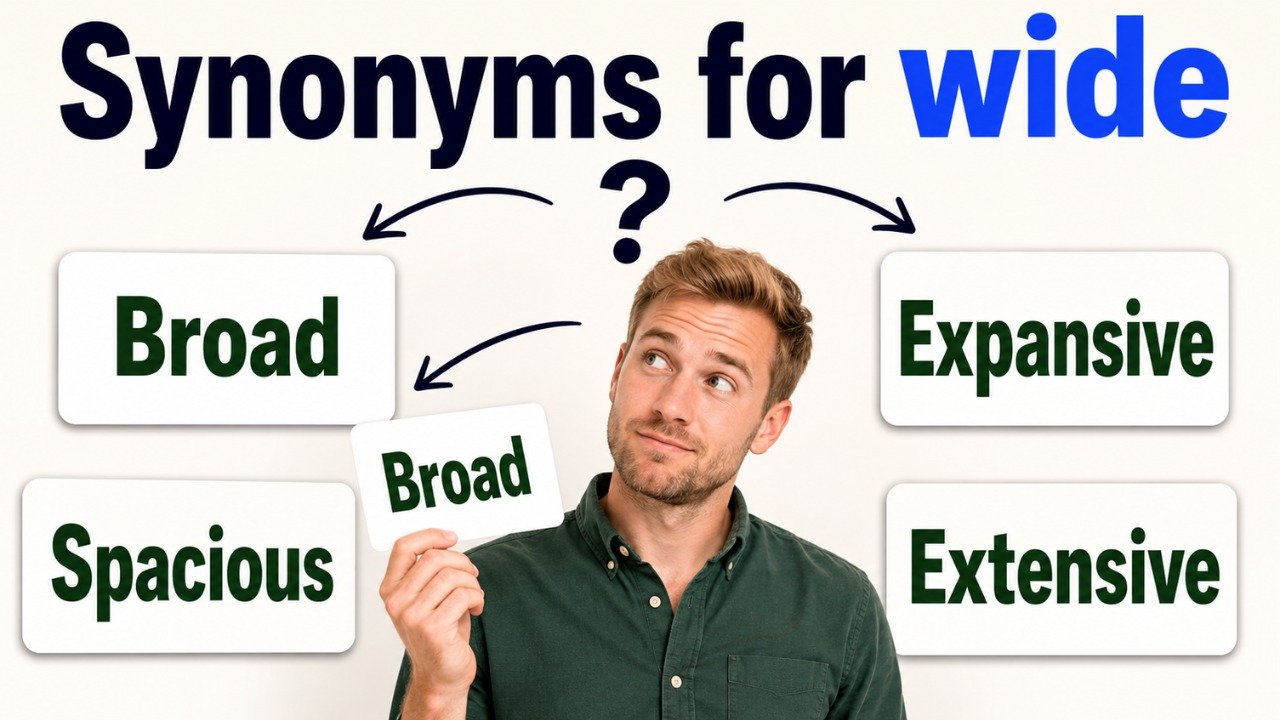
Quick Answer: Synonyms for wide include broad, expansive, extensive, spacious, ample, vast, roomy, sweeping, comprehensive, and open. The best choice depends on context. Use broad for physical width or general scope, spacious or roomy for interiors, expansive for large open areas, extensive for range or coverage, vast for extremely large spaces, comprehensive for ideas or information, and open when describing an entrance, gap, or area without restriction.
Pronunciation and Word Details
Word: Wide
Pronunciation: /waɪd/
Part of Speech: Adjective and adverb
Meaning: Extending a large distance from one side to another, covering a large area or range, or being fully open.
US Pronunciation:
UK Pronunciation:
What Does “Wide” Mean?
Wide means extending a considerable distance from one side to another or covering a large area, range, or variety.
As an adjective, wide commonly describes physical dimensions.
Example: The road is wide enough for several vehicles.
It can also describe a large range of ideas, choices, experiences, differences, or opportunities.
Example: The course covers a wide range of topics.
Wide may also describe something that is fully open.
Example: She opened the window wide.
In another sense, wide can mean away from the intended direction or target.
Example: The ball went wide of the goal.
Because wide has several meanings, words such as broad, spacious, extensive, expansive, open, and vast work differently depending on the sentence.
Meaning, Tone, and Context of “Wide”
Wide is a neutral and highly common English word. It works naturally in casual conversation, descriptive writing, essays, reports, technical explanations, and formal communication.
When discussing physical dimensions, wide usually refers to the distance between two sides.
Example: They walked through a wide doorway.
When discussing spaces, wide can suggest openness or room to move.
Example: The house has wide hallways and spacious rooms.
When discussing scope, wide often means covering many subjects, people, places, or possibilities.
Example: The research considers a wide variety of factors.
In formal writing, broad, extensive, comprehensive, or expansive may sometimes sound more precise than wide.
In descriptive writing, spacious, sweeping, vast, expansive, and open can create stronger visual impressions.
When and How to Use “Wide”
For Physical Width: Use wide when describing the distance from one side of something to the other.
Example: The bridge is wide enough to accommodate heavy traffic.
For Large Spaces: Use wide when describing an area that feels open or extensive.
Example: A wide field stretched beyond the village.
For Range: Use wide when something includes many different types, choices, subjects, or possibilities.
Example: The library contains a wide selection of books.
For Scope: Use wide when an issue, study, plan, or discussion covers many areas.
Example: The investigation has a wide scope.
For Openings: Use wide when a door, window, mouth, or other opening is fully or significantly open.
Example: He pushed the doors wide.
For Differences: Use wide when the distance between opinions, values, results, or amounts is considerable.
Example: There was a wide difference between the two estimates.
For Distance From a Target: Use wide when something misses its intended direction.
Example: His final shot went wide of the target.
Best Synonyms for Wide
Broad: Extending considerably from side to side or covering a large scope.
Example: A broad path crossed the garden.
Expansive: Covering a large physical area or broad range.
Example: The house overlooks an expansive landscape.
Extensive: Covering a large amount, area, range, or degree.
Example: The project required extensive research.
Spacious: Providing plenty of room or open space.
Example: The apartment has a spacious living area.
Roomy: Having plenty of available space inside.
Example: The vehicle has a roomy interior.
Ample: More than enough in size, space, or amount.
Example: The room provides ample space for additional seating.
Vast: Extremely large in area, size, range, or extent.
Example: A vast plain extended toward the mountains.
Sweeping: Extending broadly across an area or affecting many things.
Example: The window offers sweeping views of the countryside.
Comprehensive: Covering a broad range of information or subjects.
Example: The guide provides a comprehensive overview of the topic.
Open: Having plenty of unobstructed space or being fully accessible.
Example: The building opens into a large open courtyard.
50 Synonyms for Wide with Short Meanings
- Broad: Extending far from side to side.
- Expansive: Covering a large area or range.
- Extensive: Great in amount, area, or scope.
- Spacious: Having plenty of available room.
- Roomy: Providing comfortable interior space.
- Ample: Large enough or more than sufficient.
- Vast: Extremely great in size or extent.
- Sweeping: Extending broadly over an area or subject.
- Widespread: Existing across a large area or among many people.
- Comprehensive: Covering many or nearly all relevant aspects.
- Large: Great in size or dimensions.
- Generous: Larger or more plentiful than expected.
- Substantial: Considerable in size, amount, or extent.
- Sizable: Fairly large in size or amount.
- Considerable: Large enough to be important or noticeable.
- Immense: Extremely large in size or degree.
- Enormous: Very great in size or extent.
- Huge: Extremely large.
- Capacious: Able to contain a large amount.
- Commodious: Spacious and comfortable.
- Open: Unrestricted or having plenty of space.
- Outspread: Extended outward over a broad area.
- Extended: Made longer, broader, or greater in reach.
- Stretched: Extended across a distance or area.
- Spread Out: Extending across a broad area.
- Far Reaching: Affecting or extending over a large range.
- Far Ranging: Covering many subjects, places, or areas.
- All Encompassing: Including nearly everything relevant.
- Inclusive: Covering a broad variety of people or things.
- Unrestricted: Not limited within narrow boundaries.
- Unlimited: Having no fixed limit in extent or range.
- Boundless: Appearing to have no limits.
- Broad Based: Covering many areas, groups, or interests.
- General: Covering a subject broadly rather than narrowly.
- Universal: Applying across a very broad range.
- Diverse: Including many different types or forms.
- Varied: Containing a broad mixture or selection.
- Multifaceted: Covering many different aspects.
- Large Scale: Extensive in size, scope, or operation.
- Full: Extending to a complete or generous extent.
- Voluminous: Large in quantity, volume, or capacity.
- Expanded: Increased in size, range, or scope.
- Enlarged: Made greater in size or dimensions.
- Dilated: Widened or opened beyond a narrower state.
- Gaping: Very widely open.
- Unconfined: Not restricted within narrow limits.
- Sprawling: Extending over a large area.
- Panoramic: Providing a broad view across an area.
- Extensive in Scope: Covering many subjects or areas.
- Expansive in Scope: Broad in subject, influence, or coverage.
Read Also:
Synonyms for Horizon
Synonyms for Wide by Context
When Wide Means Broad From Side to Side
When wide describes physical dimensions, broad is usually the strongest general synonym. Large, ample, expanded, enlarged, and outspread may also work depending on the object.
Broad: Natural for roads, shoulders, rivers, paths, surfaces, and physical shapes.
Example: A broad river separates the two regions.
Expanded: Useful when something has become wider than it was previously.
Example: The expanded entrance allows easier access.
Enlarged: Best when dimensions have deliberately been increased.
Example: The enlarged doorway made the room feel more accessible.
When Wide Means Spacious
When wide refers to available room, spacious, roomy, capacious, commodious, ample, and open are useful alternatives.
Spacious: Best for rooms, buildings, interiors, and living spaces.
Example: The spacious kitchen has plenty of room for a dining table.
Roomy: More conversational and especially natural for cars, bags, rooms, and furniture.
Example: The cabin feels surprisingly roomy.
Capacious: A more formal word for something that can contain a great deal.
Example: The capacious hall can accommodate a large audience.
Ample: Emphasizes having more than enough space.
Example: There is ample room around the table.
When Wide Means Extensive
When wide refers to scope, influence, knowledge, coverage, or variety, extensive, comprehensive, sweeping, far reaching, far ranging, and broad are stronger choices.
Extensive: Best for knowledge, research, damage, experience, coverage, and investigation.
Example: She has extensive knowledge of the subject.
Comprehensive: Best when something covers nearly every important part.
Example: The report provides a comprehensive analysis.
Far Reaching: Best for effects, consequences, influence, and decisions.
Example: The decision could have far reaching consequences.
Sweeping: Useful for changes, statements, reforms, and broad views.
Example: The proposal recommends sweeping changes.
When Wide Means Large or Vast
When describing extremely large spaces or dimensions, vast, immense, enormous, huge, and expansive create a stronger sense of scale.
Vast: Especially useful for landscapes, oceans, deserts, areas, and amounts of information.
Example: A vast desert stretched beyond the horizon.
Immense: Emphasizes exceptionally great size.
Example: The building stood within an immense open space.
Expansive: Often describes landscapes, properties, views, and areas.
Example: They looked across the expansive valley.
When Wide Means Diverse or Varied
Wide frequently appears in phrases such as a wide range, wide variety, or wide selection. In these situations, diverse, varied, extensive, broad, and comprehensive can improve precision.
Diverse: Highlights differences among the included items.
Example: The program attracts a diverse group of participants.
Varied: Emphasizes having many different types.
Example: The restaurant offers a varied selection of dishes.
Extensive: Emphasizes the large number or range available.
Example: The collection includes an extensive selection of historical documents.
When Wide Means Fully Open
When wide refers to an opening, use open, gaping, dilated, or expanded depending on what is being described.
Open: The most neutral replacement.
Example: The doors remained open throughout the event.
Gaping: Suggests an unusually large or noticeable opening.
Example: A gaping hole appeared in the damaged wall.
Dilated: Common in medical, scientific, or technical contexts for something that has widened.
Example: The examination showed that the pupil was dilated.
Another Word for Wide
Another word for wide is broad. It is the most flexible single alternative because it can describe physical width as well as range, scope, knowledge, categories, and general ideas.
However, the best replacement depends on context. Spacious works better for rooms, extensive for coverage or experience, expansive for open landscapes, and comprehensive for information.
Original: The river is very wide.
Better Option: The river is very broad.
Original: The house has a wide living room.
Better Option: The house has a spacious living room.
Original: She has wide experience in the field.
Better Option: She has extensive experience in the field.
Original: The study covers a wide selection of topics.
Better Option: The study covers a broad selection of topics.
When Not to Use “Wide”
Wide can become vague when a more precise word would show exactly what kind of size, range, space, or coverage you mean.
Avoid using wide repeatedly in formal writing when broad, extensive, comprehensive, or diverse would communicate the idea more clearly.
Weak: The report covers a wide amount of information.
Better: The report covers an extensive range of information.
Wide can also sound unnatural when spacious is the intended meaning.
Weak: The apartment has a very wide interior.
Better: The apartment has a spacious interior.
Avoid wide when the sentence is really describing quantity rather than width or range.
Weak: The company received a wide amount of feedback.
Better: The company received a substantial amount of feedback.
When discussing differences among many types, diverse or varied may be more descriptive.
Weak: The class includes a wide group of learners.
Better: The class includes a diverse group of learners.
Words Commonly Confused With Wide
Wide vs Broad: Both can describe physical width and large scope. Broad often sounds more natural for shoulders, rivers, subjects, categories, and general concepts, while wide is especially common for roads, doors, gaps, distances, and ranges.
Wide vs Spacious: Wide describes side to side dimensions, while spacious describes an area that provides plenty of room.
Wide vs Large: Large refers generally to overall size. Wide specifically focuses on width or broad extent.
Wide vs Vast: Wide can describe ordinary or large dimensions. Vast suggests something extremely large in area, amount, or scope.
Wide vs Extensive: Wide can describe physical size or range. Extensive mainly describes something broad in amount, degree, coverage, or scope.
Wide vs Expansive: Wide is a general descriptive word. Expansive often creates a stronger sense of openness, size, or broad coverage.
Wide vs Comprehensive: Wide may mean broad in range. Comprehensive means covering nearly all important parts of a subject.
Wide vs Diverse: Wide describes the size of a range, while diverse emphasizes differences among the things included in that range.
Which Synonym Should You Choose?
Choose broad when describing physical width, subjects, categories, perspectives, or general scope.
Choose spacious when describing homes, rooms, buildings, interiors, or other areas with plenty of space.
Choose roomy for a more conversational description of interiors, vehicles, containers, or clothing.
Choose expansive when describing landscapes, properties, views, spaces, or broad ideas.
Choose extensive when discussing research, experience, knowledge, coverage, damage, or a large range.
Choose vast when the size or extent is extremely great.
Choose comprehensive when discussing reports, guides, studies, explanations, or information that covers nearly every important point.
Choose diverse when emphasizing the different types contained within a group or range.
Choose sweeping when describing broad changes, reforms, statements, views, or effects.
Choose ample when you want to communicate that there is more than enough space, time, or opportunity.
For essays and reports, broad, extensive, comprehensive, diverse, and far reaching often provide greater precision.
For everyday conversation, wide, broad, roomy, large, and spacious usually sound most natural.
For descriptive writing, expansive, sweeping, vast, panoramic, and sprawling can create stronger imagery.
Real Life Examples of “Wide” in Sentences
Original: The road is wide enough for several cars.
Better Option: The road is broad enough for several cars.
Original: They entered a wide living room.
Better Option: They entered a spacious living room.
Original: The organization provides a wide range of services.
Better Option: The organization provides an extensive range of services.
Original: She has wide knowledge of literature.
Better Option: She has broad knowledge of literature.
Original: We could see a wide landscape from the hill.
Better Option: We could see an expansive landscape from the hill.
Original: The issue received wide attention.
Better Option: The issue received widespread attention.
Original: The study takes a wide view of the problem.
Better Option: The study takes a comprehensive view of the problem.
Original: There is a wide difference between the two results.
Better Option: There is a considerable difference between the two results.
Original: Customers can choose from a wide selection of options.
Better Option: Customers can choose from a varied selection of options.
Original: The new policy may have a wide impact.
Better Option: The new policy may have a far reaching impact.
Synonym Groups and Usage Differences
Physical Width Group
Broad, large, expanded, enlarged, outspread, and stretched describe physical size or dimensions.
Broad is the strongest direct alternative for something extending significantly from side to side.
Example: A broad staircase leads to the upper floor.
Space Group
Spacious, roomy, ample, capacious, commodious, and open describe places or objects that provide plenty of room.
Spacious is the most natural choice for homes and interiors, while roomy is more conversational.
Example: The spacious office provides comfortable working areas.
Scope Group
Broad, extensive, comprehensive, sweeping, far reaching, far ranging, and all encompassing describe a large scope.
Extensive emphasizes amount or coverage, while comprehensive emphasizes completeness.
Example: The research involved an extensive review of previous studies.
Size Group
Vast, immense, enormous, huge, sizable, substantial, and considerable describe considerable or extreme size.
Vast and immense are strongest when the size seems exceptional.
Example: The explorers crossed a vast area of open land.
Variety Group
Diverse, varied, inclusive, multifaceted, comprehensive, and broad based describe something that contains many different elements.
Diverse emphasizes difference, while varied emphasizes variety.
Example: The collection represents a diverse range of artistic traditions.
Openness Group
Open, gaping, dilated, expanded, and unconfined describe something that is open or free from narrow limits.
Open is the most general option, while gaping suggests a noticeably large opening.
Example: The entrance remained open throughout the afternoon.
View Group
Panoramic, sweeping, expansive, broad, and open work well when describing views and landscapes.
Panoramic suggests an especially broad field of vision.
Example: The hill provides panoramic views of the surrounding countryside.
Antonyms of Wide
The antonym of wide changes according to whether you mean physical width, range, space, or scope.
Narrow: Having little distance from one side to the other.
Slim: Having a relatively small width.
Thin: Having little thickness or breadth.
Restricted: Limited in range, extent, or freedom.
Limited: Confined within a particular range or amount.
Confined: Restricted to a small space or scope.
Cramped: Providing too little space.
Tight: Having little available space.
Specific: Focused on a narrow or particular subject rather than a broad one.
Small: Limited in overall size or extent.
Restricted in Scope: Covering only a limited subject or area.
Closed: Not open or accessible.
Comparison: Wide vs Related Words
Wide vs Broad
Wide and broad often overlap, especially when describing physical dimensions. Wide is particularly natural for roads, doors, gaps, rivers, and distances. Broad is frequently used for surfaces, shoulders, categories, subjects, and ideas.
Example With Wide: The doorway is wide enough for the equipment.
Example With Broad: A broad path leads through the garden.
Wide vs Spacious
Wide describes dimensions, while spacious describes the feeling or availability of room within a place.
Example With Wide: The hallway is six feet wide.
Example With Spacious: The hallway feels spacious and open.
Wide vs Extensive
Wide can refer to physical dimensions or range. Extensive usually refers to something great in scope, quantity, degree, or coverage.
Example With Wide: The company offers a wide selection of services.
Example With Extensive: The company offers an extensive selection of services.
Wide vs Expansive
Wide is a neutral general word, while expansive often suggests something impressively broad, open, or far reaching.
Example With Wide: They looked across the wide valley.
Example With Expansive: They looked across the expansive valley.
Wide vs Vast
Wide indicates considerable breadth. Vast communicates much greater scale and is often used for enormous spaces, quantities, or concepts.
Example With Wide: A wide field surrounded the house.
Example With Vast: A vast plain stretched toward the horizon.
Wide vs Comprehensive
Wide refers to broad range or extent. Comprehensive emphasizes including nearly everything needed for complete coverage.
Example With Wide: The course covers a wide range of subjects.
Example With Comprehensive: The course provides a comprehensive introduction to the subject.
Wide vs Diverse
Wide refers to the extent of a range. Diverse describes how different the elements within that range are.
Example With Wide: The event attracted a wide range of participants.
Example With Diverse: The event attracted a diverse group of participants.
Common Phrases and Expressions With “Wide”
Wide Range: A large variety or extensive selection.
Wide Variety: Many different types or forms.
Wide Open: Completely or fully open.
Wide Area: A large geographical or physical region.
Wide Gap: A considerable difference or distance between two things.
Wide Margin: A large difference between two amounts, results, or positions.
Wide Choice: A large selection of available options.
Wide Selection: Many items or possibilities from which to choose.
Wide Audience: A large and varied group of people.
Wide Scope: A broad range of subjects, activities, or responsibilities.
Common Mistakes to Avoid
One common mistake is using wide when the sentence needs a more precise word.
For physical dimensions, wide or broad may be correct. For comfortable interior space, spacious is usually clearer. For knowledge or research, extensive or broad may sound more natural.
Another mistake is confusing wide with large. Large refers to general size, while wide specifically refers to breadth or range.
Avoid writing phrases such as a wide amount when substantial amount or large amount is more natural.
Do not automatically replace every use of wide with broad. Although the words overlap, they are not interchangeable in every expression.
For example, wide awake is a fixed expression. Broad awake would be incorrect.
Similarly, a shot can go wide of the target, but saying it went broad of the target would sound unnatural.
Avoid unnecessary repetition in essays.
Weak: The study covers a wide range of topics and provides a wide discussion of their wide effects.
Better: The study covers an extensive range of topics and provides a broad discussion of their far reaching effects.
Choose synonyms according to the specific meaning rather than simply replacing wide with a more complicated word.
Conclusion
Synonyms for wide include broad, expansive, extensive, spacious, roomy, ample, vast, sweeping, comprehensive, and open. Broad is the most flexible alternative for physical width and general scope, while spacious suits interiors, extensive suits research and coverage, and expansive works well for open landscapes. Use diverse for variety, comprehensive for complete coverage, and far reaching for influence or effects. Choosing the right synonym makes descriptions clearer, more precise, and more natural.
FAQs About Synonyms for Wide
What Is the Best Synonym for Wide?
The best general synonym for wide is broad. However, spacious, extensive, expansive, or vast may be better depending on the context.
What Is Another Word for Wide in Size?
Broad is the most direct alternative when wide refers to physical size. Large, ample, expansive, and sizable can also work in certain contexts.
What Is Another Word for a Wide Space?
Spacious is usually the best choice. Roomy, expansive, open, ample, and capacious can also describe places with plenty of space.
What Is a Formal Synonym for Wide?
Extensive, comprehensive, expansive, considerable, and far reaching are useful formal alternatives depending on the meaning.
What Is Another Word for a Wide Range?
An extensive range, broad range, diverse range, varied selection, or comprehensive selection can replace a wide range.
Is Broad the Same as Wide?
Broad and wide often have similar meanings, but they are not always interchangeable. Wide commonly describes dimensions, gaps, openings, and ranges, while broad is especially natural for subjects, ideas, categories, surfaces, and general scope.
What Is the Opposite of Wide?
Narrow is the most direct opposite of wide. Other antonyms include restricted, limited, cramped, confined, slim, and tight depending on the context.
