
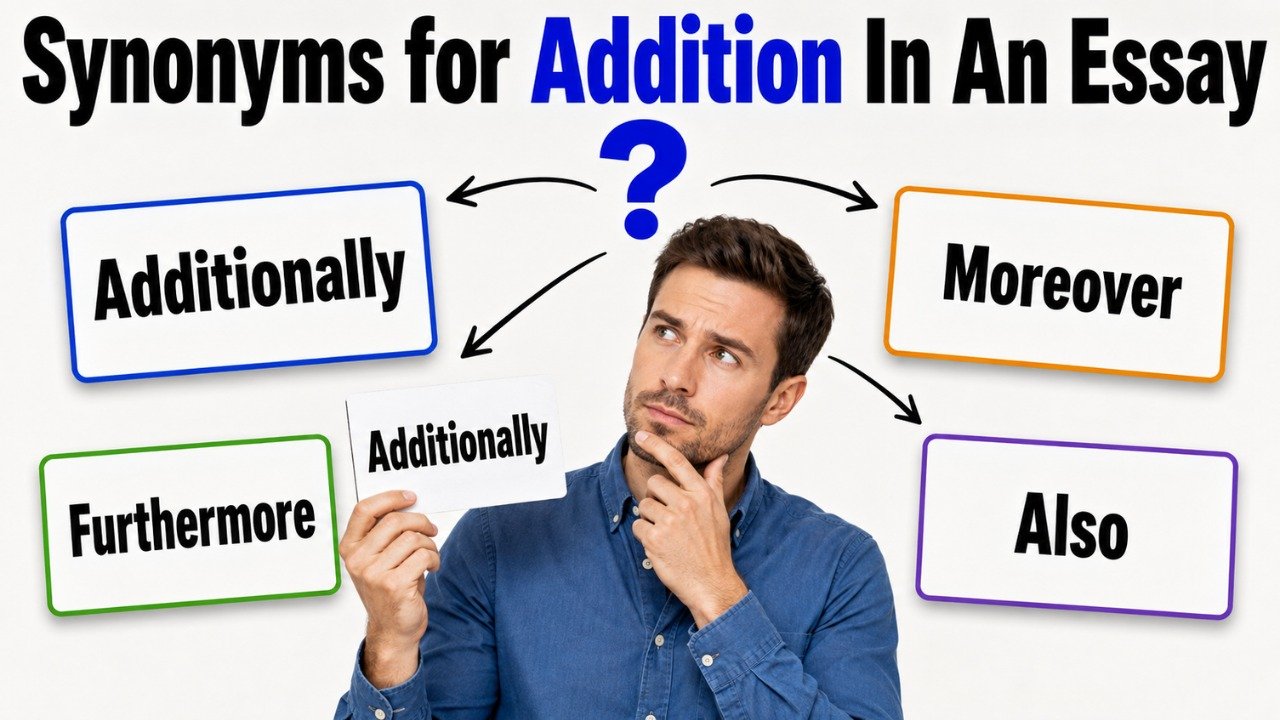
Quick Answer: The best synonyms for in addition in an essay include moreover, furthermore, additionally, also, besides, likewise, similarly, what is more, along with this, and another point is. Use moreover and furthermore for formal academic writing, additionally for a clear neutral transition, also for simple sentences, likewise and similarly when connecting comparable ideas, and what is more when adding an important supporting point. The best choice depends on whether you are adding evidence, examples, arguments, comparisons, or supporting details.
Pronunciation and Word Details
Word: In addition.
Pronunciation: /ɪn əˈdɪʃən/.
Part of Speech: Transitional phrase.
Meaning: A phrase used to introduce another idea, fact, example, reason, or supporting point.
US Pronunciation:
UK Pronunciation:
What Does “In Addition” Mean?
In addition means that another related idea, fact, reason, example, or piece of information is being added to what has already been stated.
It is commonly used as a transitional phrase in essays, reports, academic writing, explanations, and formal paragraphs.
Example: The course improves writing skills. In addition, it develops critical thinking.
In this sentence, in addition introduces another benefit.
The phrase helps readers understand that the new sentence continues the same general argument rather than introducing a contrast, result, or completely different topic.
In essays, in addition is especially useful when adding supporting evidence, another reason, a second example, or further explanation.
However, repeating it in every paragraph can make writing sound mechanical. Alternatives such as moreover, furthermore, additionally, and also can create greater variety.
Meaning, Tone, and Context of “In Addition”
In addition has a neutral to formal tone.
It works naturally in academic essays, research writing, reports, professional communication, and explanatory paragraphs.
The phrase is clearer and more formal than simple expressions such as plus. It is also less forceful than moreover or furthermore, which often introduce information that strengthens an argument.
In addition can appear at the beginning of a sentence or within a sentence.
Example: In addition, the policy may reduce unnecessary spending.
Example: The policy may, in addition, improve efficiency.
In academic writing, the first structure is usually clearer.
Writers should choose alternatives based on the relationship between ideas. Additionally simply adds another point, while similarly and likewise show that two ideas are comparable.
When and How to Use “In Addition”
For Adding Another Point: Use in addition when introducing another related argument or idea.
Example: The program reduces costs. In addition, it improves efficiency.
For Supporting Evidence: Use the phrase when adding another fact that strengthens your argument.
Example: The study showed improved attendance. In addition, participants reported greater motivation.
For Adding Examples: In addition can introduce another example related to the same topic.
Example: Several factors affect concentration. In addition, environmental noise can make focused work more difficult.
For Adding Reasons: Use it when presenting another reason that supports a conclusion.
Example: Public transportation reduces traffic. In addition, it can lower transportation costs.
For Academic Essays: Use in addition to connect related ideas between sentences or paragraphs.
Example: The proposal offers financial benefits. In addition, it may create new employment opportunities.
For Explanatory Writing: The phrase works well when expanding an explanation with more information.
Example: Plants need sufficient water. In addition, they require suitable light conditions.
Best Synonyms for In Addition in an Essay
Moreover
Synonym: Moreover introduces another important point that strengthens an argument.
Example: The plan is affordable. Moreover, it can be implemented quickly.
Furthermore
Synonym: Furthermore adds another formal supporting point or reason.
Example: The policy could reduce costs. Furthermore, it may improve service quality.
Additionally
Synonym: Additionally introduces another related fact, detail, or argument.
Example: The method saves time. Additionally, it requires fewer resources.
Also
Synonym: Also adds another related idea in a simple and natural way.
Example: The proposal is practical. It also offers several financial advantages.
Besides
Synonym: Besides introduces another reason or supporting point, often with a slightly conversational tone.
Example: The location is convenient. Besides, it offers easy access to public transportation.
Likewise
Synonym: Likewise adds a similar or corresponding point.
Example: Students benefit from regular feedback. Likewise, teachers benefit from clear evaluation criteria.
Similarly
Synonym: Similarly introduces an idea that resembles the previous one.
Example: Exercise improves physical health. Similarly, regular rest supports mental wellbeing.
What Is More
Synonym: What is more introduces an additional point that often strengthens the previous statement.
Example: The solution is inexpensive. What is more, it is easy to maintain.
Along With This
Synonym: Along with this adds another connected detail or consideration.
Example: The new system improves accuracy. Along with this, it simplifies record keeping.
Another Point Is
Synonym: Another point is introduces an additional argument or consideration clearly.
Example: Another point is that the policy may encourage greater participation.
50 Synonyms for In Addition in an Essay with Short Meanings
- Moreover: Adds an important supporting point.
- Furthermore: Introduces another formal argument.
- Additionally: Adds another related fact or idea.
- Also: Introduces extra information simply.
- Besides: Adds another reason or consideration.
- Likewise: Adds a similar or corresponding idea.
- Similarly: Connects a comparable idea.
- What Is More: Adds a stronger supporting point.
- Along With This: Introduces another connected detail.
- Another Point Is: Presents an additional argument.
- Another Factor Is: Adds another relevant cause or consideration.
- Another Reason Is: Introduces an additional supporting reason.
- Another Example Is: Adds another illustration or case.
- Another Consideration Is: Introduces another issue to examine.
- Equally Important: Adds a point of similar importance.
- Of Equal Importance: Introduces another significant idea.
- More Importantly: Adds a point with greater significance.
- Furthermore Still: Introduces an additional formal point.
- In Addition to This: Adds another related idea.
- Added to This: Introduces another supporting point.
- Together With This: Adds connected information.
- Coupled With This: Connects another contributing factor.
- Alongside This: Introduces another related consideration.
- As Well: Adds information to an existing statement.
- As Well As This: Introduces another related point.
- Not Only That: Adds another noteworthy idea.
- Beyond This: Introduces an additional consideration.
- Beyond That: Adds another point beyond what was mentioned.
- On Top of This: Adds another factor, usually less formally.
- Apart From This: Introduces another separate consideration.
- Aside From This: Adds another related factor or point.
- In the Same Way: Introduces a similar idea.
- By the Same Token: Adds a closely related argument.
- Correspondingly: Introduces a matching or related point.
- In Like Manner: Adds information in a similar way.
- To Add to This: Introduces further supporting information.
- To Further Support This: Adds evidence for an argument.
- To Build on This: Develops the previous idea further.
- Building on This Point: Adds information connected to an earlier claim.
- A Further Point Is: Introduces another formal argument.
- A Further Consideration Is: Adds another matter for discussion.
- A Further Example Is: Introduces another supporting example.
- A Further Reason Is: Adds another reason supporting an idea.
- An Additional Point Is: Introduces another argument clearly.
- An Additional Factor Is: Adds another contributing element.
- An Additional Example Is: Presents another illustration.
- An Additional Benefit Is: Adds another positive result.
- Further to This: Adds another connected point.
- There Is Also: Introduces another fact or consideration.
- It Is Also Worth Noting That: Highlights another relevant point.
Read Also:
Synonyms for Drinking

Synonyms for In Addition in an Essay by Context
When Adding Another Formal Argument
Use moreover, furthermore, additionally, a further point is, or an additional point is when adding another argument in formal writing.
Example: The policy is affordable. Furthermore, it can be introduced without major structural changes.
Example: A further point is that the proposal may improve access to essential services.
When Adding Supporting Evidence
Use additionally, to further support this, moreover, or further to this when adding evidence.
Example: The survey showed increased satisfaction. Additionally, participation rose during the same period.
Example: To further support this argument, the results indicate improved performance across all groups.
When Adding Another Reason
Use another reason is, a further reason is, besides, or what is more.
Example: Another reason is that the method requires fewer resources.
Example: What is more, the approach can reduce unnecessary expenses.
When Adding Another Example
Use another example is, a further example is, or an additional example is.
Example: Another example is the growing use of renewable energy in urban areas.
Example: An additional example is the expansion of flexible learning programs.
When Adding a Similar Idea
Use similarly, likewise, correspondingly, or in the same way.
Example: Regular exercise improves physical health. Similarly, adequate sleep supports mental performance.
Example: Employees benefit from clear goals. Likewise, managers benefit from measurable expectations.
When Building on a Previous Point
Use to build on this, building on this point, along with this, or coupled with this.
Example: Building on this point, better training may further improve employee performance.
Example: Coupled with this, clearer instructions can reduce unnecessary errors.
Another Word for In Addition
Another word for in addition is additionally. It is one of the safest alternatives because it has a similar neutral and formal tone.
However, the best replacement depends on the purpose of the sentence.
Use moreover when the added point strengthens an argument, furthermore for formal continuation, similarly for comparable ideas, and another reason is when introducing a new supporting reason.
Original: In addition, the program provides financial support.
Better Option: Additionally, the program provides financial support.
Original: In addition, the results support the original argument.
Better Option: Moreover, the results support the original argument.
Original: In addition, students developed stronger communication skills.
Better Option: Furthermore, students developed stronger communication skills.
Original: In addition, another community experienced similar changes.
Better Option: Similarly, another community experienced comparable changes.
When Not to Use “In Addition”
In addition is useful, but it should not be used automatically whenever two sentences are connected.
When Showing Contrast
Do not use in addition when the second idea contradicts the first.
Weak: The proposal is inexpensive. In addition, it may be difficult to implement.
Better: The proposal is inexpensive. However, it may be difficult to implement.
When Showing a Result
Use therefore, consequently, or as a result when one idea causes another.
Weak: The roads were flooded. In addition, several events were canceled.
Better: The roads were flooded. As a result, several events were canceled.
When Comparing Similar Ideas
Similarly or likewise may communicate the connection more clearly.
Weak: Regular exercise improves physical health. In addition, adequate rest supports mental health.
Better: Regular exercise improves physical health. Similarly, adequate rest supports mental health.
When the Phrase Becomes Repetitive
Repeated use can make an essay sound mechanical.
Weak: In addition, the policy saves money. In addition, it improves efficiency. In addition, it reduces waste.
Better: The policy saves money. Furthermore, it improves efficiency. It also reduces waste.
When a More Specific Transition Is Available
A specific phrase may explain the relationship between ideas more accurately.
Weak: In addition, there is another reason to support the proposal.
Better: Another reason to support the proposal is its long term financial benefit.
Words Commonly Confused With In Addition
In Addition vs Additionally: Both introduce extra information. Additionally is a single word and often sounds slightly more concise in formal writing.
In Addition vs Moreover: In addition simply adds information. Moreover often introduces a point that strengthens an argument.
In Addition vs Furthermore: Both are formal transitions. Furthermore often gives the added idea slightly more emphasis.
In Addition vs Also: Also is simpler and works naturally within sentences. In addition is more noticeable as a transition between sentences.
In Addition vs Similarly: In addition adds another idea. Similarly specifically shows that the new idea resembles the previous one.
In Addition vs However: In addition adds supporting information. However introduces contrast.
In Addition vs Therefore: In addition adds another point. Therefore introduces a conclusion or result.
In Addition vs Besides: Both add information, but besides can sound more conversational and may introduce an extra reason.
Which Synonym Should You Choose?
Choose moreover when the next point strongly supports or strengthens your argument.
Choose furthermore when adding another formal argument, reason, or supporting detail.
Choose additionally when you need a clear and neutral academic transition.
Choose also when adding information naturally within a sentence.
Choose similarly when two points share an important similarity.
Choose likewise when introducing a corresponding example, effect, or idea.
Choose what is more when adding another important supporting point.
Choose another reason is when organizing several reasons in an argumentative essay.
Choose another example is when presenting additional evidence or illustrations.
Choose equally important when the next point deserves the same level of attention.
Choose to further support this when introducing evidence that strengthens a claim.
Choose building on this point when developing an earlier idea rather than simply adding an unrelated detail.
For academic essays, moreover, furthermore, additionally, similarly, and a further point is are strong formal choices.
For argumentative essays, moreover, furthermore, another reason is, and equally important can help organize supporting points.
For explanatory essays, additionally, also, another example is, and along with this often sound natural.
Real Life Examples of “In Addition” in Sentences
Original: In addition, the new system reduces operating costs.
Better Option: Furthermore, the new system reduces operating costs.
Original: In addition, the evidence supports the main argument.
Better Option: Moreover, the evidence supports the main argument.
Original: In addition, students received extra learning materials.
Better Option: Additionally, students received extra learning materials.
Original: In addition, the second group experienced similar results.
Better Option: Likewise, the second group experienced similar results.
Original: In addition, another factor influenced the final outcome.
Better Option: Another factor is that limited resources influenced the final outcome.
Original: In addition, the program improved communication.
Better Option: The program also improved communication.
Original: In addition, this example demonstrates the importance of preparation.
Better Option: A further example demonstrates the importance of preparation.
Original: In addition, the organization increased staff training.
Better Option: Alongside this, the organization increased staff training.
Original: In addition, the approach offers environmental benefits.
Better Option: What is more, the approach offers environmental benefits.
Original: In addition, these findings strengthen the conclusion.
Better Option: To further support this conclusion, these findings provide additional evidence.
Synonym Groups and Usage Differences
Formal Addition Group
Moreover, furthermore, additionally, further to this, and a further point is work well in formal essays.
They help writers introduce another argument or supporting detail clearly.
Example: Furthermore, the evidence suggests that the change produced lasting benefits.
Simple Addition Group
Also, as well, there is also, and along with this add information without sounding overly formal.
Example: The new approach also reduces unnecessary paperwork.
Supporting Argument Group
Moreover, what is more, equally important, and to further support this introduce information that strengthens an argument.
Example: Moreover, the results remained consistent across all groups.
Example Group
Another example is, a further example is, and an additional example is introduce evidence or illustrations.
Example: Another example is the increased use of shared public spaces.
Comparison Group
Similarly, likewise, correspondingly, and in the same way introduce comparable information.
Example: Likewise, smaller communities reported similar improvements.
Development Group
To build on this, building on this point, coupled with this, and added to this develop an earlier argument.
Example: Building on this point, stronger communication may further improve cooperation.
Antonyms of In Addition
The opposite transition depends on the relationship you want to express.
However: Introduces a contrasting idea.
Nevertheless: Adds a contrast despite the previous point.
Conversely: Introduces an opposite situation.
Instead: Presents an alternative.
Rather: Replaces one idea with another.
On the Contrary: Introduces a directly opposing point.
In Contrast: Shows a clear difference.
Alternatively: Presents another choice.
Despite This: Introduces information that contrasts with expectations.
Yet: Introduces a short contrasting point.
Comparison: In Addition vs Related Words
In Addition vs Moreover
In addition neutrally adds information. Moreover often suggests that the next point strengthens the argument.
Example With In Addition: In addition, the program reduces expenses.
Example With Moreover: Moreover, the program produces measurable improvements in performance.
In Addition vs Furthermore
Both phrases add information, but furthermore often sounds slightly more formal and argumentative.
Example With In Addition: In addition, the plan offers another advantage.
Example With Furthermore: Furthermore, the plan addresses several long standing concerns.
In Addition vs Additionally
Both have almost the same basic meaning. Additionally is usually more concise.
Example With In Addition: In addition, the report identifies several risks.
Example With Additionally: Additionally, the report identifies several risks.
In Addition vs Also
In addition often connects complete sentences. Also commonly appears within a sentence.
Example With In Addition: In addition, the course teaches practical skills.
Example With Also: The course also teaches practical skills.
In Addition vs Similarly
In addition adds another idea. Similarly specifically shows similarity.
Example With In Addition: In addition, the second program offers financial support.
Example With Similarly: Similarly, the second program focuses on improving access to education.
In Addition vs However
In addition introduces supporting information, while however introduces contrast.
Example With In Addition: In addition, the proposal provides environmental benefits.
Example With However: However, the proposal requires significant initial investment.
In Addition vs Therefore
In addition means another point follows. Therefore means a conclusion or result follows.
Example With In Addition: In addition, several participants reported improved confidence.
Example With Therefore: Participation increased. Therefore, organizers expanded the program.
Common Phrases and Expressions With In Addition
In Addition To: Adds something alongside another thing.
Example: In addition to lower costs, the plan offers greater flexibility.
In Addition To This: Introduces another related point.
Example: In addition to this, the system provides better security.
In Addition To That: Adds another fact or consideration.
Example: In addition to that, the project created new opportunities.
In Addition To These Benefits: Introduces more advantages.
Example: In addition to these benefits, the program may improve participation.
In Addition To the Evidence: Adds another point beyond existing evidence.
Example: In addition to the evidence, several observations support the conclusion.
In Addition To the Above: Refers to information already discussed.
Example: In addition to the above, several practical concerns should be considered.
In Addition To Being: Adds another characteristic.
Example: In addition to being affordable, the system is simple to operate.
In Addition To Providing: Introduces another benefit alongside an existing one.
Example: In addition to providing financial support, the program offers training.
In Addition To Improving: Adds another outcome related to an improvement.
Example: In addition to improving efficiency, the change reduced unnecessary costs.
In Addition To Supporting: Introduces another function or benefit.
Example: In addition to supporting students, the program provides resources for teachers.
Common Mistakes to Avoid
Repeating In Addition Too Often: Using the same transition repeatedly can make an essay sound repetitive. Alternate it with furthermore, moreover, additionally, or more specific phrases.
Using Addition Words for Contrast: Do not use in addition when the next idea disagrees with the previous one. Use however, nevertheless, or in contrast.
Using In Addition for Cause and Effect: When the second idea is a result, use therefore, consequently, or as a result instead.
Overusing Formal Transitions: Too many words such as moreover and furthermore can make writing feel forced. Use transitions only where they genuinely improve clarity.
Beginning Every Sentence With a Transition: Sentence variety improves readability. Also can often fit naturally within the sentence.
Using Similarly Without Similarity: Similarly should connect genuinely comparable ideas. If you are merely adding unrelated information, additionally is more accurate.
Using Besides in Highly Formal Writing: Besides can be useful, but additionally or furthermore often sounds more appropriate in formal academic essays.
Forcing a Synonym Into Every Paragraph: A transition should reflect the relationship between ideas. Sometimes no transition is necessary.
Conclusion
Synonyms for in addition in an essay include moreover, furthermore, additionally, also, likewise, similarly, what is more, and a further point is. Use moreover and furthermore to strengthen formal arguments, additionally for neutral academic writing, similarly for comparable ideas, and another example is when introducing evidence. The strongest transition is the one that accurately explains how the new sentence relates to the previous idea. Using varied and precise connecting phrases can make an essay clearer, smoother, and more professional.
FAQs About Synonyms for In Addition in an Essay
What Is the Best Synonym for In Addition in an Essay?
Additionally is one of the closest general alternatives. Moreover and furthermore are stronger choices when adding important supporting arguments.
What Can I Say Instead of In Addition in an Essay?
You can use moreover, furthermore, additionally, also, similarly, likewise, what is more, or a further point is depending on the relationship between ideas.
Is Moreover a Good Replacement for In Addition?
Yes. Moreover is especially useful when the new point strengthens or adds importance to an existing argument.
Is Furthermore Formal Enough for an Essay?
Yes. Furthermore is a formal transition commonly suited to academic, argumentative, and explanatory writing.
Can I Use Also Instead of In Addition?
Yes. Also is clear and natural, especially within a sentence, although additionally or furthermore may sound more formal in academic writing.
What Is a Formal Alternative to In Addition?
Moreover, furthermore, additionally, equally important, and a further consideration is are useful formal alternatives.
How Can I Avoid Repeating In Addition in an Essay?
Choose transitions according to meaning. Use additionally for another fact, moreover for stronger support, similarly for comparable ideas, and another example is when adding evidence or illustrations.
