
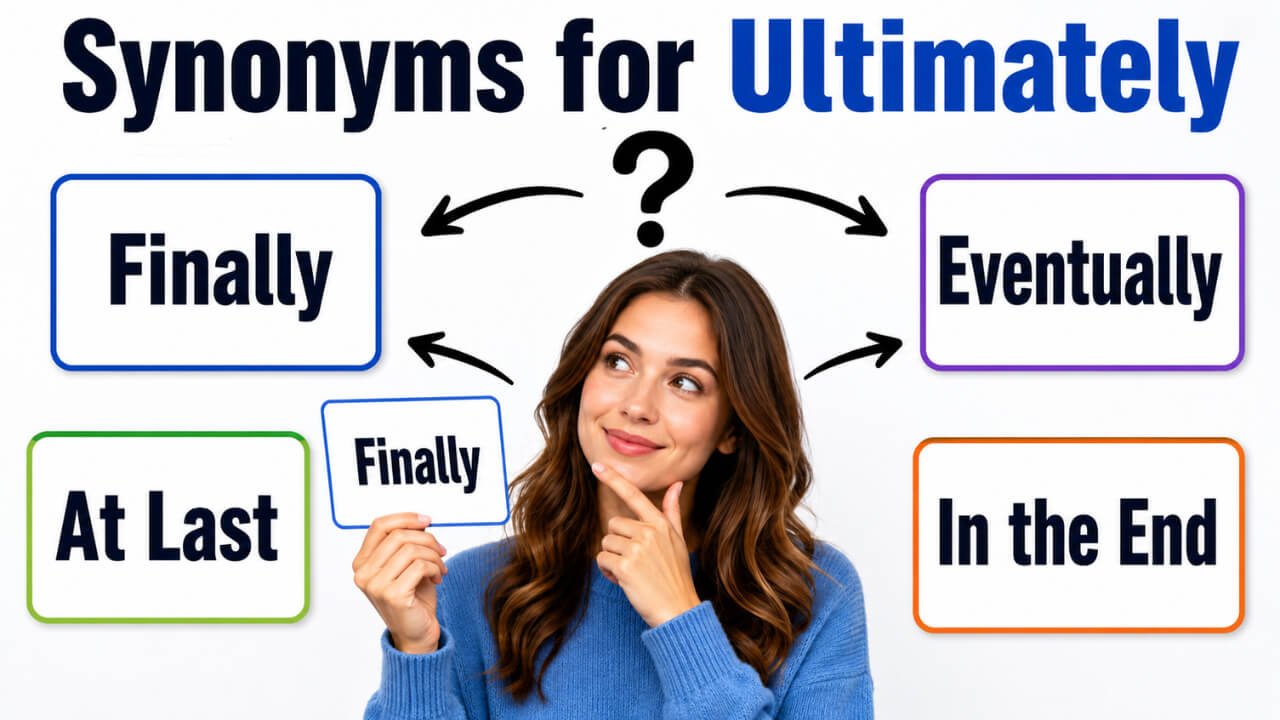
Quick Answer: The best synonyms for ultimately include finally, eventually, in the end, at last, in conclusion, in the final analysis, in the long run, all things considered, essentially, and fundamentally. Use finally for the last step, eventually for something that happens after time, in the end for final results, in conclusion for essays, and fundamentally when showing the deepest truth or main reason.
Pronunciation and Word Details
Word: Ultimately.
Pronunciation: /ˈʌl.tə.mət.li/.
Part of Speech: Adverb.
Meaning: In the end, finally, or as the final result after everything is considered.
US Pronunciation:
UK Pronunciation:
What Does “Ultimately” Mean?
Direct Answer: Ultimately means finally, in the end, or after all facts, events, reasons, or results have been considered.
Ultimately is an adverb. It often shows the final result of a situation, the final point in an explanation, or the deepest reason behind something. It can describe what happens after time passes, what becomes true after a process, or what matters most when all details are considered.
You can use ultimately in academic writing, essays, reports, professional writing, and everyday conversation. It is especially useful when you want to connect several ideas and then present the final outcome or main conclusion.
Meaning, Tone, and Context of “Ultimately”
Ultimately has a neutral and thoughtful tone. It is more formal than finally in many contexts, but it is still easy to understand in normal conversation.
In essays and reports, ultimately often means in the final analysis or when everything is considered. In everyday speech, it can mean in the end. In deeper explanations, it can mean fundamentally or essentially.
The word is commonly used in discussions about results, decisions, consequences, conclusions, long term effects, main causes, personal choices, and final meanings.
When and How to Use “Ultimately”
For Final Results: Use ultimately when explaining what happens in the end after a process, event, or situation.
Example: The plan faced several problems, but it ultimately succeeded.
For Conclusions: Use ultimately when giving the final point after discussing different ideas.
Example: Ultimately, clear vocabulary helps readers understand your message.
For Main Reasons: Use ultimately when pointing to the deepest or most important cause.
Example: The issue is ultimately about trust.
For Long Term Outcomes: Use ultimately when something becomes true after time passes.
Example: Good study habits ultimately improve writing skills.
For Final Decisions: Use ultimately when the final choice belongs to someone or something.
Example: The decision ultimately depends on the reader’s purpose.
For Core Meaning: Use ultimately when showing the basic truth behind a situation.
Example: Grammar is ultimately a tool for clearer communication.
Best Synonyms for Ultimately
Finally: At the last point or after everything else.
Example: After many attempts, the team finally solved the problem.
Eventually: After some time or after a series of events.
Example: With steady practice, the student eventually improved.
In the end: As the final result.
Example: In the end, the simpler sentence was stronger.
At last: Finally, especially after waiting or effort.
Example: At last, they found the correct answer.
In conclusion: Used before the final point in writing or speaking.
Example: In conclusion, word choice changes the tone of a sentence.
In the final analysis: When everything has been considered carefully.
Example: In the final analysis, meaning depends on context.
In the long run: After a long period of time.
Example: Reading regularly helps vocabulary in the long run.
All things considered: After thinking about every important detail.
Example: All things considered, the shorter phrase works better.
Essentially: In the most basic or important sense.
Example: The two words are essentially similar in meaning.
Fundamentally: At the most basic or important level.
Example: The problem is fundamentally about unclear communication.
50 Synonyms for Ultimately with Short Meanings
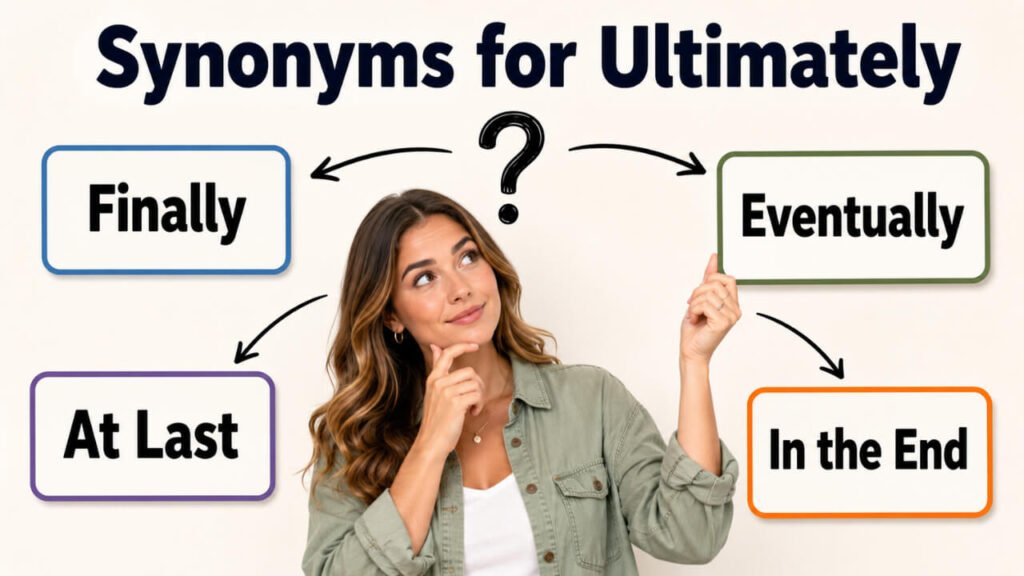
- Finally: At the last point.
- Eventually: After some time.
- In the end: As the final result.
- At last: After waiting or effort.
- Lastly: As the final item or point.
- At the end: At the final stage.
- By the end: Before or at the final point.
- In time: After enough time has passed.
- In due course: At the proper later time.
- Sooner or later: At some future point.
- In the long run: After a long period.
- Over time: Gradually as time passes.
- In the final outcome: As the final result.
- As a final outcome: As the result after everything.
- In the final result: In the end result.
- As a result: Because of what happened.
- In the final analysis: After careful consideration.
- In the last analysis: After everything is examined.
- All things considered: After considering all details.
- When all is said and done: After everything has been considered.
- At the end of the day: In the final or practical sense.
- On balance: After weighing the main points.
- Overall: Considering everything together.
- In conclusion: As the final statement.
- To conclude: To give the final point.
- To sum up: To state the main final idea.
- In summary: In a short final form.
- In closing: As the final part.
- As a final point: As the last idea.
- The bottom line is: The main final point is.
- In essence: In the basic meaning.
- Essentially: In the most basic sense.
- Fundamentally: At the deepest level.
- Basically: In a simple basic way.
- At heart: In the true basic nature.
- At bottom: In the most basic sense.
- In truth: In the real sense.
- In reality: In the actual situation.
- In effect: In practical result.
- In practical terms: In real use or effect.
- At the core: At the central point.
- In the main: Mostly or overall.
- As things turn out: As the situation finally develops.
- As it turns out: As the final truth becomes clear.
- After everything: After all events or points.
- After all: Considering the final truth.
- In the final reckoning: After final judgment or calculation.
- Conclusively: In a final and certain way.
- Decisively: In a final and clear way.
- Definitively: In a final and certain manner.
Read Also:
Synonyms for Overall
Synonyms for Ultimately by Context
When Ultimately Means Finally
Use these synonyms when ultimately describes the last step, final moment, or end of a process.
Useful Synonyms: Finally, eventually, at last, lastly, at the end, by the end.
Example: The writer finally found a stronger synonym.
Example: The meaning became clear at last.
When Ultimately Means In the End
Use these synonyms when showing the final result after many events, choices, or changes.
Useful Synonyms: In the end, in the final outcome, in the final result, as things turn out, after everything.
Example: In the end, the shorter sentence sounded more natural.
Example: After everything, the original phrase was still the clearest option.
When Ultimately Means In Conclusion
Use these synonyms in essays, reports, explanations, and formal writing.
Useful Synonyms: In conclusion, to conclude, to sum up, in summary, in closing, as a final point.
Example: In conclusion, synonyms help writers choose tone more carefully.
Example: To sum up, context decides which word works best.
When Ultimately Means Fundamentally
Use these synonyms when ultimately points to the deepest reason, main truth, or basic idea.
Useful Synonyms: Fundamentally, essentially, basically, in essence, at heart, at the core.
Example: The question is fundamentally about meaning.
Example: At the core, grammar helps people communicate clearly.
When Ultimately Means After Consideration
Use these synonyms when you want to show a final judgment after weighing many details.
Useful Synonyms: All things considered, in the final analysis, on balance, overall, when all is said and done.
Example: All things considered, the formal word fits the essay better.
Example: In the final analysis, clarity matters more than style.
Another Word for Ultimately
Direct Answer: Another word for ultimately is finally, but the best single replacement depends on the sentence.
Use finally when talking about the last step. Use eventually when time passes before something happens. Use in the end when showing a final result. Use fundamentally when explaining the deepest reason or basic truth.
Original: Ultimately, the plan worked.
Better Option: In the end, the plan worked.
Original: The answer is ultimately about context.
Better Option: The answer is fundamentally about context.
Original: She ultimately became a stronger writer.
Better Option: She eventually became a stronger writer.
Original: Ultimately, the essay supports the same idea.
Better Option: In conclusion, the essay supports the same idea.
When Not to Use “Ultimately”
Do not use ultimately when a simpler or more specific word would make the sentence clearer. In casual speech, finally or in the end may sound more natural. In formal essays, in conclusion may be better for the final paragraph. When discussing gradual change, eventually is often more accurate.
Avoid using ultimately too often in the same article or paragraph. Repetition can make writing sound heavy and less natural.
Weak: Ultimately, the class ended, and ultimately, everyone understood the lesson.
Better: Finally, the class ended, and everyone understood the lesson.
Weak: Ultimately, she reached the station after two hours.
Better: She eventually reached the station after two hours.
Weak: Ultimately, this paragraph will finish the essay.
Better: In conclusion, this paragraph will finish the essay.
Weak: The room is ultimately large.
Better: The room is very large.
Words Commonly Confused With Ultimately
Ultimately vs Finally: Ultimately often means as the final result or deepest truth, while finally usually means at the last point in time or order.
Ultimately vs Eventually: Ultimately focuses on final result, while eventually focuses on something happening after time passes.
Ultimately vs Lastly: Ultimately gives a final result or conclusion, while lastly introduces the final item in a list.
Ultimately vs Finally: Finally can mark the last step, but ultimately can also show the main conclusion after deeper thought.
Ultimately vs Fundamentally: Ultimately can mean in the final result, while fundamentally means at the most basic level.
Ultimately vs Essentially: Ultimately may point to the final outcome, while essentially points to the basic nature of something.
Ultimately vs Conclusively: Ultimately means in the end, while conclusively means in a final and certain way.
Which Synonym Should You Choose?
Choose finally when writing about the last event, step, or point in a sequence.
Choose eventually when something happens after time, delay, effort, or gradual change.
Choose in the end when showing the final result of a situation.
Choose at last when something happens after waiting, effort, or difficulty.
Choose in conclusion when writing the final part of an essay, article, or formal explanation.
Choose in the final analysis when presenting a thoughtful final judgment.
Choose all things considered when showing that many details were weighed before the final opinion.
Choose in the long run when describing results that appear after a long time.
Choose fundamentally when explaining the deepest reason or main cause.
Choose essentially when simplifying something to its basic meaning.
Real Life Examples of “Ultimately” in Sentences
Original: Ultimately, the new method helped the students.
Better Option: In the end, the new method helped the students.
Original: She ultimately chose the simpler sentence.
Better Option: She finally chose the simpler sentence.
Original: The project ultimately became successful.
Better Option: The project eventually became successful.
Original: Ultimately, vocabulary improves through practice.
Better Option: In the long run, vocabulary improves through practice.
Original: The issue is ultimately about clarity.
Better Option: The issue is fundamentally about clarity.
Original: Ultimately, the writer wanted a more polite tone.
Better Option: In the final analysis, the writer wanted a more polite tone.
Original: The lesson ultimately shows why context matters.
Better Option: The lesson essentially shows why context matters.
Original: Ultimately, both words can be correct.
Better Option: All things considered, both words can be correct.
Original: The discussion ultimately ended with agreement.
Better Option: The discussion finally ended with agreement.
Original: Ultimately, the answer depends on the sentence.
Better Option: The bottom line is that the answer depends on the sentence.
Synonym Groups and Usage Differences
Final Time Group
This group shows something happening at the last point or after delay.
Synonyms: Finally, eventually, at last, in time, in due course.
Example: The student eventually understood the difference.
Final Result Group
This group shows what happens after all events, choices, or changes.
Synonyms: In the end, in the final outcome, as things turn out, after everything.
Example: In the end, the simple word worked best.
Conclusion Group
This group is useful for essays, reports, explanations, and closing statements.
Synonyms: In conclusion, to conclude, to sum up, in summary, in closing.
Example: In conclusion, synonyms should match tone and context.
Deep Meaning Group
This group explains the main reason, basic truth, or central idea.
Synonyms: Fundamentally, essentially, basically, in essence, at heart.
Example: The rule is essentially about sentence clarity.
Judgment Group
This group helps when giving a final opinion after considering different points.
Synonyms: All things considered, on balance, overall, in the final analysis.
Example: On balance, the formal synonym is more suitable.
Antonyms of Ultimately
Initially: At the beginning.
First: Before anything else.
Originally: At the start or in the earliest form.
At first: In the beginning stage.
To begin with: At the start of a discussion or process.
First of all: Before other points are mentioned.
Temporarily: For a short time, not finally.
Provisionally: For now, but not as a final decision.
Immediately: At once, without delay.
Currently: At the present time, not necessarily in the end.
Presently: Now or soon, depending on context.
Superficially: On the surface, not at the deepest level.
Comparison: Ultimately vs Related Words
Ultimately vs Finally
Difference: Ultimately focuses on the final result or conclusion, while finally focuses more on the last moment or last step.
Example With Ultimately: Ultimately, the decision depends on the reader’s purpose.
Example With Finally: Finally, the teacher explained the last rule.
Ultimately vs Eventually
Difference: Ultimately shows the final result, while eventually shows that something happens after time passes.
Example With Ultimately: Ultimately, the plan succeeded.
Example With Eventually: The plan eventually succeeded after several changes.
Ultimately vs Lastly
Difference: Ultimately gives a final result or judgment, while lastly introduces the final item in a list.
Example With Ultimately: Ultimately, the strongest synonym depends on context.
Example With Lastly: Lastly, check the tone of your sentence.
Ultimately vs Fundamentally
Difference: Ultimately can mean in the end, while fundamentally means at the deepest or most basic level.
Example With Ultimately: Ultimately, the problem was solved.
Example With Fundamentally: The problem was fundamentally about poor communication.
Ultimately vs Essentially
Difference: Ultimately can show a final outcome, while essentially shows the basic meaning or true nature.
Example With Ultimately: Ultimately, the answer changed.
Example With Essentially: The two answers are essentially the same.
Ultimately vs In Conclusion
Difference: Ultimately works in many sentence positions, while in conclusion is mainly used to introduce a final summary.
Example With Ultimately: Ultimately, strong writing depends on clear word choice.
Example With In Conclusion: In conclusion, strong writing depends on clear word choice.
Common Phrases and Expressions With Ultimately
Ultimately Responsible: Finally accountable for something.
Ultimately Decide: Make the final decision.
Ultimately Depends: Depends in the final result.
Ultimately Means: Means in the deepest or final sense.
Ultimately Leads To: Results in something in the end.
Ultimately Results In: Produces a final outcome.
Ultimately Comes Down To: Is mainly about one final issue.
Ultimately About: Mainly or fundamentally connected to something.
Ultimately Successful: Successful in the end.
Ultimately True: True in the final or deepest sense.
Common Mistakes to Avoid
One common mistake is using ultimately when the sentence only needs finally. If you are simply describing the last step in a process, finally may sound clearer.
Another mistake is using ultimately when time is the main idea. If something happens after a delay, eventually is often more natural.
Writers also confuse ultimately with lastly. Use lastly for the final item in a list, and use ultimately for a final result or conclusion.
Avoid using ultimately too often in formal writing. It is useful, but repeated use can make an article sound heavy. Replace it with in the end, in conclusion, in the final analysis, essentially, or fundamentally when the context fits.
Also avoid using ultimately with simple physical descriptions. A sentence like the bag is ultimately heavy sounds unnatural. Use very, extremely, or a stronger adjective instead.
Conclusion
Synonyms for ultimately help writers express final results, conclusions, long term outcomes, and deeper meanings with more precision. Use finally for the last step, eventually for delayed results, in the end for final outcomes, in conclusion for essays, and fundamentally or essentially for core meaning. The best replacement depends on whether you are discussing time, result, judgment, or basic truth. Choosing the right synonym makes your writing clearer, smoother, and more natural.
FAQs About Synonyms for Ultimately
What is the best synonym for ultimately?
Answer: The best general synonym for ultimately is in the end. It works well when describing a final result or outcome.
What is a formal synonym for ultimately?
Answer: Formal synonyms for ultimately include in the final analysis, all things considered, in conclusion, and fundamentally.
Is ultimately the same as finally?
Answer: Not always. Finally usually means at the last point, while ultimately often means as the final result or deepest conclusion.
What is another word for ultimately in an essay?
Answer: In an essay, good alternatives include in conclusion, in the final analysis, to conclude, and all things considered.
What is another word for ultimately in casual speech?
Answer: In casual speech, you can use in the end, finally, eventually, or at the end of the day.
Can ultimately mean fundamentally?
Answer: Yes, ultimately can mean fundamentally when it points to the deepest reason, main truth, or basic cause.
What is the opposite of ultimately?
Answer: Opposites of ultimately include initially, first, originally, at first, and to begin with.
