
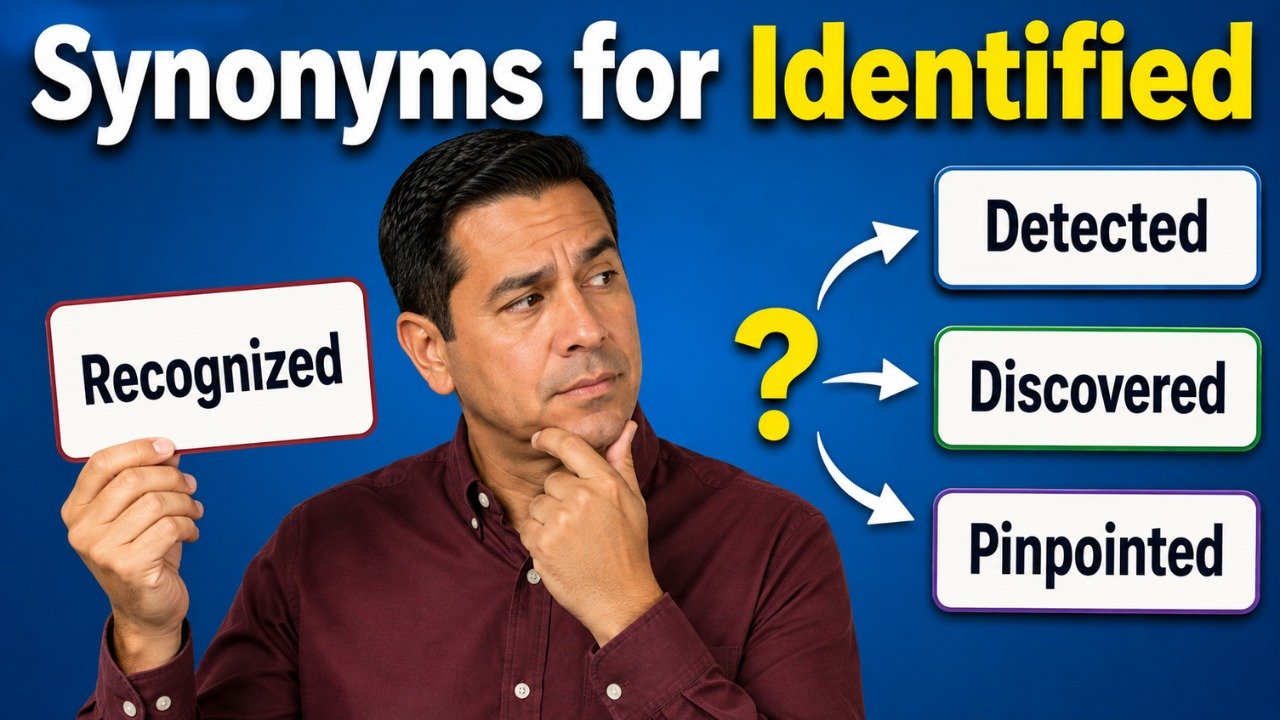
Quick Answer: The best synonyms for identified include recognized, detected, named, established, determined, discovered, located, distinguished, verified, and confirmed. Use recognized when someone or something becomes familiar, detected when something hidden is found, and named when its exact identity is stated. Established and determined suit formal reports or investigations. Verified and confirmed show that an identity or fact has been checked, while distinguished explains how one person or object was separated from others.
Pronunciation and Word Details
Word: Identified.
Pronunciation: /aɪˈdentɪfaɪd/
Part of Speech: Verb, past tense and past participle of identify. It can also function as an adjective in some contexts.
Meaning: Recognized, named, discovered, or established the identity or nature of someone or something.
US Pronunciation:
UK Pronunciation:
What Does “Identified” Mean?
Identified means recognized, named, discovered, or established exactly who or what someone or something was.
The word is usually the past tense or past participle form of the verb identify. It may also work like an adjective when describing a person, object, issue, or group whose identity has already been established.
Example: The witness identified the driver.
In this sentence, identified means that the witness recognized and named the driver.
Example: Researchers identified the cause of the problem.
Here, identified means that researchers discovered or determined the cause.
Example: The identified risks were added to the report.
In this example, identified functions like an adjective. It describes risks that have already been recognized and recorded.
The exact meaning changes according to context. Identified can mean recognized by appearance, detected through observation, named in a document, classified into a group, located during a search, or confirmed through evidence.
Meaning, Tone, and Context of “Identified”
Identified generally has a neutral and informative tone. It is widely used in everyday conversation, formal writing, academic work, investigations, reports, research, technical explanations, and professional communication.
Neutral Use: Identified can simply mean recognized or named.
Example: She identified the person in the photograph.
Formal Use: In reports and research, it often means established through careful examination.
Example: The study identified several causes of declining performance.
Technical Use: In scientific or technical contexts, it may mean detected, isolated, classified, or verified.
Example: The technician identified a fault in the electrical system.
Investigative Use: In an investigation, it may refer to recognizing a person, locating evidence, or determining a cause.
Example: Investigators identified the source of the noise.
Medical Use: In health related contexts, identified may mean detected or diagnosed. However, diagnosed is normally more precise when referring to a medical condition.
Example: The examination identified an unusual change.
Personal Use: Identified may describe a person recognizing a feeling, need, goal, strength, or weakness.
Example: He identified the main reason for his frustration.
Classification Use: It can explain that something was placed into a particular category.
Example: The plant was identified as a rare species.
The word is not usually emotional. Its tone is factual and clear. However, it can sound serious when used in discussions of mistakes, risks, suspects, illnesses, or security concerns.
When and How to Use “Identified”
For Recognizing a Person or Object
Use identified when someone recognizes a person, place, object, voice, sound, or image.
Example: She identified her former teacher in the photograph.
For Naming Someone or Something
Use identified when the exact name or identity of a person, object, issue, or category becomes known.
Example: The report identified the person responsible for the final review.
For Discovering a Cause
Use identified when an examination reveals the reason behind an event, issue, change, or result.
Example: The team identified poor communication as the main cause of the delay.
For Detecting a Problem
Use identified when a fault, risk, weakness, or unusual condition is discovered.
Example: The inspection identified several safety concerns.
For Confirming an Identity
Use identified when evidence proves who or what someone or something is.
Example: The object was positively identified through detailed examination.
For Classifying Something
Use identified when an item, person, species, style, or condition is placed into a particular group.
Example: The flower was identified as a type of wild orchid.
For Locating Something
Use identified when the exact position, source, or location of something is found.
Example: Engineers identified the source of the water leak.
For Selecting an Important Detail
Use identified when a person or group chooses a particular issue, goal, need, or priority for attention.
Example: The committee identified cost reduction as its main priority.
For Describing Previously Recognized Information
Use identified before a noun when the person, risk, issue, or object has already been established.
Example: Every identified problem was included in the final document.
Best Synonyms for Identified
Recognized
Synonym: Recognized means knew someone or something from previous knowledge, experience, or distinctive features.
Example: She recognized the speaker from an earlier meeting.
Detected
Synonym: Detected means discovered something that was hidden, unclear, or difficult to notice.
Example: The device detected a small change in temperature.
Named
Synonym: Named means stated or provided the exact name of someone or something.
Example: The witness named the person who entered the room.
Established
Synonym: Established means proved or determined a fact, identity, cause, or relationship.
Example: The examination established the source of the error.
Determined
Synonym: Determined means reached a conclusion after consideration, testing, or investigation.
Example: The team determined that the problem began during installation.
Discovered
Synonym: Discovered means found something that was previously unknown or unnoticed.
Example: Researchers discovered a new pattern in the results.
Located
Synonym: Located means found the position or place of someone or something.
Example: The workers located the damaged pipe beneath the floor.
Distinguished
Synonym: Distinguished means recognized the difference between similar people, objects, sounds, or ideas.
Example: She distinguished the original painting from the copy.
Verified
Synonym: Verified means checked and proved that an identity, claim, or detail was correct.
Example: The officer verified the visitor’s identity.
Confirmed
Synonym: Confirmed means established that something was true, correct, or definite.
Example: The final test confirmed the cause of the failure.
50 Synonyms for Identified with Short Meanings
- Recognized: Knew someone or something from familiar features.
- Detected: Discovered something hidden or difficult to notice.
- Named: Gave or stated the exact name.
- Established: Proved or determined a fact or identity.
- Determined: Reached a conclusion after examination.
- Discovered: Found something previously unknown.
- Located: Found the exact position of someone or something.
- Distinguished: Separated one person or thing from another by noticing differences.
- Verified: Checked and proved to be correct.
- Confirmed: Established as true or definite.
- Classified: Placed into a particular group or category.
- Categorized: Organized according to shared qualities.
- Labeled: Attached a name, term, or description.
- Designated: Officially selected or described for a purpose.
- Specified: Stated clearly and exactly.
- Pinpointed: Found or described with great precision.
- Spotted: Noticed or saw someone or something.
- Noticed: Became aware of something through observation.
- Observed: Saw or examined something carefully.
- Perceived: Became aware of something through the senses or mind.
- Discerned: Recognized something that was difficult to notice or understand.
- Diagnosed: Determined the nature of a condition or problem.
- Traced: Followed evidence back to its source or origin.
- Found: Discovered or located someone or something.
- Selected: Chose someone or something from a group.
- Singled Out: Chose one person or thing for special attention.
- Marked: Indicated or made something noticeable.
- Recorded: Entered information into a written or stored form.
- Documented: Created a detailed record of something.
- Described: Explained the qualities or appearance of something.
- Defined: Explained or established the exact nature of something.
- Characterized: Described through distinctive qualities or features.
- Attributed: Connected an action, quality, or result to a particular source.
- Associated: Connected someone or something with another person, group, or idea.
- Linked: Showed a relationship between two or more things.
- Matched: Connected something with a corresponding person, object, or record.
- Isolated: Separated a specific element from surrounding material.
- Exposed: Revealed something previously hidden.
- Uncovered: Brought unknown or concealed information to light.
- Revealed: Made a fact, identity, or detail known.
- Acknowledged: Recognized the existence, truth, or importance of something.
- Authenticated: Proved that someone or something was genuine.
- Validated: Confirmed that information, evidence, or a result was acceptable or correct.
- Ascertained: Discovered a fact with certainty through examination.
- Cataloged: Recorded and arranged systematically.
- Registered: Officially recorded or recognized.
- Indexed: Organized information so it could be found easily.
- Inventoried: Listed and recorded items in an organized way.
- Profiled: Described important qualities, behavior, or characteristics.
- Recognized As: Accepted or understood someone or something as belonging to a particular type.
Read Also:
Synonyms for Must

Synonyms for Identified by Context
When Identified Means Recognized
Use these words when someone realizes who or what a person, object, sound, image, or place is.
Recognized: Best for people, faces, voices, objects, and familiar details.
Example: She recognized the singer’s voice immediately.
Noticed: Best when someone becomes aware of a visible change or detail.
Example: He noticed a small crack near the window.
Spotted: Best in casual language when someone sees a person or object.
Example: We spotted the missing book beneath the desk.
Perceived: Best when awareness comes through observation, thought, or the senses.
Example: She perceived a change in his attitude.
Discerned: Best when something is difficult to recognize.
Example: The listener discerned a faint sound in the distance.
When Identified Means Named
Use these alternatives when the exact name, title, identity, or description is stated.
Named: Best when giving the name of a person, object, place, or issue.
Example: The witness named the individual she had seen.
Specified: Best when stating an exact person, requirement, amount, or detail.
Example: The instructions specified the required materials.
Labeled: Best when attaching a descriptive word or category.
Example: Each container was labeled according to its contents.
Designated: Best for an official role, purpose, place, or responsibility.
Example: The room was designated as a quiet study area.
Defined: Best when explaining the exact nature or boundaries of something.
Example: The document defined the responsibilities of each member.
When Identified Means Detected
Use these words when something hidden, unclear, unexpected, or difficult to notice is found.
Detected: Best for faults, signals, changes, risks, and hidden conditions.
Example: The sensor detected movement near the entrance.
Discovered: Best when finding something previously unknown.
Example: The researchers discovered an unexpected connection.
Uncovered: Best when hidden information becomes known through investigation.
Example: The review uncovered several reporting errors.
Exposed: Best when a hidden problem, weakness, or truth is revealed.
Example: The inspection exposed weaknesses in the structure.
Observed: Best when something is noticed through careful examination.
Example: Scientists observed a change in the material.
When Identified Means Determined
Use these alternatives when an answer, cause, fact, or conclusion is reached after careful examination.
Determined: Best for conclusions based on evidence, testing, or reasoning.
Example: The panel determined that further review was necessary.
Established: Best when evidence firmly proves a fact or relationship.
Example: The investigation established the sequence of events.
Ascertained: Best in formal writing when a fact becomes known with certainty.
Example: The inspector ascertained the cause of the damage.
Diagnosed: Best when determining the nature of a medical, mechanical, or organizational problem.
Example: The technician diagnosed a fault in the cooling system.
Pinpointed: Best when locating an exact cause, place, time, or detail.
Example: The team pinpointed the source of the unusual sound.
When Identified Means Confirmed
Use these alternatives when an identity, fact, claim, result, or connection has been checked.
Confirmed: Best when new information proves an earlier belief or result.
Example: The second test confirmed the original finding.
Verified: Best when information has been checked for accuracy.
Example: The editor verified every date in the document.
Authenticated: Best when proving that a document, object, signature, or identity is genuine.
Example: An expert authenticated the historical letter.
Validated: Best for methods, information, systems, and results that have been tested or approved.
Example: The review validated the accuracy of the process.
Matched: Best when a person, object, detail, or record corresponds with another.
Example: The sample matched the description in the report.
When Identified Means Classified
Use these words when someone or something is placed into a group according to shared qualities.
Classified: Best for formal grouping according to defined standards.
Example: The material was classified as recyclable.
Categorized: Best when organizing people, objects, or information into groups.
Example: The responses were categorized by topic.
Characterized: Best when describing something through its main qualities.
Example: The period was characterized by rapid social change.
Cataloged: Best when recording and organizing a collection.
Example: Every item was cataloged according to its origin.
Indexed: Best when organizing information for quick reference.
Example: The documents were indexed by subject.
When Identified Means Singled Out
Use these alternatives when one person, issue, item, or goal is selected from a larger group.
Selected: Best when a person or thing is deliberately chosen.
Example: Three proposals were selected for further review.
Singled Out: Best when one person or thing receives special attention.
Example: The report singled out communication as a major weakness.
Designated: Best when someone or something is officially chosen for a purpose.
Example: One employee was designated as the project coordinator.
Marked: Best when something is indicated for attention or action.
Example: The damaged boxes were marked for inspection.
Prioritized: Best when something is chosen as more important than other options.
Example: The team prioritized the most urgent repairs.
Another Word for Identified
The best general replacement for identified is recognized. It works naturally when someone realizes who or what a person, object, sound, quality, or issue is.
However, the most accurate alternative depends on context. Use detected for hidden problems, named for a stated identity, determined for a conclusion, located for a position, classified for a category, and confirmed when evidence proves something.
Original: She identified the person in the photograph.
Better Option: She recognized the person in the photograph.
Original: The inspection identified a fault in the system.
Better Option: The inspection detected a fault in the system.
Original: Researchers identified the main cause of the change.
Better Option: Researchers determined the main cause of the change.
Original: The report identified three areas for improvement.
Better Option: The report highlighted three areas for improvement.
When Not to Use “Identified”
Avoid identified when another word can explain the exact action more clearly.
When Something Was Only Noticed
Identified suggests that the nature or identity of something became known. Use noticed when someone simply became aware of it.
Weak: She identified that the door was open.
Better: She noticed that the door was open.
When a Hidden Issue Was Detected
Detected is often more precise for signals, faults, risks, changes, or hidden conditions.
Weak: The device identified a change in pressure.
Better: The device detected a change in pressure.
When a Medical Condition Was Diagnosed
Diagnosed is usually more accurate when a qualified professional determines the nature of a condition.
Weak: The doctor identified the patient with a seasonal allergy.
Better: The doctor diagnosed the patient with a seasonal allergy.
When a Location Was Found
Located or pinpointed is clearer when describing the position of a person, object, source, or problem.
Weak: The workers identified the broken pipe beneath the wall.
Better: The workers located the broken pipe beneath the wall.
When a Fact Was Confirmed
Use confirmed or verified when the main idea is that evidence proved something correct.
Weak: The records identified that the payment had been received.
Better: The records confirmed that the payment had been received.
When Someone Was Merely Mentioned
Identified may wrongly suggest recognition or confirmation.
Weak: The article identified several possible solutions.
Better: The article mentioned several possible solutions.
When the Evidence Is Uncertain
Do not use identified if the identity, cause, or conclusion has not been established.
Weak: The unclear image identified the visitor as Daniel.
Better: The unclear image suggested that the visitor might be Daniel.
When the Sentence Becomes Repetitive
Repeated use of identified can make formal writing sound mechanical.
Repetitive: The review identified several risks and identified three possible solutions.
Better: The review uncovered several risks and proposed three possible solutions.
Words Commonly Confused With Identified
Identified vs Recognized: Identified can mean established the identity or nature of something. Recognized usually means knew something because it was familiar.
Example With Identified: Investigators identified the source of the message.
Example With Recognized: She recognized the writer’s familiar style.
Identified vs Detected: Identified explains what something is. Detected means discovered that something exists.
Example With Identified: The technician identified the damaged component.
Example With Detected: The sensor detected unusual heat inside the machine.
Identified vs Named: Identified may involve recognition, investigation, or classification. Named simply means stated the name.
Example With Identified: The witness identified the driver from a photograph.
Example With Named: The witness named the driver during the interview.
Identified vs Diagnosed: Identified is a general word for recognizing a problem. Diagnosed means determining the exact nature of a medical, technical, or organizational condition.
Example With Identified: The review identified a problem with communication.
Example With Diagnosed: The consultant diagnosed the underlying cause of the communication problem.
Identified vs Confirmed: Identified means recognized or established who or what something is. Confirmed means proved that earlier information was correct.
Example With Identified: The team identified the source of the error.
Example With Confirmed: Additional testing confirmed that the source had been identified correctly.
Identified vs Classified: Identified establishes identity or nature. Classified places something into a group.
Example With Identified: The expert identified the material as oak.
Example With Classified: The expert classified the material as hardwood.
Identified vs Located: Identified explains what something is. Located explains where it is.
Example With Identified: The engineer identified the source of the leak.
Example With Located: The engineer located the leak behind the wall.
Which Synonym Should You Choose?
Choose recognized when someone knows a familiar person, face, voice, object, or pattern.
Choose detected when a hidden fault, signal, risk, change, or condition is discovered.
Choose named when the exact identity or title of someone or something is stated.
Choose determined when evidence or reasoning leads to a conclusion.
Choose established when a formal investigation or examination proves a fact.
Choose discovered when something previously unknown becomes known.
Choose located when finding the position of a person, object, source, or problem.
Choose pinpointed when an exact cause, place, moment, or detail is found.
Choose distinguished when separating one similar person, sound, object, or idea from another.
Choose confirmed when later evidence supports an earlier belief or result.
Choose verified when facts, records, claims, or identities are carefully checked.
Choose authenticated when proving that an object, document, signature, or identity is genuine.
Choose diagnosed when determining the exact nature of a medical, mechanical, or organizational problem.
Choose classified when placing something into a formal group or category.
Choose categorized when organizing information or items by shared qualities.
Choose singled out when selecting one person, issue, or detail for special attention.
Choose specified when exact requirements, names, amounts, or details are stated.
Choose documented when a finding has been recorded with supporting information.
Choose highlighted in reports, essays, or emails when drawing attention to an important issue.
Choose noticed in casual conversation when someone simply becomes aware of something.
Real Life Examples of “Identified” in Sentences
Original: She identified the man standing near the entrance.
Better Option: She recognized the man standing near the entrance.
Original: The machine identified a small change in temperature.
Better Option: The machine detected a small change in temperature.
Original: The report identified poor planning as the main issue.
Better Option: The report named poor planning as the main issue.
Original: The investigation identified the cause of the delay.
Better Option: The investigation determined the cause of the delay.
Original: Workers identified the damaged cable behind the wall.
Better Option: Workers located the damaged cable behind the wall.
Original: Experts identified the document as genuine.
Better Option: Experts authenticated the document as genuine.
Original: The study identified a connection between the two patterns.
Better Option: The study established a connection between the two patterns.
Original: The teacher identified three students for the leadership program.
Better Option: The teacher selected three students for the leadership program.
Original: The plant was identified as a type of wild rose.
Better Option: The plant was classified as a type of wild rose.
Original: The review identified several important concerns.
Better Option: The review highlighted several important concerns.
Synonym Groups and Usage Differences
Recognition Group
This group includes recognized, noticed, spotted, perceived, observed, and discerned. These words describe becoming aware of a person, object, feature, or change.
Recognized suggests familiarity. Noticed means becoming aware of something. Spotted is more casual and visual. Discerned suggests that recognition required careful attention.
Example: She recognized the familiar voice immediately.
Discovery Group
This group includes detected, discovered, uncovered, exposed, revealed, and found. These words describe bringing something unknown or hidden into awareness.
Detected is useful for signals, faults, and changes. Discovered is broader. Uncovered often suggests investigation. Exposed may suggest that something was intentionally hidden.
Example: The inspection detected damage beneath the surface.
Naming Group
This group includes named, labeled, specified, designated, described, and defined. These words provide a title, term, role, or exact explanation.
Named states an identity. Labeled attaches a descriptive term. Specified gives exact information. Designated officially assigns a role or purpose.
Example: The document specified the person responsible for approval.
Verification Group
This group includes verified, confirmed, authenticated, validated, established, and ascertained. These words show that evidence supports an identity, fact, or conclusion.
Verified emphasizes checking. Confirmed supports an earlier finding. Authenticated proves that something is genuine. Established suggests strong supporting evidence.
Example: The records verified the customer’s identity.
Classification Group
This group includes classified, categorized, cataloged, indexed, registered, and inventoried. These words describe organizing and recording information or objects.
Classified and categorized place things into groups. Cataloged and inventoried create organized records. Indexed makes stored information easier to locate.
Example: The files were categorized according to subject.
Selection Group
This group includes selected, singled out, designated, marked, and prioritized. These words describe choosing someone or something for attention, responsibility, or action.
Selected is neutral. Singled out emphasizes one choice from a group. Designated suggests an official decision. Prioritized shows greater importance.
Example: Communication was singled out as the most urgent issue.
Connection Group
This group includes linked, associated, attributed, matched, and traced. These words explain a relationship between a person, action, source, event, or result.
Linked shows a connection. Attributed assigns a cause or source. Matched connects corresponding details. Traced follows evidence back to an origin.
Example: Investigators traced the error to an outdated record.
Antonyms of Identified
The opposite of identified depends on whether the word means recognized, discovered, named, confirmed, or classified.
Unidentified: Not yet recognized or named.
Unrecognized: Not known or accepted from familiar qualities.
Undetected: Existing without being discovered.
Unknown: Not known, understood, or established.
Unnamed: Not given or stated by name.
Anonymous: Having no publicly known name or identity.
Overlooked: Not noticed or considered.
Missed: Failed to notice, discover, or understand.
Ignored: Deliberately given no attention.
Hidden: Kept out of sight or knowledge.
Concealed: Intentionally prevented from being seen or known.
Obscured: Made difficult to see, recognize, or understand.
Unconfirmed: Not yet proved to be true.
Unverified: Not checked or supported by evidence.
Unclassified: Not placed into a category.
Misidentified: Recognized or described incorrectly.
Confused: Mistaken for someone or something else.
Unspecified: Not stated clearly or exactly.
Comparison: Identified vs Related Words
Identified vs Recognized
Identified means established who or what someone or something was. Recognized usually means knew someone or something because of familiar qualities.
Example With Identified: The investigator identified the owner of the vehicle.
Example With Recognized: She recognized the vehicle from its unusual shape.
Identified vs Detected
Identified explains the exact identity or nature of something. Detected only means that its existence became known.
Example With Identified: The technician identified the fault as a damaged wire.
Example With Detected: The system detected a fault during operation.
Identified vs Named
Identified may involve evidence, recognition, or examination. Named means directly giving the name.
Example With Identified: The witness identified the woman in the photograph.
Example With Named: The witness named the woman during the interview.
Identified vs Determined
Identified often focuses on recognizing a person, object, cause, or issue. Determined focuses on reaching a conclusion through evidence or reasoning.
Example With Identified: The review identified poor scheduling as a concern.
Example With Determined: The review determined that poor scheduling caused the delay.
Identified vs Discovered
Identified explains what something is after it has been recognized. Discovered emphasizes finding something previously unknown.
Example With Identified: Experts identified the object as an ancient tool.
Example With Discovered: Workers discovered the object beneath the ground.
Identified vs Located
Identified establishes identity or nature. Located finds position.
Example With Identified: The team identified the missing item as a historical document.
Example With Located: The team located the historical document in a storage room.
Identified vs Confirmed
Identified means recognized, named, or established. Confirmed means proved that an earlier claim, result, or belief was correct.
Example With Identified: The test identified the source of the problem.
Example With Confirmed: A second test confirmed the original result.
Identified vs Classified
Identified determines what something is. Classified places it into an organized group.
Example With Identified: The expert identified the bird as a young eagle.
Example With Classified: The expert classified the bird as a protected species.
Identified vs Diagnosed
Identified is a broad term for recognizing an issue. Diagnosed is more precise for determining the exact nature of a condition or complex problem.
Example With Identified: The manager identified a decline in productivity.
Example With Diagnosed: The consultant diagnosed unclear responsibilities as the underlying cause.
Identified vs Verified
Identified establishes who or what something is. Verified checks that the identification or information is correct.
Example With Identified: The clerk identified the account holder.
Example With Verified: The clerk verified the account holder’s details.
Common Phrases and Expressions With “Identified”
Identified As: Recognized or classified as a particular person, thing, type, or condition.
Example: The object was identified as a traditional farming tool.
Identified By: Recognized through a feature, person, method, or piece of evidence.
Example: The plant can be identified by its narrow leaves.
Clearly Identified: Recognized or stated without uncertainty.
Example: Every responsibility was clearly identified in the plan.
Positively Identified: Confirmed with strong evidence or complete confidence.
Example: The missing item was positively identified by its owner.
Correctly Identified: Recognized or named without error.
Example: She correctly identified every bird in the photograph.
Easily Identified: Simple to recognize because of clear features.
Example: The building is easily identified by its tall entrance.
Newly Identified: Recently recognized, discovered, or classified.
Example: The newly identified issue required immediate attention.
Previously Identified: Recognized or recorded at an earlier time.
Example: The team reviewed every previously identified risk.
Formally Identified: Officially recognized, recorded, or named.
Example: The location was formally identified as a protected area.
Identified Through: Discovered or recognized by using a particular method.
Example: The cause was identified through detailed testing.
Common Mistakes to Avoid
Using Identified for Simple Observation
Identified is stronger than noticed. Do not use it when someone merely becomes aware of an obvious detail.
Incorrect: He identified that the lights were off.
Correct: He noticed that the lights were off.
Confusing Identification With Detection
Detection proves that something exists. Identification explains what it is.
Unclear: The sensor identified movement.
Better: The sensor detected movement.
Clear Identification: The system identified the movement as coming from a small animal.
Using Identified Before Evidence Is Certain
Identified suggests a reasonably firm conclusion. Use suspected, suggested, or possibly recognized when evidence is incomplete.
Incorrect: The unclear photograph identified the person as James.
Correct: The unclear photograph suggested that the person might be James.
Confusing Identified With Diagnosed
Use diagnosed for a professionally determined medical condition or complex fault.
Less Precise: The specialist identified the condition as seasonal asthma.
Better: The specialist diagnosed the condition as seasonal asthma.
Using the Wrong Preposition
Use identified as when stating an identity, role, type, or category.
Correct: The material was identified as natural stone.
Use identified by when explaining who recognized something or which feature made recognition possible.
Correct: The tree was identified by its distinctive leaves.
Use identified with when describing a strong connection or shared identity.
Correct: She strongly identified with the character’s struggle.
Writing Vague Sentences
Explain exactly what was identified and why it matters.
Vague: Several things were identified.
Better: The inspection identified three damaged cables and two loose connections.
Repeating Identified Too Often
Use alternatives to make writing more natural and precise.
Repetitive: The study identified a pattern, identified its cause, and identified possible solutions.
Better: The study discovered a pattern, determined its cause, and proposed possible solutions.
Using Identified When Selected Is Intended
Identified does not always mean chosen.
Unclear: The manager identified Maria for the new role.
Better: The manager selected Maria for the new role.
Confusing Identified With Misidentified
Misidentified means that someone or something was recognized or named incorrectly.
Incorrect: The witness identified the wrong person correctly.
Correct: The witness misidentified the person.
Conclusion
The most useful synonyms for identified include recognized, detected, named, determined, established, located, classified, verified, and confirmed. Choose recognized for familiar people or objects, detected for hidden problems, named for exact identities, and determined for conclusions based on evidence. Located is best for positions, while verified and confirmed show accuracy or certainty. Understanding these synonyms for identified helps you describe recognition, discovery, classification, selection, and verification with greater precision.
FAQs About Synonyms for Identified
What Is the Best Synonym for Identified?
Recognized is the best general synonym when someone realizes who or what a person or object is. Detected, named, determined, located, or confirmed may be more precise in other contexts.
Is Recognized a Synonym for Identified?
Yes. Recognized is a close synonym when identified means knowing someone or something through familiar qualities, appearance, sound, or previous experience.
What Is a Formal Synonym for Identified?
Established, determined, ascertained, verified, authenticated, classified, and documented are useful formal alternatives. The best choice depends on whether the sentence describes proof, discovery, organization, or confirmation.
What Is Another Word for Identified a Problem?
Detected, discovered, uncovered, diagnosed, pinpointed, noticed, or recognized can replace identified a problem. Use diagnosed for a complex cause and pinpointed for an exact source.
What Is the Difference Between Identified and Detected?
Detected means discovering that something exists. Identified means determining exactly what it is. A system may detect a sound before an expert identifies its source.
What Is the Opposite of Identified?
Common opposites include unidentified, unrecognized, undetected, unknown, unnamed, unverified, hidden, overlooked, and unclassified.
Can Identified Mean Selected?
Identified can sometimes mean selected for attention, action, or responsibility. However, selected, chosen, designated, or singled out may express that meaning more clearly.
