
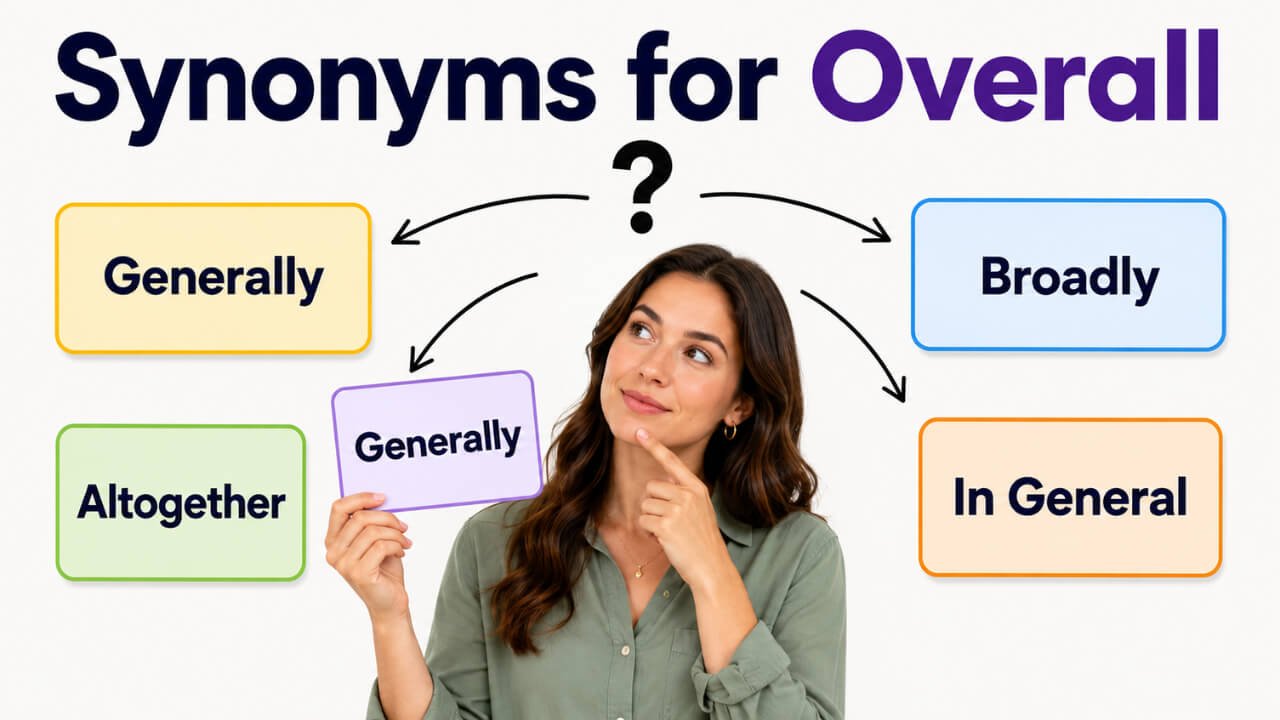
Quick Answer: Synonyms for overall include generally, in general, on the whole, all in all, as a whole, broadly, collectively, altogether, total, and comprehensive. Use generally for a broad statement, on the whole for a balanced summary, as a whole for considering everything together, total for numbers or amounts, and comprehensive when describing something complete or wide in scope.
Pronunciation and Word Details
Word: Overall.
Pronunciation: /ˌoʊvərˈɔːl/.
Part of Speech: Adjective and adverb.
Meaning: Overall means considering everything together or looking at the total result, general situation, or complete picture.
US Pronunciation:
UK Pronunciation:
What Does “Overall” Mean?
Overall means considered as a whole, including all parts, details, results, or factors.
As an adverb, overall is used to give a general judgment after considering different points. For example, “Overall, the project was successful.”
As an adjective, overall describes the total or complete effect, result, impression, score, quality, or condition. For example, “The overall performance improved.”
The word works in many sentence contexts, including summaries, reviews, reports, essays, evaluations, opinions, comparisons, results, and everyday conversation.
Meaning, Tone, and Context of “Overall”
Overall is a neutral, clear, and useful word. It is common in both formal and casual English.
In formal writing, overall often appears in reports, academic essays, business summaries, research findings, performance reviews, and data analysis. It helps writers summarize a complete situation without focusing on every single detail.
In casual speech, overall usually means “when everything is considered.” It is helpful when someone wants to give a balanced opinion, such as saying a movie, meal, event, plan, or experience was good despite a few small problems.
Overall can also sound slightly analytical because it invites the reader to think about the full picture.
When and How to Use “Overall”
For General Summary: Use overall when giving a broad opinion after considering all details.
Example: Overall, the meeting was productive.
For Final Judgment: Use overall when you want to state the main result after reviewing several points.
Example: The overall result was better than expected.
For Total Effect: Use overall when describing the complete impact of something.
Example: The new design improved the overall look of the room.
For Combined Performance: Use overall when several parts contribute to one final evaluation.
Example: Her overall performance was strong throughout the course.
For Complete View: Use overall when you want readers to think about the full situation rather than one detail.
Example: Overall, the plan is practical, but it needs a clearer timeline.
Best Synonyms for Overall
Generally: In most cases or as a broad statement.
Example: Generally, the new policy has helped employees work more efficiently.
In General: Considering the usual or broad situation.
Example: In general, the results were positive.
On the Whole: Considering everything together, especially with balance.
Example: On the whole, the event was well organized.
All in All: After considering every part of the situation.
Example: All in all, it was a successful trip.
As a Whole: Considering something as one complete unit.
Example: The team, as a whole, performed well.
Broadly: In a general way, without focusing on small details.
Example: Broadly, the proposal supports long term growth.
Collectively: Considered together as a group.
Example: The students collectively improved their scores.
Altogether: In total or when everything is included.
Example: Altogether, the changes made the process easier.
Total: Complete amount, result, or effect.
Example: The total cost was lower than expected.
Comprehensive: Complete and covering all important parts.
Example: The report gave a comprehensive view of the problem.
50 Synonyms for Overall with Short Meanings
- Generally: In most cases or in a broad way.
- In General: Considering the usual or complete situation.
- On the Whole: Considering everything together.
- All in All: After everything has been considered.
- As a Whole: As one complete thing.
- Broadly: In a general way.
- Collectively: Together as a group.
- Altogether: With everything included.
- Total: Complete in amount or result.
- Entire: Including every part.
- Complete: Having all necessary parts.
- Comprehensive: Covering all important points.
- Inclusive: Including everything relevant.
- Full: Complete or not partial.
- Whole: Complete and not divided.
- Overall View: Complete understanding of a situation.
- General: Not limited to one detail.
- Global: Covering the complete system or situation.
- Aggregate: Total after combining parts.
- Cumulative: Increasing or formed by adding parts together.
- Combined: Joined together into one result.
- Net: Final after gains and losses are considered.
- Final: Coming after all parts are considered.
- Ultimate: Final or most important.
- Main: Most important in the complete picture.
- Broad: Covering many parts or ideas.
- Large Scale: Affecting many parts or a wide area.
- Complete Picture: Full understanding of all parts.
- Big Picture: Main view without focusing on small details.
- General Picture: Broad view of a situation.
- Summary: Short statement of main points.
- In Total: With all parts counted.
- Taken Together: Considered as one combined result.
- By and Large: Mostly or generally true.
- Mostly: True in most situations.
- Largely: Mainly or to a great extent.
- Primarily: Mainly or chiefly.
- Principally: Mostly or mainly.
- Predominantly: Mostly or more than anything else.
- Mainly: More than any other factor.
- Essentially: In the most basic or important sense.
- Basically: In simple or general terms.
- Typically: Usually or normally.
- Usually: Happening in most cases.
- Commonly: Happening often or in many cases.
- Overall Result: Final result after all factors are included.
- Total Effect: Complete impact of something.
- Complete Assessment: Full evaluation of all parts.
- General Impression: Broad feeling or opinion.
- Final Assessment: Last judgment after reviewing everything.
Read Also:
Synonyms for Large

Synonyms for Overall by Context
When Overall Means Generally
Use these synonyms when overall means in most cases, usually, or broadly speaking.
Generally: Generally, the students understood the lesson.
In General: In general, the feedback was positive.
Usually: Usually, this method gives clear results.
Typically: Typically, the process takes two days.
Broadly: Broadly, the idea is useful and practical.
When Overall Means As a Whole
Use these synonyms when you want to consider all parts together instead of looking at one detail.
As a Whole: The class, as a whole, showed improvement.
On the Whole: On the whole, the report was clear.
All in All: All in all, the experience was enjoyable.
Taken Together: Taken together, the results show progress.
Collectively: The changes collectively improved the system.
When Overall Means Total
Use these synonyms when talking about numbers, amounts, scores, costs, results, or combined effects.
Total: The total score increased this month.
Aggregate: The aggregate data showed steady growth.
Cumulative: The cumulative effect was stronger than expected.
Combined: The combined cost was still affordable.
Net: The net result was a small improvement.
When Overall Means Final Judgment
Use these synonyms when giving a final opinion, conclusion, review, or assessment.
Final: The final assessment was positive.
Ultimate: The ultimate result depends on execution.
Main: The main conclusion is that the plan works.
Summary: The summary shows steady progress.
General Impression: My general impression is that the service improved.
When Overall Means Complete or Comprehensive
Use these synonyms when overall describes something complete, full, or wide in scope.
Complete: The complete review covered every stage.
Comprehensive: The guide gave a comprehensive explanation.
Inclusive: The inclusive plan considered every department.
Full: The full report explains the problem clearly.
Entire: The entire process was reviewed carefully.
Another Word for Overall
Another word for overall is generally when you mean “in most cases” or “considering the situation broadly.” However, the best alternative depends on context. Use as a whole when considering all parts together, total for numbers or amounts, on the whole for balanced judgment, and comprehensive for something complete.
Original: Overall, the lesson was useful.
Better Option: In general, the lesson was useful.
Original: The overall cost was lower than expected.
Better Option: The total cost was lower than expected.
Original: The team showed overall improvement.
Better Option: The team, as a whole, showed improvement.
Original: The article gives an overall explanation.
Better Option: The article gives a comprehensive explanation.
When Not to Use “Overall”
Do not use overall when a more exact word would make the meaning clearer. Overall can sound vague if the reader does not know whether you mean generally, totally, finally, completely, or collectively.
Weak: The overall thing was good.
Better: The experience, as a whole, was good.
Weak: The overall money was too much.
Better: The total cost was too high.
Weak: Overall, the data proves the result.
Better: Taken together, the data supports the result.
Weak: The overall guide explains grammar.
Better: The comprehensive guide explains grammar.
Do not use overall too many times in one paragraph. Repeating it can make writing sound flat. Replace it with generally, on the whole, as a whole, total, or final assessment depending on the sentence.
Words Commonly Confused With Overall
Overall vs Generally: Overall means considering everything together. Generally means in most cases or in a broad sense.
Overall vs Altogether: Overall gives a general judgment or total view. Altogether often means completely or with all parts counted.
Overall vs Total: Overall can describe a general view, impression, quality, or result. Total is usually used for numbers, amounts, scores, or costs.
Overall vs Average: Overall means considering all parts together. Average means the usual or calculated middle value.
Overall vs Comprehensive: Overall can mean general or total. Comprehensive means complete and covering all important details.
Overall vs Ultimately: Overall means considering everything together. Ultimately means in the end or finally.
Which Synonym Should You Choose?
Choose generally when making a broad statement about what is usually true.
Choose in general when you want a simple phrase for a broad opinion.
Choose on the whole when giving a balanced summary with both good and bad points.
Choose all in all when summarizing a complete experience in a conversational way.
Choose as a whole when talking about a group, system, team, article, report, or situation as one complete unit.
Choose total when writing about numbers, costs, scores, amounts, or measurements.
Choose aggregate when discussing combined data, results, or statistics.
Choose comprehensive when describing something complete, detailed, and wide in coverage.
Choose final assessment when giving a conclusion after reviewing all parts.
Choose big picture when you want to focus on the main view instead of small details.
Real Life Examples of “Overall” in Sentences
Original: Overall, the exam was easier than expected.
Better Option: In general, the exam was easier than expected.
Original: The overall cost of the trip was high.
Better Option: The total cost of the trip was high.
Original: The overall quality of the article improved.
Better Option: The quality of the article, as a whole, improved.
Original: Overall, the results were positive.
Better Option: On the whole, the results were positive.
Original: The overall effect of the changes was helpful.
Better Option: The combined effect of the changes was helpful.
Original: Overall, the students performed well.
Better Option: Collectively, the students performed well.
Original: The overall report was clear and detailed.
Better Option: The comprehensive report was clear and detailed.
Original: Overall, the plan still needs improvement.
Better Option: All in all, the plan still needs improvement.
Original: The overall score increased this year.
Better Option: The aggregate score increased this year.
Original: Overall, her answer was correct.
Better Option: Generally, her answer was correct.
Synonym Groups and Usage Differences
General Meaning Group
Words in this group show a broad statement rather than a specific detail. Use generally, in general, usually, typically, and broadly when you are explaining what is mostly true.
Example: Generally, shorter sentences are easier to read.
Whole Situation Group
Words in this group consider all parts together. Use as a whole, on the whole, all in all, taken together, and collectively when summarizing a full situation.
Example: Taken together, the changes made the article stronger.
Total Amount Group
Words in this group work best with numbers, scores, costs, data, and measurable results. Use total, aggregate, cumulative, combined, and net when everything is counted.
Example: The total score was higher than last month.
Complete Coverage Group
Words in this group describe something full, complete, or wide in scope. Use complete, comprehensive, inclusive, full, and entire when nothing important is missing.
Example: The comprehensive review covered every major issue.
Final Judgment Group
Words in this group help you make a conclusion after reviewing details. Use final, ultimate, main, summary, and final assessment when giving the last judgment.
Example: The final assessment shows clear improvement.
Antonyms of Overall
Partial: Not complete or not including everything.
Specific: Focused on one exact detail.
Individual: Considered separately rather than together.
Separate: Not joined or combined.
Limited: Restricted in scope or amount.
Narrow: Focused on a small area or detail.
Detailed: Focused on small parts rather than the whole.
Particular: Referring to one special thing or case.
Local: Limited to one area or section.
Fragmented: Broken into separate parts.
Isolated: Considered alone, without the full context.
Incomplete: Missing some necessary parts.
Comparison: Overall vs Related Words
Overall vs Generally
Overall means considering everything together. Generally means in most cases or in a broad way.
Example With Overall: Overall, the course was useful.
Example With Generally: Generally, students found the course useful.
Overall vs Total
Overall can describe the complete view, result, quality, or impression. Total is best for numbers, amounts, scores, and costs.
Example With Overall: The overall quality improved.
Example With Total: The total cost increased.
Overall vs Altogether
Overall often gives a broad judgment. Altogether means with everything included or completely.
Example With Overall: Overall, the event was successful.
Example With Altogether: Altogether, twenty people joined the class.
Overall vs Comprehensive
Overall may mean general or complete, depending on context. Comprehensive means complete and covering all important details.
Example With Overall: The article gives an overall view of grammar rules.
Example With Comprehensive: The article gives a comprehensive explanation of grammar rules.
Overall vs Average
Overall refers to the complete view or total result. Average refers to a calculated middle or usual level.
Example With Overall: Her overall performance was strong.
Example With Average: Her average score was eighty percent.
Common Phrases and Expressions With Overall
Overall Result: Final result after all parts are considered.
Overall Performance: Complete performance across all tasks or areas.
Overall Quality: General quality after reviewing every part.
Overall Score: Total or final score.
Overall Effect: Complete impact of something.
Overall Impression: General feeling or opinion after seeing or experiencing something.
Overall View: Broad understanding of the full situation.
Overall Cost: Total cost after everything is included.
Overall Meaning: General meaning of a word, phrase, text, or idea.
Overall Improvement: Progress shown across the full situation or time period.
Common Mistakes to Avoid
A common mistake is using overall when the sentence needs a more exact word. If you are talking about money, use total. If you are talking about a full explanation, use comprehensive. If you are talking about a broad opinion, use generally or in general.
Another mistake is placing overall awkwardly in a sentence. It often works best at the beginning of a summary sentence or before a noun as an adjective.
Weak: The cost overall of the project was high.
Better: The overall cost of the project was high.
Weak: The report was overall helpful.
Better: Overall, the report was helpful.
Avoid confusing overall with average. Overall performance means the complete performance. Average performance means the usual or calculated middle level.
Also avoid repeating overall in every sentence of a paragraph. Use alternatives like on the whole, as a whole, collectively, total, and final assessment to make writing smoother.
Conclusion
Synonyms for overall help you summarize ideas, results, scores, costs, opinions, and complete situations more clearly. Use generally for broad statements, on the whole for balanced judgment, as a whole for complete situations, total for amounts, and comprehensive for full coverage. The best synonym depends on whether you mean a general view, combined result, total number, final judgment, or complete explanation.
FAQs About Synonyms for Overall
What is the best synonym for overall?
The best synonym for overall is generally when you mean broadly or in most cases. Use as a whole when you mean considering everything together.
What is another word for overall in writing?
Good alternatives include generally, in general, on the whole, all in all, as a whole, broadly, total, and comprehensive.
Is overall the same as total?
Overall and total are related, but they are not always the same. Total usually refers to numbers or amounts, while overall can refer to a general view, effect, quality, or result.
What is a formal synonym for overall?
Formal synonyms for overall include collectively, comprehensively, in aggregate, taken together, as a whole, and in total.
What is a casual way to say overall?
Casual ways to say overall include all in all, basically, in general, mostly, and on the whole.
Can overall start a sentence?
Yes, overall can start a sentence when giving a summary or final opinion. For example, “Overall, the results were positive.”
What is the opposite of overall?
Opposites of overall include partial, specific, individual, separate, limited, narrow, and incomplete.
