
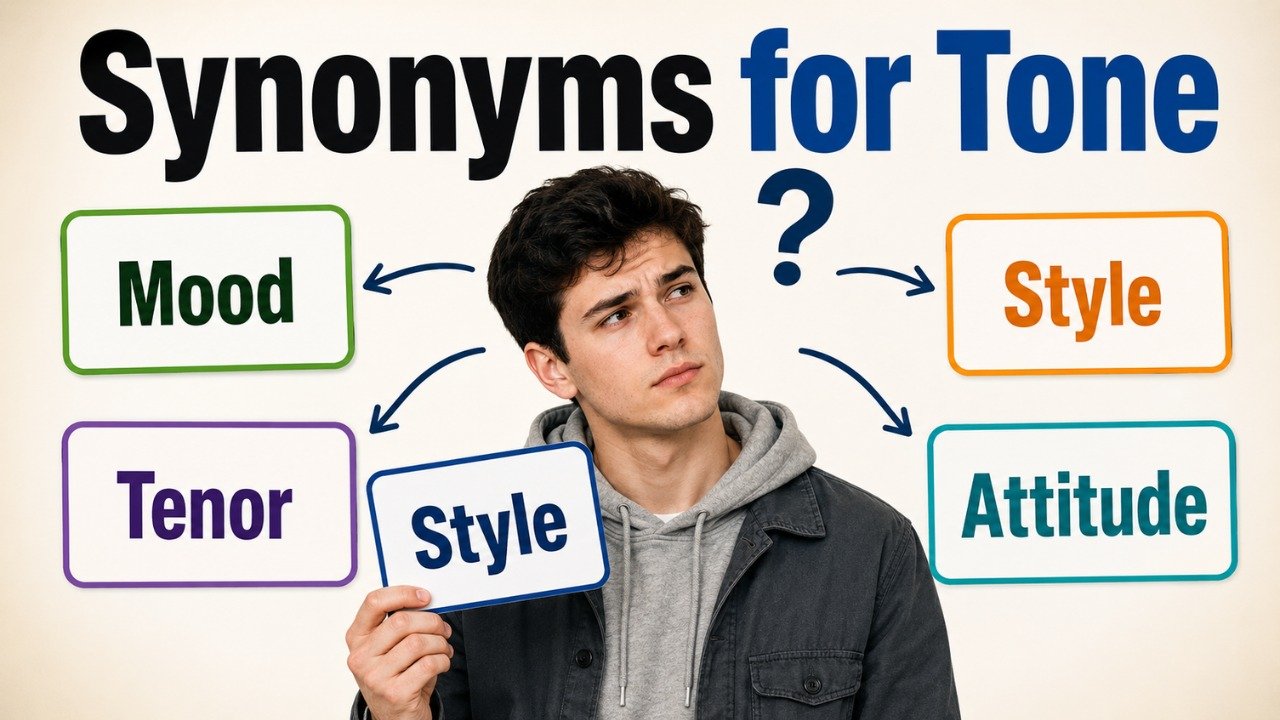
Quick Answer: The best synonyms for tone are voice, manner, attitude, mood, style, tenor, character, quality, inflection, and shade. Use voice for the personality expressed in speech or writing, manner for the way someone communicates, and attitude for the feeling behind their words. Mood describes the emotional atmosphere of a text or situation. Inflection and pitch fit spoken sound, while shade is best for color. The right synonym depends on whether tone refers to communication, emotion, sound, writing, color, or physical condition.
Pronunciation and Word Details
Word: Tone.
Pronunciation: /toʊn/
Part of Speech: Noun and verb.
Meaning: The quality, attitude, mood, sound, color, or degree expressed by a voice, message, object, or condition.
US Pronunciation:
UK Pronunciation:
What Does “Tone” Mean?
Tone means the particular quality, feeling, attitude, sound, or appearance expressed by someone or something.
As a noun, tone can describe the way a person sounds while speaking. It can also refer to the attitude expressed in writing, the emotional quality of a conversation, the pitch or character of a sound, a shade of color, or the firmness of muscles.
Speech Context: Her tone sounded calm and reassuring.
Writing Context: The article uses a formal and informative tone.
Attitude Context: His impatient tone made the request sound rude.
Mood Context: The opening scene establishes a serious tone.
Sound Context: The instrument produced a warm, rich tone.
Color Context: She selected a lighter tone of blue.
Physical Context: Regular exercise can improve muscle tone.
As a verb, tone can mean to strengthen muscles, adjust a color, or reduce the intensity of something.
Example: She exercises to tone her arms.
The meaning of tone depends heavily on context. In communication, it usually refers to attitude or manner. In music, it describes sound quality. In design, it may refer to color.
Meaning, Tone, and Context of “Tone”
Tone is a neutral and flexible word. It can be used in casual conversation, professional communication, academic writing, music, art, design, language study, and health related discussions.
Formal Use: Tone appears in essays, reports, speeches, workplace messages, and literary analysis.
Conversational Use: People commonly discuss someone’s tone of voice during everyday conversations.
Emotional Use: Tone may communicate kindness, anger, confidence, impatience, humor, sadness, or respect.
Academic Use: In literature, tone describes the writer’s attitude toward the subject or audience.
Professional Use: In business communication, tone affects whether a message sounds polite, direct, friendly, formal, or demanding.
Technical Use: In music and linguistics, tone can refer to pitch, sound quality, or changes in vocal meaning.
Visual Use: In art and design, tone can describe the lightness, darkness, warmth, or coolness of a color.
Tone does not always reveal the speaker’s exact intention. A sentence may appear polite in writing but sound sarcastic when spoken with a particular inflection.
When and How to Use “Tone”
For Voice Quality
Use tone when describing how a person’s voice sounds.
Example: His gentle tone helped the child feel safe.
For Attitude in Speech
Use tone when a speaker’s attitude is expressed through volume, emphasis, rhythm, or word choice.
Example: Her annoyed tone showed that she was losing patience.
For Writing Style
Use tone when describing the attitude or personality of written content.
Example: The email should have a polite and professional tone.
For Emotional Atmosphere
Use tone when referring to the feeling created by a conversation, event, story, or message.
Example: The unexpected joke changed the tone of the meeting.
For Musical Sound
Use tone when describing the quality or character of a musical sound.
Example: The singer produced a clear and powerful tone.
For Pitch and Intonation
Use tone when discussing changes in voice that affect meaning.
Example: A rising tone can make a statement sound like a question.
For Color
Use tone when describing the lightness, darkness, warmth, or coolness of a color.
Example: The room was decorated in soft earth tones.
For Physical Condition
Use tone when discussing the firmness or strength of muscles.
Example: Swimming can help improve overall muscle tone.
For Setting Expectations
Use tone when something establishes the mood, behavior, or direction of what follows.
Example: Her welcoming introduction set a positive tone for the event.
Best Synonyms for Tone
Voice
Synonym: The distinctive personality or style expressed through speech or writing.
Example: The writer has a clear and confident voice.
Manner
Synonym: The way someone speaks, behaves, or communicates.
Example: His calm manner made the discussion easier.
Attitude
Synonym: The feeling, opinion, or approach expressed through words or behavior.
Example: Her helpful attitude was clear from the message.
Mood
Synonym: The emotional feeling created by a place, message, event, or piece of writing.
Example: The music created a peaceful mood.
Style
Synonym: A distinctive way of speaking, writing, presenting, or creating something.
Example: The report uses a direct and professional style.
Tenor
Synonym: The general character, direction, or emotional quality of communication.
Example: The serious tenor of the discussion surprised everyone.
Character
Synonym: The recognizable quality or nature of a sound, message, or situation.
Example: The conversation had a friendly character.
Quality
Synonym: The particular nature or feature of a sound, voice, color, or expression.
Example: Her voice had a warm quality.
Inflection
Synonym: A change in the pitch or emphasis of the voice.
Example: His upward inflection made the sentence sound uncertain.
Shade
Synonym: A particular variation of a color or a slight difference in meaning or feeling.
Example: The designer chose a softer shade of green.
50 Synonyms for Tone with Short Meanings
- Voice: A distinctive speaking or writing personality.
- Manner: The way someone communicates or behaves.
- Attitude: A feeling or viewpoint expressed through words.
- Mood: The emotional atmosphere of a message or situation.
- Style: A distinctive method of expression.
- Tenor: The general character or direction of communication.
- Character: The recognizable nature of a sound or message.
- Quality: A particular feature of sound, expression, or color.
- Expression: The communication of a feeling or idea.
- Inflection: A change in vocal pitch or emphasis.
- Intonation: The rise and fall of the speaking voice.
- Pitch: The highness or lowness of a sound.
- Timbre: The distinctive sound quality of a voice or instrument.
- Resonance: A deep, full, or lasting sound quality.
- Cadence: The rhythm and flow of speech or sound.
- Modulation: A controlled change in voice, sound, or intensity.
- Accent: A distinctive way of speaking or emphasizing something.
- Register: A level or range of language or vocal sound.
- Delivery: The way spoken words are presented.
- Phrasing: The arrangement and expression of words or musical passages.
- Emphasis: Special importance given through stress or expression.
- Feeling: The emotion communicated by words or sound.
- Spirit: The general emotional character of something.
- Atmosphere: The feeling created by a place, event, or message.
- Temper: A person’s emotional state or manner.
- Disposition: A person’s usual emotional attitude.
- Approach: The way someone handles communication or a subject.
- Stance: A position or attitude toward an issue.
- Outlook: A general way of viewing a situation.
- Sentiment: A feeling or opinion expressed in communication.
- Flavor: A distinctive quality or impression.
- Shade: A variation in color, meaning, or feeling.
- Hue: A particular color or color family.
- Tint: A lighter variation of a color.
- Coloration: A particular color effect or sound quality.
- Intensity: The strength of a sound, feeling, or color.
- Warmth: A friendly, rich, or comforting quality.
- Coolness: A calm, distant, or visually cool quality.
- Firmness: A strong and controlled manner.
- Softness: A gentle quality in sound, language, or color.
- Politeness: A courteous and considerate manner.
- Harshness: A rough, severe, or unpleasant quality.
- Formality: A serious and conventional style.
- Informality: A relaxed and conversational style.
- Seriousness: A thoughtful or important emotional quality.
- Humor: A playful or amusing quality.
- Undertone: A subtle feeling or meaning beneath the surface.
- Overtone: An additional suggested meaning or sound.
- Note: A particular feeling, quality, or musical sound.
- Nuance: A small difference in meaning, feeling, or expression.
Read Also:
Synonyms for Wind

Synonyms for Tone by Context
When Tone Means Attitude
Use attitude, manner, stance, approach, temper, or disposition when tone describes how someone feels or behaves toward a person or subject.
Attitude is the clearest choice when words communicate approval, annoyance, confidence, or disrespect. Manner focuses on behavior, while stance describes a position on an issue.
Example With Tone: His defensive tone made cooperation difficult.
Example With Attitude: His defensive attitude made cooperation difficult.
Example With Manner: His defensive manner made cooperation difficult.
When Tone Means Writing Style
Use voice, style, tenor, register, expression, or delivery when discussing written or spoken communication.
Voice describes the writer’s recognizable personality. Style covers sentence structure, word choice, and presentation. Register describes the level of formality.
Example With Tone: The article has an encouraging tone.
Example With Voice: The article has an encouraging voice.
Example With Style: The article uses an encouraging style.
When Tone Means Mood
Use mood, atmosphere, feeling, spirit, sentiment, or character when describing the emotional effect of a scene, conversation, or event.
Mood is the strongest choice for the feeling experienced by the audience. Atmosphere is especially useful for places and events.
Example With Tone: The dark lighting created a mysterious tone.
Example With Mood: The dark lighting created a mysterious mood.
Example With Atmosphere: The dark lighting created a mysterious atmosphere.
When Tone Means Vocal Sound
Use inflection, intonation, pitch, cadence, delivery, or modulation when discussing how speech sounds.
Inflection refers to changes in pitch or emphasis. Intonation describes the overall rise and fall of speech. Cadence focuses on rhythm.
Example With Tone: Her questioning tone revealed uncertainty.
Example With Inflection: Her questioning inflection revealed uncertainty.
Example With Intonation: Her rising intonation revealed uncertainty.
When Tone Means Musical Quality
Use timbre, resonance, quality, pitch, note, or coloration when discussing voices and instruments.
Timbre describes the distinctive sound of a voice or instrument. Resonance emphasizes richness and depth, while pitch refers to how high or low a sound is.
Example With Tone: The instrument has a bright tone.
Example With Timbre: The instrument has a bright timbre.
Example With Resonance: The instrument produces impressive resonance.
When Tone Means Color
Use shade, hue, tint, coloration, warmth, or coolness when discussing color.
Shade is the most flexible alternative. Hue identifies the basic color, while tint refers to a lighter version created by adding white.
Example With Tone: She selected a warm tone for the wall.
Example With Shade: She selected a warm shade for the wall.
Example With Hue: She selected a warm hue for the wall.
When Tone Means Strength or Intensity
Use intensity, firmness, softness, harshness, or strength when describing how powerful something sounds or appears.
Intensity is useful for strong feelings, colors, or sounds. Firmness describes controlled authority, while softness describes gentleness.
Example With Tone: The manager used a firm tone.
Example With Firmness: The manager spoke with firmness.
Example With Intensity: The intensity of his voice surprised the group.
Another Word for Tone
Voice is often the best general replacement for tone when discussing writing or communication. It describes the personality, attitude, or style expressed through words.
The best alternative depends on meaning. Use mood for emotional atmosphere, attitude for behavior, inflection for vocal changes, timbre for musical sound, and shade for color.
Original: The writer uses a friendly tone.
Better Option: The writer uses a friendly voice.
Original: His tone became impatient.
Better Option: His manner became impatient.
Original: The opening scene has a serious tone.
Better Option: The opening scene creates a serious mood.
Original: The room uses a pale blue tone.
Better Option: The room uses a pale blue shade.
When Not to Use “Tone”
Tone can sound vague when a more precise word would explain the meaning clearly.
Weak: The singer has an unusual tone.
Better: The singer has a distinctive timbre.
Avoid using tone when you specifically mean mood. Tone usually reflects the creator’s attitude, while mood describes the feeling experienced by the audience.
Weak: The reader felt frightened because of the frightening tone.
Better: The dark imagery created a frightening mood for the reader.
Do not use tone when pitch is the exact meaning.
Weak: The final sound had a higher tone.
Better: The final sound had a higher pitch.
Avoid using tone for a precise color description when shade, hue, or tint would be clearer.
Weak: Use a lighter tone of red.
Better: Use a lighter shade of red.
Tone may also sound too general in professional feedback.
Weak: Improve the tone of this message.
Better: Make the message more polite, direct, and reassuring.
Do not assume that word choice alone determines tone. Punctuation, sentence length, emphasis, context, rhythm, and delivery can also affect it.
Weak: The word is friendly, so the entire message has a friendly tone.
Better: The message sounds friendly because of its welcoming words and gentle phrasing.
Avoid repeating tone several times in the same paragraph.
Weak: The tone of the speech was serious, and that tone created a formal tone.
Better: The speech used a serious voice that created a formal atmosphere.
Words Commonly Confused With Tone
Tone vs Mood: Tone is the attitude expressed by a speaker or writer. Mood is the emotion created for the listener or reader.
Tone vs Voice: Tone can change depending on the situation. Voice is the more consistent personality or style of a speaker or writer.
Tone vs Attitude: Tone is how an attitude sounds or appears in communication. Attitude is the underlying feeling or viewpoint.
Tone vs Pitch: Tone may describe the overall quality of a sound. Pitch refers specifically to how high or low the sound is.
Tone vs Inflection: Tone is the general emotional or vocal quality. Inflection is a specific change in pitch or emphasis.
Tone vs Style: Tone communicates attitude or emotion. Style includes the broader choices used to express ideas.
Tone vs Tenor: Tone may refer to a specific moment or sentence. Tenor usually describes the overall character or direction of a discussion.
Tone vs Shade: Tone has many meanings, while shade is used more specifically for color or slight differences in meaning.
Tone vs Timbre: Tone is a broad term for sound quality. Timbre is the distinctive quality that separates one voice or instrument from another.
Which Synonym Should You Choose?
Choose Voice: When describing the recognizable personality of a writer, speaker, or publication.
Choose Manner: When focusing on the way someone speaks, behaves, or responds.
Choose Attitude: When communication expresses approval, annoyance, confidence, disrespect, or another viewpoint.
Choose Mood: When describing the emotional feeling created for an audience.
Choose Style: When discussing the broader method of writing, speaking, presenting, or creating.
Choose Tenor: When describing the overall character or direction of a discussion, report, or message.
Choose Register: When distinguishing formal, informal, academic, technical, or conversational language.
Choose Inflection: When a change in pitch or emphasis affects spoken meaning.
Choose Intonation: When describing the overall rise and fall of a voice.
Choose Timbre: When discussing the distinctive sound quality of a singer, speaker, or instrument.
Choose Pitch: When identifying whether a sound is high or low.
Choose Shade: When referring to a particular variation of a color.
Choose Atmosphere: When describing the feeling created by a setting or event.
Choose Firmness: When a speaker communicates controlled authority.
Choose Politeness: When evaluating whether communication sounds courteous and considerate.
Real Life Examples of “Tone” in Sentences
Original: Her tone made the message feel welcoming.
Better Option: Her friendly manner made the message feel welcoming.
Original: The writer uses a confident tone throughout the article.
Better Option: The writer uses a confident voice throughout the article.
Original: His tone suggested that he was annoyed.
Better Option: His attitude suggested that he was annoyed.
Original: The lighting gave the room a peaceful tone.
Better Option: The lighting gave the room a peaceful atmosphere.
Original: The teacher used a firm tone with the class.
Better Option: The teacher spoke with firmness to the class.
Original: Her tone rose at the end of the sentence.
Better Option: Her pitch rose at the end of the sentence.
Original: The instrument produced a rich tone.
Better Option: The instrument produced a rich timbre.
Original: The report has a highly formal tone.
Better Option: The report uses a highly formal register.
Original: The designer chose a darker tone of green.
Better Option: The designer chose a darker shade of green.
Original: The joke changed the tone of the conversation.
Better Option: The joke changed the mood of the conversation.
Synonym Groups and Usage Differences
Communication Group
This group includes voice, manner, attitude, expression, delivery, and approach.
These words describe how a person communicates. Voice emphasizes personality, manner emphasizes behavior, and delivery focuses on spoken presentation.
Example: Her calm delivery made the instructions easy to follow.
Writing Group
This group includes style, voice, tenor, register, phrasing, and expression.
Style describes the writer’s overall method. Voice describes personality, while register indicates the level of formality.
Example: The guide uses a clear and conversational register.
Emotional Group
This group includes mood, feeling, atmosphere, spirit, sentiment, and temper.
Mood and atmosphere describe the emotional effect of a setting or message. Sentiment describes an expressed opinion or feeling.
Example: The final paragraph creates a hopeful mood.
Vocal Group
This group includes inflection, intonation, pitch, cadence, modulation, and emphasis.
These words describe how speech rises, falls, flows, and stresses particular ideas.
Example: Her rising inflection made the statement sound like a question.
Musical Group
This group includes timbre, resonance, note, pitch, quality, and coloration.
Timbre identifies the distinctive sound of a voice or instrument. Resonance describes depth and fullness.
Example: The singer’s warm timbre gave the song a comforting quality.
Color Group
This group includes shade, hue, tint, coloration, warmth, and coolness.
Hue identifies the main color. Shade describes a darker or distinct variation, while tint usually describes a lighter version.
Example: The artist added a soft blue tint to the background.
Intensity Group
This group includes firmness, softness, intensity, harshness, warmth, and coolness.
These alternatives describe how strong, gentle, friendly, severe, close, or distant something feels.
Example: The softness of her voice helped calm the audience.
Meaning Group
This group includes undertone, overtone, nuance, note, flavor, and character.
These words describe subtle or additional meanings. Undertone is often hidden, while overtone is more noticeable.
Example: His compliment carried an undertone of sarcasm.
Antonyms of Tone
The opposite of tone depends on whether tone refers to sound, attitude, mood, color, or physical firmness.
Silence: A complete absence of sound.
Flatness: A lack of vocal variation, emotion, or energy.
Monotony: Unchanging sound, style, or expression.
Neutrality: An absence of strong attitude or emotion.
Harshness: A rough or unpleasant sound or manner.
Softness: A gentle sound or quality, when contrasted with firmness.
Informality: A relaxed style, when contrasted with formal tone.
Formality: A serious style, when contrasted with casual tone.
Brightness: A light or vivid visual quality, when contrasted with darkness.
Darkness: A deep or low visual quality, when contrasted with brightness.
Weakness: A lack of strength or firmness.
Slackness: A lack of physical firmness or tension.
Colorlessness: An absence of color or distinctive visual quality.
Emotionlessness: A lack of expressed feeling.
Indifference: A lack of concern, interest, or emotional involvement.
Comparison: Tone vs Related Words
Tone vs Voice
Tone changes according to the subject, audience, or situation. Voice is the more consistent personality of a writer or speaker.
Example With Tone: The writer adopts a serious tone when discussing safety.
Example With Voice: The writer’s voice remains clear and approachable throughout the book.
Tone vs Mood
Tone reflects the attitude of the speaker, writer, or creator. Mood is the emotional effect experienced by the audience.
Example With Tone: The narrator uses a critical tone.
Example With Mood: The dark setting creates an uneasy mood.
Tone vs Attitude
Attitude is the underlying opinion or feeling. Tone is the way that attitude appears in speech or writing.
Example With Tone: Her sarcastic tone made the comment sound insulting.
Example With Attitude: Her dismissive attitude made cooperation difficult.
Tone vs Style
Tone communicates attitude or emotion. Style includes vocabulary, sentence structure, pacing, organization, and presentation.
Example With Tone: The letter has a respectful tone.
Example With Style: The letter uses a concise and formal style.
Tone vs Pitch
Tone can describe the overall quality of a sound. Pitch refers specifically to its highness or lowness.
Example With Tone: The instrument produces a warm tone.
Example With Pitch: The instrument produces a high pitch.
Tone vs Inflection
Tone is the broad emotional quality of speech. Inflection is a change in pitch or emphasis within speech.
Example With Tone: His tone sounded uncertain.
Example With Inflection: His rising inflection made him sound uncertain.
Tone vs Timbre
Tone is a general word for sound quality. Timbre is the unique quality that distinguishes one voice or instrument from another.
Example With Tone: The singer has a pleasant tone.
Example With Timbre: The singer has a warm and recognizable timbre.
Tone vs Shade
Tone may refer to sound, attitude, mood, or color. Shade refers more specifically to a variation of color or meaning.
Example With Tone: The room uses warm earth tones.
Example With Shade: The wall is painted in a deep brown shade.
Common Phrases and Expressions With “Tone”
Tone of Voice: The attitude or emotion communicated through speech.
Set the Tone: Establish the mood, style, or expectations for what follows.
Change Your Tone: Adjust the manner or attitude used while speaking.
Formal Tone: A serious and professional style of communication.
Friendly Tone: A warm, welcoming, and approachable manner.
Neutral Tone: Communication that avoids strong emotion or bias.
Serious Tone: A thoughtful manner suited to important subjects.
Conversational Tone: A natural style that resembles ordinary speech.
Respectful Tone: A polite manner that recognizes another person’s dignity.
Firm Tone: A controlled and confident way of speaking.
Sarcastic Tone: A manner that expresses mockery or the opposite of the literal words.
Skin Tone: The natural color and appearance of a person’s skin.
Muscle Tone: The natural firmness and tension of muscles.
Color Tone: The lightness, darkness, warmth, or coolness of a color.
Tone Down: Reduce the strength, brightness, intensity, or offensiveness of something.
Common Mistakes to Avoid
Confusing Tone and Mood
Tone describes the creator’s attitude. Mood describes the emotion created for the audience.
Incorrect: The reader’s tone became nervous while reading the scene.
Correct: The reader’s mood became nervous while reading the scene.
Confusing Tone and Voice
Voice is usually consistent, while tone changes according to the situation.
Weak: The writer has a completely different voice in every paragraph.
Better: The writer changes tone according to each subject.
Using Tone When Pitch Is More Accurate
Pitch specifically describes whether a sound is high or low.
Weak: Her tone became higher at the end.
Better: Her pitch became higher at the end.
Using Tone When Timbre Is More Precise
Timbre describes the distinctive quality of a voice or instrument.
Weak: The violin has a unique tone compared with the flute.
Better: The violin has a unique timbre compared with the flute.
Describing Tone Too Vaguely
Words such as good, bad, nice, or strange do not explain the communication clearly.
Vague: The email has a bad tone.
Clear: The email sounds impatient and overly demanding.
Assuming Tone Comes Only From Words
Punctuation, rhythm, emphasis, sentence length, volume, facial expression, and context can affect tone.
Weak: The sentence contains polite words, so its tone must be polite.
Better: The sentence uses polite words, but the sharp delivery makes it sound impatient.
Repeating Tone Too Often
Replace repeated uses with precise alternatives.
Weak: The article’s tone is friendly, and this tone creates a welcoming tone.
Better: The article uses a friendly voice that creates a welcoming mood.
Confusing Shade, Hue, and Tone
Hue identifies the main color. Shade is a variation that is often darker. Tone describes the overall lightness, darkness, warmth, or coolness.
Weak: Choose a blue tone, shade, or hue because they all mean exactly the same thing.
Better: Choose the precise color word according to the visual quality you mean.
Ignoring the Audience
A tone that suits one audience may sound inappropriate to another.
Weak: The same casual tone works in every message.
Better: Use a formal tone for official communication and a relaxed tone for familiar readers.
Using Tone to Describe Meaning Alone
Tone affects how meaning is communicated, but it is not the same as the literal meaning.
Weak: The tone of the sentence means that the meeting begins at noon.
Better: The sentence states that the meeting begins at noon, while its tone sounds formal.
Conclusion
Synonyms for tone include voice, manner, attitude, mood, style, tenor, inflection, timbre, pitch, and shade. Voice works best for writing personality, while attitude and manner describe communication behavior. Use mood for emotional atmosphere, inflection for vocal changes, timbre for musical sound, and shade for color. Because tone has several meanings, choosing a context specific alternative makes your sentence clearer and helps readers understand whether you are describing speech, writing, emotion, sound, color, or physical condition.
FAQs About Synonyms for Tone
What Is the Best Synonym for Tone?
Voice is the best general synonym for tone in writing and communication. Mood, attitude, manner, style, and quality may fit other contexts.
What Is Another Word for Tone of Voice?
Manner, inflection, intonation, delivery, attitude, and vocal quality can replace tone of voice depending on the intended meaning.
What Is a Synonym for Tone in Writing?
Voice, style, tenor, register, attitude, and expression are useful synonyms for tone in writing.
Are Tone and Mood the Same?
No. Tone describes the creator’s attitude, while mood describes the feeling created for the audience.
What Is Another Word for Musical Tone?
Timbre is best for distinctive sound quality. Pitch, resonance, note, and coloration may also be suitable.
What Is Another Word for Color Tone?
Shade, hue, tint, coloration, warmth, and coolness are useful alternatives for color tone.
What Is the Difference Between Tone and Voice?
Voice is a writer’s or speaker’s consistent personality. Tone is the attitude used in a particular situation or message.
