
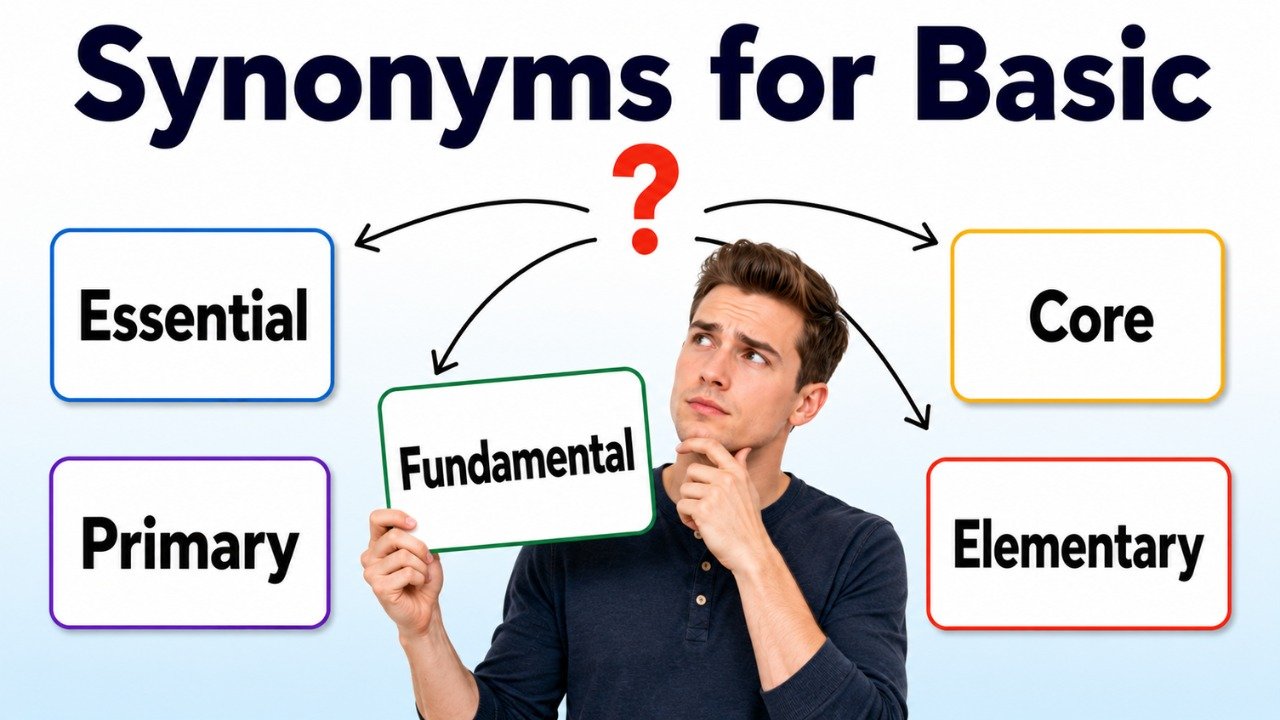
Quick Answer: The best synonyms for basic are fundamental, essential, elementary, simple, introductory, foundational, primary, rudimentary, standard, and ordinary. Use fundamental or foundational for an important underlying principle, essential for something necessary, elementary for beginner level knowledge, and simple for something easy to understand. Standard and ordinary describe something common or usual, while rudimentary refers to something that is only partly developed.
Pronunciation and Word Details
Word: Basic
Pronunciation: /ˈbeɪ.sɪk/
Part of Speech: Adjective and noun
Meaning: Basic describes something simple, essential, introductory, ordinary, or forming the foundation of something.
US Pronunciation:
UK Pronunciation:
What Does “Basic” Mean?
Basic means simple, essential, introductory, or connected to the foundation of something.
As an adjective, basic can describe knowledge, skills, needs, equipment, designs, rules, and structures. It often refers to the most important starting elements of a subject.
In the phrase basic knowledge, the word means introductory or elementary understanding. In basic needs, it means essential things required for life. A basic design is usually simple and free from unnecessary details.
Basic can also describe something ordinary or standard. For example, a basic room may contain only the usual furniture and facilities.
As a noun, basics refers to the most important principles, facts, or skills that someone must learn first.
Meaning, Tone, and Context of “Basic”
Basic usually has a neutral tone, but its meaning and emotional effect depend on the context.
In education, basic is neutral and helpful. It refers to beginner level information, simple instructions, or foundational skills.
In technical writing, basic describes the central structure or essential function of a system. It helps separate necessary features from advanced ones.
In everyday conversation, basic may describe something plain, ordinary, or uncomplicated. Depending on the speaker’s tone, it can sound practical or slightly critical.
When basic describes needs, rights, principles, or requirements, it carries a serious meaning. Basic needs are not unimportant. They are the essential things that must be provided before other goals can be achieved.
The word may sound negative when it describes a person’s knowledge, style, or ability. In such cases, introductory, developing, straightforward, or uncomplicated may sound more respectful.
When and How to Use “Basic”
For Essential Needs: Use basic when discussing things that are necessary for health, safety, comfort, or survival.
Example: Clean water and secure shelter are basic human needs.
For Beginner Knowledge: Use basic for information taught at the beginning of a subject.
Example: The course introduces basic grammar and sentence structure.
For Simple Designs: Basic can describe an object, plan, or style without advanced details.
Example: The apartment has a basic but comfortable interior.
For Foundational Principles: Use basic when referring to the central ideas on which a system or subject is built.
Example: Respect is a basic principle of healthy communication.
For Standard Features: Basic may describe the normal version of a product, service, or arrangement.
Example: The basic package includes the most commonly requested features.
For Limited Development: Basic can describe something that has not yet become detailed or advanced.
Example: The early model had only basic controls.
For Clear Instructions: Basic works well when information has been simplified for easy understanding.
Example: The guide provides basic steps for preparing the equipment.
Best Synonyms for Basic
Fundamental: Forming the central foundation of a subject, system, or idea.
Example: Trust is fundamental to a successful partnership.
Essential: Completely necessary for a particular purpose or result.
Example: Clear communication is essential during an emergency.
Elementary: Suitable for beginners or limited to the simplest principles.
Example: The first lesson covers elementary mathematics.
Simple: Easy to understand, perform, or use.
Example: The instructor gave a simple explanation of the process.
Introductory: Designed to present the first ideas of a subject.
Example: She enrolled in an introductory writing course.
Foundational: Providing the base on which later knowledge or development depends.
Example: Reading is a foundational skill for young learners.
Primary: First in importance, order, or purpose.
Example: Safety remains our primary concern.
Rudimentary: Existing in a simple or partly developed form.
Example: The village had a rudimentary communication system.
Standard: Normal, usual, or widely accepted.
Example: This is the standard procedure for checking the results.
Ordinary: Common and not especially advanced, unusual, or decorative.
Example: The room contained only ordinary furniture.
50 Synonyms for Basic with Short Meanings
- Fundamental: Forming the main foundation of something.
- Essential: Completely necessary or extremely important.
- Elementary: Related to the earliest and simplest level.
- Simple: Easy to understand or perform.
- Introductory: Intended for someone beginning a subject.
- Foundational: Providing a base for later development.
- Primary: First or greatest in importance.
- Rudimentary: Simple and not fully developed.
- Standard: Normal and widely accepted.
- Ordinary: Common and not unusual or advanced.
- Plain: Simple and without decoration or complexity.
- Conventional: Following common or traditional practices.
- Common: Frequently found, used, or experienced.
- Core: Forming the most important central part.
- Underlying: Existing beneath and supporting something else.
- Preliminary: Coming before the main or advanced stage.
- Beginning: Connected with the first stage.
- Initial: Occurring or existing at the start.
- Minimal: Using only the smallest necessary amount.
- Uncomplicated: Easy to understand and free from difficulty.
- Straightforward: Clear, direct, and easy to follow.
- Bare: Containing only what is strictly necessary.
- Necessary: Required for a particular purpose.
- Central: Extremely important to the main subject.
- Principal: Most important among several elements.
- Root: Located at the original source or foundation.
- Baseline: Providing a starting level for comparison.
- General: Covering the main points without much detail.
- Regular: Normal, usual, or commonly available.
- Usual: Commonly experienced, chosen, or expected.
- Everyday: Ordinary and used in daily life.
- Normal: Typical and expected in a situation.
- Modest: Simple and not large, expensive, or elaborate.
- Unsophisticated: Lacking advanced detail or complexity.
- Primitive: Belonging to an early or undeveloped stage.
- Crude: Roughly made and lacking refinement.
- Simplified: Made easier by reducing complexity.
- Accessible: Easy for people to understand or use.
- Easy: Requiring little effort or advanced knowledge.
- Entry Level: Suitable for beginners or newcomers.
- Starter: Intended for the first stage of learning or use.
- Elemental: Related to the simplest or most essential elements.
- Cardinal: Most important or fundamental.
- Intrinsic: Naturally forming an essential part of something.
- Indispensable: So necessary that it cannot be removed.
- Requisite: Required for a particular purpose or situation.
- Skeletal: Containing only the main structure or outline.
- Stripped Down: Reduced to only the most necessary features.
- No Frills: Simple and without unnecessary extras.
- Austere: Plain, limited, and without decorative features.
Read Also:
Synonyms for Watch
Synonyms for Basic by Context
When Basic Means Fundamental
Fundamental, foundational, core, underlying, root, cardinal, and elemental describe ideas or elements that support everything else.
Fundamental is the strongest general choice. Foundational emphasizes the role of something as a base for future development. Core describes the central part of a subject, while underlying refers to something that may not be immediately visible.
Example: Honesty is a fundamental requirement in every trusting relationship.
Example: Students must understand the core principles before moving to advanced lessons.
When Basic Means Simple
Simple, uncomplicated, straightforward, plain, accessible, easy, and simplified are useful when something is easy to understand or use.
Simple is broad and neutral. Straightforward emphasizes clarity and directness. Accessible suggests that information can be understood by many people, including beginners.
Example: The guide offers a straightforward explanation of the process.
Example: The teacher made the difficult topic accessible to younger students.
When Basic Means Introductory
Elementary, introductory, beginning, initial, entry level, starter, preliminary, and rudimentary describe an early stage of learning or development.
Introductory is suitable for courses and educational material. Elementary refers to the simplest principles. Rudimentary often suggests that knowledge or development remains limited.
Example: The workshop teaches introductory photography skills.
Example: He has only a rudimentary understanding of the subject.
When Basic Means Essential
Essential, necessary, primary, principal, indispensable, requisite, and central refer to something important or required.
Essential and necessary are direct alternatives. Indispensable is stronger because it means something cannot be removed or replaced. Primary emphasizes first importance.
Example: Careful planning is essential for a successful event.
Example: Reliable transportation is a primary requirement for the role.
When Basic Means Ordinary
Standard, ordinary, common, conventional, normal, regular, usual, and everyday describe something typical rather than advanced or unusual.
Standard works well for procedures, features, and accepted practices. Ordinary describes something common. Conventional refers to something that follows familiar traditions or methods.
Example: The room includes standard furniture and lighting.
Example: They used a conventional method to solve the problem.
When Basic Means Plain
Plain, minimal, bare, modest, austere, skeletal, stripped down, and no frills describe something without decoration or additional features.
Minimal often has a positive design meaning. Bare may suggest that something lacks comfort or detail. Austere sounds stronger and may describe a severe or extremely plain appearance.
Example: She selected a minimal design with only essential details.
Example: The temporary office had a bare and practical interior.
Another Word for Basic
Fundamental is often the best replacement for basic when discussing important ideas, principles, skills, or structures.
However, the best alternative depends on the intended meaning. Use simple for something easy, introductory for beginner material, essential for something necessary, and standard for something ordinary or commonly accepted.
Original: The book explains the basic principles of communication.
Better Option: The book explains the fundamental principles of communication.
Original: She attended a basic language course.
Better Option: She attended an introductory language course.
Original: The device has basic controls.
Better Option: The device has simple controls.
Original: Food and shelter are basic requirements.
Better Option: Food and shelter are essential requirements.
When Not to Use “Basic”
Avoid basic when it does not clearly show whether you mean simple, necessary, introductory, ordinary, or foundational.
The word may be too general in academic or professional writing. A more precise alternative can help readers understand your exact meaning.
Weak: The report discusses the basic problems affecting the project.
Better: The report discusses the fundamental problems affecting the project.
Do not use basic when you mean easy. A basic activity may involve foundational knowledge but still require considerable effort.
Weak: The examination was basic.
Better: The examination was straightforward.
Avoid describing a person as basic when you mean that the person has limited experience. This wording may sound dismissive or disrespectful.
Weak: She is a basic designer.
Better: She is an entry level designer who is developing her skills.
Basic may also be misleading when discussing necessities. Basic needs are essential rather than unimportant.
Weak: Housing is only a basic concern.
Better: Housing is an essential concern.
Avoid repeating basic throughout a paragraph.
Weak: The basic course teaches basic skills through basic exercises.
Better: The introductory course teaches foundational skills through simple exercises.
Words Commonly Confused With Basic
Basic vs Simple: Basic refers to the starting elements or essential features of something. Simple means easy to understand or lacking complexity.
Basic vs Fundamental: Basic can mean introductory, ordinary, or simple. Fundamental specifically describes something central to the foundation of a subject or system.
Basic vs Essential: Basic may describe a starting level. Essential means completely necessary.
Basic vs Elementary: Basic is a broad word. Elementary usually refers to the earliest or simplest educational level.
Basic vs Standard: Basic may mean limited to necessary features. Standard means normal, accepted, or commonly provided.
Basic vs Ordinary: Basic may describe something foundational or simple. Ordinary means common and not unusual.
Basic vs Rudimentary: Basic can be neutral or positive. Rudimentary often suggests that something is poorly developed or limited.
Basic vs Minimal: Basic describes essential or introductory features. Minimal describes the smallest possible amount or number of features.
Which Synonym Should You Choose?
Choose fundamental when discussing principles, rights, structures, theories, or important problems.
Choose essential when something is necessary for success, safety, survival, or completion.
Choose elementary when discussing the earliest level of knowledge or education.
Choose introductory for courses, lessons, guides, explanations, and materials designed for beginners.
Choose simple when something is easy to understand, use, explain, or perform.
Choose straightforward when instructions, methods, or explanations are direct and clear.
Choose foundational when a skill or concept supports future learning or development.
Choose primary when something is first in importance.
Choose standard when describing accepted procedures, common features, or normal versions.
Choose ordinary when something is common and not unusual.
Choose rudimentary when something exists only in a limited or partly developed form.
Choose minimal when a design or arrangement contains very few details.
Choose plain when something has little decoration.
Choose no frills when describing a practical service or product without unnecessary extras.
Real Life Examples of “Basic” in Sentences
Original: The class teaches basic writing skills.
Better Option: The class teaches foundational writing skills.
Original: We need a basic understanding of the rules.
Better Option: We need an elementary understanding of the rules.
Original: The instructions are basic and clear.
Better Option: The instructions are simple and clear.
Original: Food is a basic human need.
Better Option: Food is an essential human need.
Original: The room contains basic furniture.
Better Option: The room contains standard furniture.
Original: He created a basic outline for the report.
Better Option: He created a preliminary outline for the report.
Original: The system provides basic protection.
Better Option: The system provides fundamental protection.
Original: Her knowledge of the language is basic.
Better Option: Her knowledge of the language is introductory.
Original: The machine has a basic design.
Better Option: The machine has a straightforward design.
Original: They lived in a basic wooden shelter.
Better Option: They lived in a rudimentary wooden shelter.
Synonym Groups and Usage Differences
Foundation Group
Fundamental, foundational, core, root, elemental, underlying, and cardinal describe the ideas or structures on which something depends.
Fundamental is appropriate for serious principles and issues. Foundational is especially useful for education and development. Core refers to the central part of something.
Example: Critical thinking is a foundational skill for advanced study.
Simplicity Group
Simple, uncomplicated, straightforward, accessible, easy, and simplified describe something that is not difficult to understand or use.
Straightforward emphasizes directness. Accessible emphasizes ease of understanding for a wide audience. Simplified means complexity has been intentionally reduced.
Example: The writer provided an accessible summary of the scientific findings.
Beginner Group
Elementary, introductory, beginning, entry level, starter, initial, and preliminary relate to an early stage.
Elementary focuses on simple knowledge. Introductory is common for courses and books. Preliminary describes work completed before the main stage begins.
Example: The introductory course prepares students for advanced study.
Necessity Group
Essential, necessary, indispensable, requisite, primary, principal, and central describe importance or requirement.
Essential and necessary are the most common options. Indispensable is stronger and suggests that success is impossible without the item.
Example: Regular practice is essential for improving pronunciation.
Ordinary Group
Standard, ordinary, common, conventional, regular, usual, normal, and everyday describe something familiar or commonly accepted.
Standard often relates to rules or features. Conventional relates to traditional practices. Everyday describes ordinary daily experiences.
Example: The staff followed the standard safety procedure.
Plainness Group
Plain, minimal, bare, austere, modest, skeletal, stripped down, and no frills describe a lack of decoration or additional features.
Minimal can sound stylish and positive. Bare may imply that important comforts are absent. Skeletal describes an outline containing only central elements.
Example: The proposal presents a skeletal plan that requires further detail.
Antonyms of Basic
The opposite of basic changes according to whether basic means simple, introductory, essential, ordinary, or plain.
Advanced: Requiring higher knowledge or developed skills.
Complex: Containing many connected and difficult parts.
Complicated: Difficult to understand or manage.
Sophisticated: Highly developed, refined, or technically advanced.
Detailed: Containing extensive and specific information.
Elaborate: Carefully developed with many decorative or complex features.
Specialized: Designed for a narrow subject, task, or group.
Exceptional: Unusually impressive or different from the ordinary.
Unusual: Not commonly experienced or expected.
Luxurious: Providing expensive comfort and attractive features.
Decorative: Designed with visual details and ornament.
Optional: Available by choice rather than required.
Secondary: Less important than the main consideration.
Nonessential: Not completely necessary.
Refined: Improved through careful development or greater sophistication.
Comparison: Basic vs Related Words
Basic vs Fundamental
Basic has several meanings, including simple, ordinary, and introductory. Fundamental specifically refers to the foundation or most important principle.
Example With Basic: The guide explains basic computer skills.
Example With Fundamental: Privacy is a fundamental right.
Basic vs Simple
Basic describes starting elements or necessary features. Simple describes something that is easy or not complex.
Example With Basic: The course provides basic scientific knowledge.
Example With Simple: The teacher gave a simple explanation.
Basic vs Essential
Basic can describe an introductory level or ordinary version. Essential means completely necessary.
Example With Basic: He purchased the basic equipment package.
Example With Essential: Protective clothing is essential in the laboratory.
Basic vs Elementary
Basic is useful in general contexts. Elementary strongly suggests the earliest level of education or knowledge.
Example With Basic: She understands the basic rules.
Example With Elementary: The lesson introduces elementary arithmetic.
Basic vs Standard
Basic often means limited to necessary features. Standard means commonly accepted or normally provided.
Example With Basic: The basic model has fewer controls.
Example With Standard: The standard procedure requires two inspections.
Basic vs Rudimentary
Basic may be neutral, while rudimentary suggests limited development or a rough early form.
Example With Basic: He has basic knowledge of repair work.
Example With Rudimentary: The remote settlement had a rudimentary medical facility.
Common Phrases and Expressions With “Basic”
Basic Needs: Essential things required for health, safety, and survival.
Basic Knowledge: An introductory understanding of a subject.
Basic Skills: Foundational abilities needed for further development.
Basic Principles: The central rules or ideas of a subject.
Basic Requirements: Conditions that must be satisfied first.
Basic Training: Initial instruction that prepares someone for future responsibilities.
Basic Information: The main facts without extensive detail.
Basic Structure: The central arrangement supporting something.
Basic Level: The earliest or least advanced stage.
Basic Understanding: General knowledge of the main ideas.
Common Mistakes to Avoid
A common mistake is assuming that basic always means easy. A basic concept may be foundational and still require careful study.
Writers also confuse basic with essential. Basic equipment may contain only standard features, while essential equipment is necessary for completing a task safely.
Avoid using basic as a vague description. Instead of writing basic issue, explain whether the issue is fundamental, primary, common, or straightforward.
Do not use basic to criticize a person’s intelligence, style, or ability. Introductory, developing, entry level, or inexperienced may communicate the intended meaning more respectfully.
Another mistake is using rudimentary as a neutral synonym in every context. Rudimentary often suggests limited development, so it may sound critical.
Avoid repetition by selecting alternatives that match the context. Use fundamental for principles, essential for needs, simple for instructions, standard for procedures, and introductory for beginner lessons.
Conclusion
Learning synonyms for basic makes it easier to communicate whether something is simple, essential, introductory, ordinary, or foundational. Fundamental and foundational suit principles and important skills, while essential describes necessities. Simple and straightforward work for clear instructions, and introductory or elementary fit beginner material. Standard and ordinary describe common features, while rudimentary suggests limited development. By choosing the synonym that matches your intended context, you can make every sentence more accurate, natural, and useful.
FAQs About Synonyms for Basic
What Is the Best Synonym for Basic?
Fundamental is a strong general synonym when basic refers to an important foundation. Simple, essential, and introductory are better in other contexts.
What Is Another Word for Basic Knowledge?
Elementary knowledge, introductory knowledge, foundational knowledge, and general understanding are useful alternatives.
What Is a More Formal Word for Basic?
Fundamental, foundational, elementary, primary, and rudimentary are suitable formal alternatives, depending on the intended meaning.
Is Basic the Same as Simple?
Not always. Basic can mean foundational, essential, or introductory, while simple usually means easy or uncomplicated.
What Is a Positive Synonym for Basic?
Foundational, essential, accessible, straightforward, and uncomplicated can express the meaning positively.
What Is a Stronger Word Than Basic?
Fundamental is stronger when discussing principles or serious issues. Essential is stronger when something is completely necessary.
What Is the Opposite of Basic?
Common opposites include advanced, complex, sophisticated, elaborate, detailed, specialized, and luxurious.
