
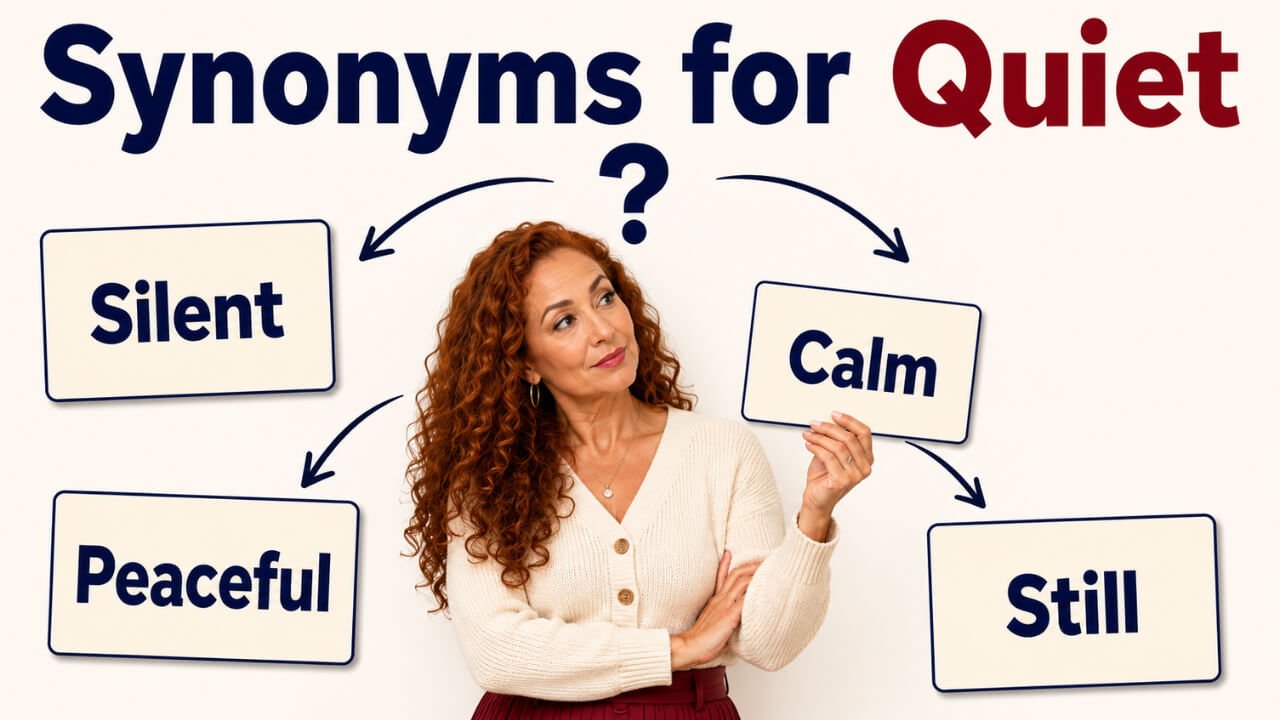
Quick Answer: The best synonyms for quiet include silent, calm, peaceful, still, hushed, muted, low, soft, tranquil, and noiseless. Use silent when there is no sound, calm for a peaceful mood, soft for a gentle sound, hushed for a lowered voice, tranquil for a relaxed place, and muted when something is less loud or less intense.
Pronunciation and Word Details
Word: Quiet.
Pronunciation: /ˈkwaɪət/.
Part of Speech: Adjective, noun, and verb.
Meaning: Quiet means making little or no noise, calm, peaceful, or not busy.
US Pronunciation:
UK Pronunciation:
What Does “Quiet” Mean?
Quiet means making little or no sound. It can describe a person, place, voice, activity, mood, or moment that is calm, peaceful, or not loud.
As an adjective, quiet describes something with low noise or little activity. For example, “a quiet room” means a room with little sound. As a noun, quiet means a state of calm or silence. For example, “She enjoyed the quiet.” As a verb, quiet means to make something calmer or less noisy.
Quiet can also suggest personality. A quiet person may be shy, reserved, thoughtful, or simply not very talkative.
Meaning, Tone, and Context of “Quiet”
Quiet is a common, neutral word. It works in casual speech, formal writing, descriptions, stories, essays, and everyday conversation. It usually sounds polite and clear.
The tone depends on context. Quiet can feel positive when it means peaceful, calm, or relaxing. It can feel neutral when it simply means not loud. It can feel slightly negative when it suggests someone is distant, shy, inactive, or not speaking when expected.
Quiet is often used for places, voices, sounds, people, moods, behavior, and environments. In descriptive writing, it helps create a calm or still atmosphere.
When and How to Use “Quiet”
For Low Noise: Use quiet when something has little sound.
Example: The library was quiet during the afternoon.
For Peaceful Places: Use quiet when a place feels calm and relaxing.
Example: They found a quiet garden behind the house.
For Soft Voices: Use quiet when someone speaks gently or not loudly.
Example: He gave a quiet answer.
For Reserved Personality: Use quiet when someone does not speak much.
Example: She is quiet in large groups but friendly with close friends.
For Less Activity: Use quiet when a place or period is not busy.
Example: The store was quiet after lunch.
For Calming Something: Use quiet as a verb when noise, fear, or movement becomes calmer.
Example: The teacher tried to quiet the class.
Best Synonyms for Quiet
Silent: Making no sound.
Example: The room became silent after the announcement.
Calm: Peaceful and free from stress or noise.
Example: The lake looked calm in the morning.
Peaceful: Relaxed, gentle, and free from disturbance.
Example: They spent the evening in a peaceful village.
Still: Not moving or making noise.
Example: The forest was still before sunrise.
Hushed: Very quiet, often because people are speaking softly.
Example: The crowd waited in a hushed silence.
Muted: Softened, reduced, or not bright or loud.
Example: The music played at a muted level.
Soft: Gentle and not loud.
Example: She spoke in a soft voice.
Low: Quiet in volume or intensity.
Example: He kept his voice low during the meeting.
Tranquil: Deeply calm and peaceful.
Example: The tranquil beach helped her relax.
Noiseless: Without noise.
Example: The machine moved in a noiseless way.
50 Synonyms for Quiet with Short Meanings
- Silent: Making no sound.
- Calm: Peaceful and not disturbed.
- Peaceful: Free from noise, stress, or conflict.
- Still: Without sound or movement.
- Hushed: Very quiet or softly spoken.
- Muted: Softened in sound or effect.
- Soft: Gentle and not loud.
- Low: Quiet in volume.
- Tranquil: Deeply peaceful and calm.
- Noiseless: Completely without noise.
- Soundless: Having no sound.
- Restful: Calm and relaxing.
- Serene: Calm, clear, and peaceful.
- Placid: Calm and undisturbed.
- Gentle: Soft, mild, and calm.
- Subdued: Quiet, controlled, or less intense.
- Reserved: Quiet in speech or behavior.
- Reticent: Not willing to speak much.
- Taciturn: Naturally quiet and not talkative.
- Shy: Quiet because of nervousness or timidity.
- Introverted: Quiet and inward focused.
- Unspoken: Not said aloud.
- Unvoiced: Not expressed in words.
- Whispered: Spoken very softly.
- Faint: Weak or barely heard.
- Muffled: Made less clear or less loud.
- Dulled: Reduced in sound or sharpness.
- Mild: Gentle and not strong.
- Composed: Calm and self controlled.
- Relaxed: Calm and free from tension.
- Undisturbed: Not interrupted or bothered.
- Secluded: Quiet because it is away from others.
- Private: Away from public noise or attention.
- Lonely: Quiet because few people are present.
- Empty: Quiet because no one is there.
- Inactive: Quiet because little is happening.
- Slow: Quiet because activity is light.
- Sleepy: Quiet, slow, or not busy.
- Dormant: Quiet because temporarily inactive.
- Lull: A quiet pause or calm period.
- Silence: A state with no sound.
- Peace: A calm and quiet state.
- Calmness: The quality of being quiet and steady.
- Stillness: Complete calm without sound or movement.
- Serenity: A peaceful and quiet feeling.
- Privacy: A quiet state away from attention.
- Quietness: The quality of being quiet.
- Soothe: To make calm or quiet.
- Settle: To become calm or quiet.
- Lower: To make a sound less loud.
Read Also:
Synonyms for Stated
Synonyms for Quiet by Context
When Quiet Means Silent
Use these synonyms when you mean there is no sound or almost no sound.
Silent: The classroom was silent during the test.
Noiseless: The door opened in a noiseless way.
Soundless: The film showed a soundless scene of falling snow.
Still: The night was still and dark.
When Quiet Means Calm
Use these synonyms when quiet describes a peaceful mood, place, or feeling.
Calm: The calm morning helped her focus.
Peaceful: They walked through a peaceful field.
Serene: His face looked serene after the long rest.
Tranquil: The tranquil lake reflected the trees.
When Quiet Means Soft in Sound
Use these synonyms when quiet describes a low voice, gentle sound, or reduced volume.
Soft: She used a soft voice with the child.
Low: Please keep your voice low.
Muted: The TV played with muted sound.
Faint: They heard a faint noise outside.
When Quiet Means Reserved
Use these synonyms when quiet describes a person who does not speak much.
Reserved: He is reserved around new people.
Reticent: She was reticent about her plans.
Taciturn: The taciturn man answered with only a few words.
Introverted: An introverted student may prefer small group discussions.
When Quiet Means Not Busy
Use these synonyms when quiet describes low activity.
Slow: Business was slow on Monday morning.
Inactive: The account has been inactive for months.
Sleepy: They moved to a sleepy town near the hills.
Empty: The station felt empty late at night.
Another Word for Quiet
Another word for quiet is silent when you mean no sound. However, the best replacement depends on context. Use calm for a peaceful feeling, soft for a gentle voice, reserved for a quiet person, and tranquil for a relaxing place.
Original: The room was quiet after the meeting.
Better Option: The room was silent after the meeting.
Original: She has a quiet personality.
Better Option: She has a reserved personality.
Original: The beach was quiet in the morning.
Better Option: The beach was tranquil in the morning.
Original: He spoke in a quiet tone.
Better Option: He spoke in a soft tone.
When Not to Use “Quiet”
Do not use quiet when a more exact word would explain the meaning better. Quiet can sound too general if you mean completely without sound, emotionally calm, shy, private, inactive, or softly spoken.
Weak: The machine was quiet.
Better: The machine was noiseless.
Weak: She gave a quiet reply.
Better: She gave a soft reply.
Weak: The town was quiet.
Better: The town was peaceful.
Weak: He is quiet in meetings.
Better: He is reserved in meetings.
Weak: The office was quiet this week.
Better: The office was slow this week.
Words Commonly Confused With Quiet
Quiet vs Silent: Quiet means little noise, while silent means no sound at all.
Quiet vs Calm: Quiet often refers to sound or activity, while calm refers to emotion, mood, or peaceful behavior.
Quiet vs Peaceful: Quiet means not loud, while peaceful means calm, pleasant, and free from disturbance.
Quiet vs Soft: Quiet can describe a place, person, or sound, while soft usually describes gentle sound, touch, color, or tone.
Quiet vs Reserved: Quiet can describe low noise or few words, while reserved describes a person who does not openly express thoughts or feelings.
Quiet vs Hushed: Quiet is general, while hushed often means people are speaking in low voices because of respect, secrecy, or tension.
Which Synonym Should You Choose?
Choose silent when there is no sound at all.
Choose calm when describing a peaceful mood, emotion, or behavior.
Choose peaceful when writing about a relaxing place, situation, or environment.
Choose soft when describing a gentle voice or sound.
Choose low when describing volume.
Choose hushed when describing a soft, serious, or secretive voice.
Choose tranquil when writing about nature, rest, or a deeply peaceful setting.
Choose reserved when describing a person who does not talk much.
Choose muted when describing reduced sound, color, feeling, or effect.
Choose still when describing a place or moment with no movement and little sound.
Real Life Examples of “Quiet” in Sentences
Original: The house was quiet after everyone left.
Better Option: The house was silent after everyone left.
Original: She gave a quiet laugh.
Better Option: She gave a soft laugh.
Original: The park was quiet in the early morning.
Better Option: The park was peaceful in the early morning.
Original: He is quiet around strangers.
Better Option: He is reserved around strangers.
Original: The music was quiet in the background.
Better Option: The music was low in the background.
Original: A quiet feeling filled the room.
Better Option: A calm feeling filled the room.
Original: The village was quiet and beautiful.
Better Option: The village was tranquil and beautiful.
Original: They waited in a quiet crowd.
Better Option: They waited in a hushed crowd.
Original: The office has been quiet lately.
Better Option: The office has been slow lately.
Original: Please quiet the noise.
Better Option: Please lower the noise.
Synonym Groups and Usage Differences
Silence Group
This group includes silent, noiseless, soundless, and still. These words focus on no sound or almost no sound.
Example: The hall was silent after the speech.
Calmness Group
This group includes calm, peaceful, serene, tranquil, and restful. These words describe a peaceful feeling, place, or mood.
Example: The garden felt serene at sunset.
Soft Sound Group
This group includes soft, low, muted, faint, muffled, and hushed. These words describe reduced volume or gentle sound.
Example: She answered in a low voice.
Personality Group
This group includes reserved, reticent, taciturn, shy, and introverted. These words describe people who speak less or avoid attention.
Example: He seemed reticent during the interview.
Low Activity Group
This group includes slow, inactive, sleepy, dormant, and empty. These words describe places, times, or situations with little movement or activity.
Example: The market was slow in the afternoon.
Antonyms of Quiet
Loud: Making a lot of noise.
Noisy: Full of sound or disturbance.
Boisterous: Loud, lively, and energetic.
Talkative: Speaking often or a lot.
Chatty: Informal and very talkative.
Busy: Full of activity or people.
Active: Moving, working, or happening.
Restless: Unable to stay calm or still.
Disturbed: Interrupted or not peaceful.
Rowdy: Noisy, rough, and hard to control.
Comparison: Quiet vs Related Words
Quiet vs Silent
Quiet means little noise. Silent means no sound.
Example With Quiet: The room was quiet during the lesson.
Example With Silent: The room was silent after the shocking news.
Quiet vs Calm
Quiet often describes low sound or low activity. Calm describes peace, control, or lack of stress.
Example With Quiet: The street was quiet at midnight.
Example With Calm: She stayed calm during the problem.
Quiet vs Peaceful
Quiet focuses on little noise. Peaceful adds a sense of comfort, safety, and relaxation.
Example With Quiet: The hotel room was quiet.
Example With Peaceful: The hotel room felt peaceful.
Quiet vs Soft
Quiet can describe a place, person, or sound. Soft usually describes a gentle sound, touch, or tone.
Example With Quiet: Please be quiet during the movie.
Example With Soft: Please speak in a soft voice.
Quiet vs Reserved
Quiet can mean not loud or not talkative. Reserved specifically describes a person who does not openly speak or show feelings.
Example With Quiet: He was quiet during dinner.
Example With Reserved: He is reserved with people he does not know well.
Common Phrases and Expressions With Quiet
Quiet Place: A location with little noise.
Quiet Room: A room where people can work, rest, or think without noise.
Quiet Voice: A soft or low voice.
Quiet Time: A period for rest, reading, prayer, study, or calm activity.
Keep Quiet: To stop talking or making noise.
Stay Quiet: To remain silent or calm.
Quiet Life: A simple, peaceful life with little disturbance.
Quiet Moment: A short peaceful period.
Quiet Confidence: Calm self belief without showing off.
Quiet Corner: A peaceful small area away from noise.
Common Mistakes to Avoid
Avoid using quiet again and again when a more specific synonym would improve your writing. Silent, soft, peaceful, calm, reserved, and tranquil often create a clearer meaning.
Do not use quiet when you mean completely soundless unless no sound is truly present. Silent or noiseless may be better.
Do not confuse quiet with quite. Quiet means not loud. Quite means fairly, completely, or to a noticeable degree.
Avoid calling a person quiet when you actually mean shy, introverted, private, reserved, or thoughtful. These words give readers a more accurate idea.
Do not use quiet for weak descriptions in formal writing when the context needs precision. For example, “low volume,” “reduced activity,” or “minimal noise” may sound clearer in reports.
Conclusion
Synonyms for quiet help you describe silence, calm, soft sound, reserved behavior, and peaceful places with more accuracy. Use silent for no sound, soft for gentle volume, calm for emotions, peaceful for relaxing settings, reserved for personality, and tranquil for deep stillness. Quiet is a useful everyday word, but choosing the right synonym makes your writing clearer, more natural, and more expressive.
FAQs About Synonyms for Quiet
What are the best synonyms for quiet?
The best synonyms for quiet are silent, calm, peaceful, soft, still, hushed, muted, low, tranquil, and noiseless.
What is another word for quiet in a sentence?
Another word for quiet is silent if you mean no sound. For a peaceful place, peaceful or tranquil may be better.
What is a formal synonym for quiet?
Formal synonyms for quiet include silent, tranquil, subdued, reserved, reticent, and undisturbed.
What is a casual synonym for quiet?
Casual synonyms for quiet include calm, soft, low, peaceful, and still.
What is a stronger word than quiet?
Silent is stronger than quiet when you mean no sound at all. Noiseless and soundless are also strong options.
What is a synonym for a quiet person?
A quiet person can be called reserved, shy, introverted, reticent, or taciturn, depending on the reason they speak less.
What is the opposite of quiet?
The opposite of quiet can be loud, noisy, talkative, busy, active, restless, or rowdy, depending on the context.
