
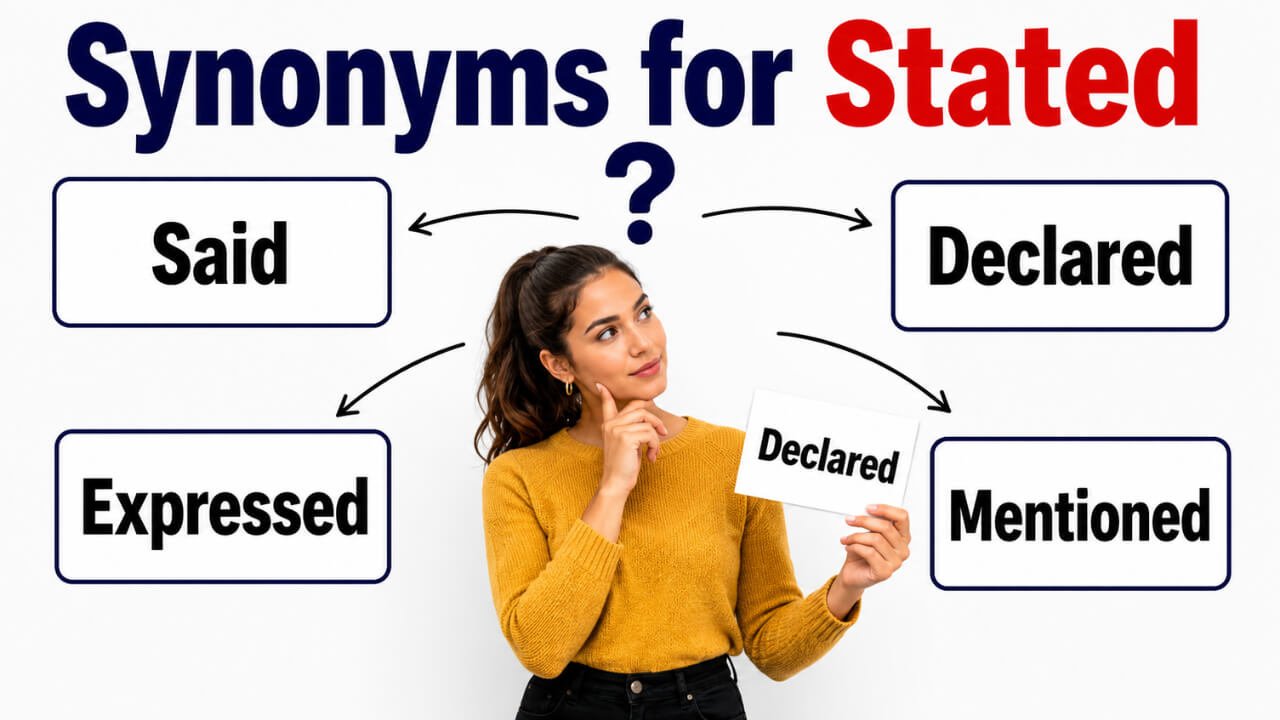
Quick Answer: The best synonyms for stated are said, declared, expressed, mentioned, noted, reported, asserted, specified, indicated, and explained. Use said for simple speech, declared for formal or public statements, expressed for thoughts or feelings, noted for brief written points, asserted for confident claims, specified for exact details, and reported for information shared in news, research, or official writing.
Pronunciation and Word Details
Word: Stated.
Pronunciation: /ˈsteɪtɪd/.
Part of Speech: Verb and adjective.
Meaning: Stated means said, written, expressed, or clearly given in words.
US Pronunciation:
UK Pronunciation:
What Does “Stated” Mean?
Direct Answer: Stated means clearly said, written, or expressed.
Meaning: Stated is commonly used as the past tense of the verb state. It can also work as an adjective when something has been officially written, named, or declared. For example, a stated rule is a rule that has been clearly given.
Use: The word stated often appears in essays, reports, instructions, official documents, news writing, and formal communication. It can describe what someone said, what a document explains, what a rule requires, or what a source makes clear.
Meaning, Tone, and Context of “Stated”
Tone: Stated is neutral, clear, and slightly formal.
Context: It is common in academic writing, business writing, reports, legal style writing, instructions, and summaries. It sounds more formal than said but less forceful than declared or proclaimed.
Style: Stated works well when you want to show that information was given clearly. It does not always show emotion. It focuses more on the message than on the speaker’s feelings.
Example: The manager stated the new policy during the meeting.
When and How to Use “Stated”
For Reporting Speech: Use stated when repeating what someone said in a clear or formal way.
Example: The teacher stated that the test would begin at nine.
For Written Information: Use stated when referring to information found in a document, rule, form, or notice.
Example: The agreement stated the payment terms clearly.
For Official Communication: Use stated when a person, group, or authority gives information formally.
Example: The committee stated its decision after the review.
For Academic Writing: Use stated when summarizing an author’s point or a source’s claim.
Example: The writer stated that education improves social progress.
For Clear Details: Use stated when something is directly mentioned rather than implied.
Example: The email stated the exact deadline.
Best Synonyms for Stated
Said: Spoke or wrote something in words.
Example: She said the meeting would start soon.
Declared: Announced something clearly and formally.
Example: The judge declared the result final.
Expressed: Shared a thought, feeling, or idea.
Example: He expressed concern about the delay.
Mentioned: Referred to something briefly.
Example: She mentioned the new schedule in her message.
Noted: Stated something briefly or carefully.
Example: The report noted several important changes.
Reported: Gave information about an event, fact, or result.
Example: The team reported strong progress.
Asserted: Stated something confidently.
Example: He asserted that the decision was fair.
Specified: Gave exact details or conditions.
Example: The contract specified the delivery date.
Indicated: Showed, suggested, or stated information.
Example: The results indicated a clear improvement.
Explained: Made something clear by giving details.
Example: The guide explained how the system works.
50 Synonyms for Stated with Short Meanings
- Said: Spoke or wrote something.
- Declared: Announced clearly or formally.
- Expressed: Shared a thought or feeling.
- Mentioned: Referred to briefly.
- Noted: Pointed out briefly or carefully.
- Reported: Gave information or results.
- Announced: Made information known publicly.
- Asserted: Said something with confidence.
- Explained: Made something clear.
- Described: Gave details about something.
- Specified: Gave exact details.
- Indicated: Showed or pointed out.
- Claimed: Said something as true.
- Affirmed: Confirmed something positively.
- Confirmed: Said that something is true.
- Revealed: Made information known.
- Communicated: Shared information with others.
- Articulated: Expressed clearly and carefully.
- Voiced: Said an opinion or feeling.
- Presented: Put forward information or an idea.
- Put Forward: Offered an idea or argument.
- Set Out: Explained clearly and fully.
- Made Clear: Explained in an understandable way.
- Wrote: Put something in written words.
- Documented: Recorded information officially.
- Listed: Gave items in order.
- Quoted: Repeated exact words.
- Cited: Referred to as support or evidence.
- Recounted: Told details about an event.
- Narrated: Told a story or sequence.
- Told: Gave information to someone.
- Conveyed: Communicated an idea or message.
- Published: Made written information available.
- Proclaimed: Announced strongly or publicly.
- Testified: Gave a formal statement.
- Alleged: Claimed without full proof.
- Argued: Gave reasons to support a point.
- Maintained: Continued to say something was true.
- Submitted: Formally presented an idea or statement.
- Acknowledged: Accepted or admitted something.
- Admitted: Accepted something as true.
- Outlined: Gave the main points.
- Detailed: Explained with specific information.
- Defined: Gave the meaning of something.
- Introduced: Brought up a point or idea.
- Summarized: Gave the main idea briefly.
- Answered: Responded to a question.
- Replied: Answered in speech or writing.
- Observed: Made a thoughtful comment.
- Remarked: Said something as a comment.
Read Also:
Synonyms for This Shows in an Essay

Synonyms for Stated by Context
When Stated Means Said
Useful Synonyms: Said, told, replied, answered, remarked.
Example: She stated that she was ready.
Better Option: She said that she was ready.
When Stated Means Declared Formally
Useful Synonyms: Declared, announced, proclaimed, affirmed, testified.
Example: The official stated the final result.
Better Option: The official announced the final result.
When Stated Means Written or Recorded
Useful Synonyms: Wrote, documented, listed, specified, recorded.
Example: The form stated the applicant’s address.
Better Option: The form listed the applicant’s address.
When Stated Means Explained
Useful Synonyms: Explained, described, outlined, detailed, set out.
Example: The guide stated the steps clearly.
Better Option: The guide explained the steps clearly.
When Stated Means Claimed
Useful Synonyms: Claimed, asserted, argued, maintained, alleged.
Example: The speaker stated that the plan would work.
Better Option: The speaker asserted that the plan would work.
Another Word for Stated
Direct Answer: Another word for stated is said, but the best replacement depends on context.
Best Choice: Use said for simple speech, declared for formal statements, mentioned for brief references, specified for exact details, and asserted for strong claims.
Original: The report stated the main problem.
Better Option: The report identified the main problem.
Original: She stated her opinion during the discussion.
Better Option: She expressed her opinion during the discussion.
Original: The notice stated the rules.
Better Option: The notice listed the rules.
Original: He stated that the result was correct.
Better Option: He confirmed that the result was correct.
When Not to Use “Stated”
Weak Use: Do not use stated too often in the same paragraph. It can make writing sound repetitive.
Weak: The author stated the problem and stated the solution.
Better: The author identified the problem and explained the solution.
Unclear Use: Avoid stated when the sentence needs a more exact verb.
Weak: The chart stated an increase in sales.
Better: The chart showed an increase in sales.
Too Formal: In casual conversation, said often sounds more natural than stated.
Weak: My friend stated that he was tired.
Better: My friend said that he was tired.
Wrong Tone: Avoid stated when the meaning is emotional.
Weak: She stated her sadness.
Better: She expressed her sadness.
Words Commonly Confused With Stated
Stated vs Said: Said is simple and common. Stated sounds more formal and clear.
Stated vs Declared: Stated means said clearly. Declared means announced firmly or officially.
Stated vs Mentioned: Stated means gave information clearly. Mentioned means referred to something briefly.
Stated vs Explained: Stated gives information. Explained gives details that help someone understand.
Stated vs Claimed: Stated is neutral. Claimed can suggest that the information may need proof.
Stated vs Asserted: Stated is clear. Asserted is stronger and more confident.
Stated vs Specified: Stated gives information. Specified gives exact details.
Which Synonym Should You Choose?
Choose said: When writing simple dialogue or casual sentences.
Choose declared: When the statement is official, public, or strong.
Choose expressed: When the sentence is about feelings, thoughts, concerns, or opinions.
Choose mentioned: When the point is brief or not the main focus.
Choose noted: When writing reports, summaries, essays, or formal observations.
Choose asserted: When someone states a point confidently or strongly.
Choose specified: When writing about exact rules, dates, numbers, conditions, or details.
Choose reported: When writing about results, findings, events, or official information.
Choose explained: When the sentence needs clarity, reasons, or step by step meaning.
Real Life Examples of “Stated” in Sentences
Original: The teacher stated the homework deadline.
Better Option: The teacher announced the homework deadline.
Original: The report stated that sales increased.
Better Option: The report showed that sales increased.
Original: She stated her concerns during the meeting.
Better Option: She expressed her concerns during the meeting.
Original: The form stated the required documents.
Better Option: The form listed the required documents.
Original: He stated that the answer was correct.
Better Option: He confirmed that the answer was correct.
Original: The author stated the main idea clearly.
Better Option: The author explained the main idea clearly.
Original: The notice stated the office hours.
Better Option: The notice specified the office hours.
Original: The witness stated what happened.
Better Option: The witness testified about what happened.
Original: The article stated several causes of stress.
Better Option: The article described several causes of stress.
Original: The manager stated the new rule.
Better Option: The manager declared the new rule.
Synonym Groups and Usage Differences
Speech Group
Use: Said, told, replied, answered, and remarked work best for spoken or written communication.
Example: She said the plan was ready.
Formal Statement Group
Use: Declared, announced, proclaimed, and testified work best when the statement is official or public.
Example: The spokesperson announced the decision.
Explanation Group
Use: Explained, described, outlined, detailed, and set out work best when information needs clarity.
Example: The guide explained the process.
Claim Group
Use: Claimed, asserted, argued, alleged, and maintained work best when someone presents a belief, opinion, or position.
Example: The expert asserted that the method was reliable.
Written Detail Group
Use: Specified, listed, documented, cited, and quoted work best for forms, documents, rules, sources, and written evidence.
Example: The policy specified the required steps.
Antonyms of Stated
Unstated: Not said or written clearly.
Implied: Suggested without being directly said.
Hidden: Kept from being seen or known.
Concealed: Deliberately kept secret.
Unspoken: Understood but not said aloud.
Suggested: Hinted rather than clearly stated.
Omitted: Left out or not included.
Denied: Said that something is not true.
Withheld: Kept back from being shared.
Contradicted: Said the opposite of something.
Comparison: Stated vs Related Words
Stated vs Said
Difference: Said is the most common and natural word for speech. Stated sounds more formal and direct.
Example With Stated: She stated that the plan was complete.
Example With Said: She said that the plan was complete.
Stated vs Declared
Difference: Stated means said clearly. Declared means announced with authority or confidence.
Example With Stated: The leader stated the goal.
Example With Declared: The leader declared the goal publicly.
Stated vs Mentioned
Difference: Stated gives clear information. Mentioned gives brief information without much detail.
Example With Stated: He stated the reason for the delay.
Example With Mentioned: He mentioned the delay briefly.
Stated vs Explained
Difference: Stated presents information. Explained makes the information easier to understand.
Example With Stated: The teacher stated the rule.
Example With Explained: The teacher explained the rule.
Stated vs Specified
Difference: Stated can be general. Specified means gave exact details.
Example With Stated: The email stated the deadline.
Example With Specified: The email specified the deadline as Friday.
Stated vs Asserted
Difference: Stated is neutral. Asserted is stronger and shows confidence.
Example With Stated: She stated that the method was useful.
Example With Asserted: She asserted that the method was useful.
Common Phrases and Expressions With Stated
Stated Clearly: Said or written in an easy to understand way.
Stated Above: Mentioned earlier in the text.
Stated Below: Mentioned later in the text.
As Stated: As already said or written.
Previously Stated: Said or written before.
Clearly Stated: Expressed without confusion.
Stated Purpose: The purpose that has been given clearly.
Stated Goal: The goal that has been named or explained.
Stated Reason: The reason that has been directly given.
Stated Policy: A rule or policy that has been officially written or announced.
Common Mistakes to Avoid
Repeating Stated Too Much: Use stated only when it fits. Repeating it can make writing sound stiff.
Better Advice: Replace repeated uses with said, explained, noted, reported, or specified.
Using Stated for Feelings: Stated can sound too flat for emotions.
Better Advice: Use expressed, shared, revealed, or voiced for feelings.
Using Stated for Visual Data: Charts and graphs do not usually state information unless they include written text.
Better Advice: Use showed, indicated, displayed, or revealed.
Using Strong Synonyms Incorrectly: Declared, proclaimed, and asserted are stronger than stated.
Better Advice: Use them only when the tone is confident, official, or public.
Confusing Stated and Specified: Specified is better when exact details matter.
Better Advice: Use specified for dates, numbers, limits, rules, and conditions.
Conclusion
Conclusion: Synonyms for stated help you choose a clearer and more accurate word for each sentence. Use said for simple speech, declared for formal announcements, expressed for thoughts and feelings, mentioned for brief references, specified for exact details, and asserted for confident claims. In essays, reports, emails, and everyday writing, the best synonym depends on tone, context, and purpose. Choosing the right alternative makes your writing more natural, precise, and useful for readers.
FAQs About Synonyms for Stated
What are the best synonyms for stated?
Answer: The best synonyms for stated are said, declared, expressed, mentioned, noted, reported, asserted, specified, indicated, and explained.
What is another word for stated in an essay?
Answer: In an essay, good alternatives include argued, noted, explained, claimed, asserted, described, and indicated.
Is stated more formal than said?
Answer: Yes, stated is usually more formal than said. Said is better for simple or casual writing.
What is a formal synonym for stated?
Answer: Formal synonyms for stated include declared, asserted, affirmed, reported, specified, and testified.
What is the difference between stated and mentioned?
Answer: Stated means said clearly. Mentioned means referred to briefly, often without much detail.
Can stated mean written?
Answer: Yes, stated can refer to written information, especially in documents, forms, notices, rules, and reports.
What is the opposite of stated?
Answer: Opposites of stated include unstated, unspoken, implied, hidden, concealed, omitted, and withheld.
