
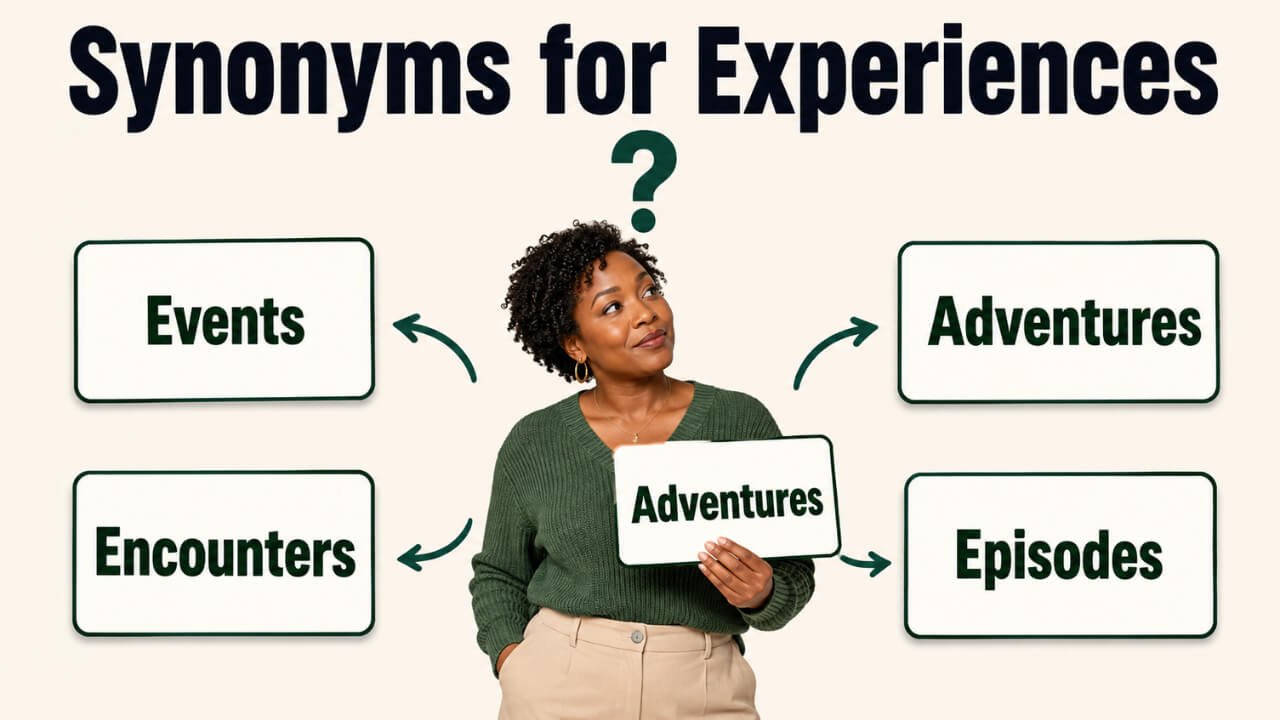
Quick Answer: Synonyms for experiences include events, encounters, situations, moments, episodes, adventures, happenings, memories, lessons, and occurrences. The best synonym depends on context. Use events for things that happen, encounters for meeting people or facing situations, memories for past personal experiences, lessons for learning, adventures for exciting experiences, and background for professional or life experience.
Pronunciation and Word Details
Word: Experiences
Pronunciation: /ɪkˈspɪr.i.ən.sɪz/
Part of Speech: Noun, plural. It can also be a verb in some sentences.
Meaning: Experiences are events, situations, or moments that someone lives through, learns from, or remembers.
US Pronunciation:
UK Pronunciation:
What Does “Experiences” Mean?
Experiences means events, situations, feelings, or activities that a person goes through in life. It is most commonly used as a plural noun. It can describe personal moments, professional history, travel events, emotional situations, learning opportunities, or memorable parts of life.
The word can also work as a verb. For example, “She experiences stress before exams” means she goes through or feels stress. In most vocabulary and synonym contexts, however, experiences usually means things someone has lived through.
Example: His experiences taught him patience.
Example: Travel experiences can change the way people see the world.
Meaning, Tone, and Context of “Experiences”
Experiences is a neutral and flexible word. It works in casual, formal, academic, personal, emotional, and professional writing. The tone changes depending on the subject. Personal experiences can sound emotional or reflective. Work experiences can sound professional. Learning experiences can sound educational. Travel experiences can sound exciting or memorable.
The word is common in essays, resumes, stories, biographies, speeches, interviews, and everyday conversation. It is useful because it can describe both simple events and meaningful life moments. However, a more specific synonym often makes writing stronger. For example, events is clearer for things that happened, lessons is better for learning, and memories is better for past moments someone remembers.
When and How to Use “Experiences”
For Personal Moments: Use experiences when describing things someone has lived through personally.
Example: Her childhood experiences shaped her personality.
For Learning: Use experiences when an event teaches someone something.
Example: Difficult experiences can teach valuable lessons.
For Professional Background: Use experiences when talking about work history, skills, or practical knowledge.
Example: His experiences in customer service helped him handle people well.
For Travel: Use experiences when describing places, activities, and memories from trips.
Example: Their travel experiences made them more open minded.
For Emotional Situations: Use experiences when describing feelings or situations someone has gone through.
Example: She shared her experiences with grief and recovery.
For Stories and Memories: Use experiences when talking about past events that someone remembers.
Example: He wrote a book about his life experiences.
Best Synonyms for Experiences
Events: Things that happen or take place.
Example: The events of that day changed their plans.
Encounters: Meetings or direct experiences with people, places, or situations.
Example: Her encounters with different cultures shaped her thinking.
Situations: Conditions or circumstances someone faces.
Example: These situations helped him become more confident.
Moments: Short periods of time that are meaningful or memorable.
Example: The trip was full of beautiful moments.
Episodes: Separate events or parts of a longer story.
Example: His life included many difficult episodes.
Adventures: Exciting, unusual, or risky experiences.
Example: Their adventures taught them courage.
Happenings: Events or things that occur.
Example: The town was known for its unusual happenings.
Memories: Experiences remembered from the past.
Example: She kept many happy memories from school.
Lessons: Experiences that teach something useful.
Example: His failures became important lessons.
Occurrences: Things that happen, especially noticeable events.
Example: Such occurrences were rare in the village.
50 Synonyms for Experiences with Short Meanings
- Events: Things that happen.
- Encounters: Direct meetings or situations faced.
- Situations: Conditions or circumstances someone goes through.
- Moments: Short meaningful periods of time.
- Episodes: Separate events in a longer story.
- Adventures: Exciting or unusual experiences.
- Happenings: Things that occur.
- Memories: Past experiences remembered.
- Lessons: Experiences that teach something.
- Occurrences: Events that take place.
- Incidents: Specific events, often unexpected.
- Circumstances: Conditions surrounding an event.
- Stories: Personal accounts of experiences.
- Events of life: Important things lived through.
- Life events: Major moments in someone’s life.
- Personal history: Experiences from someone’s past.
- Background: Past experience, training, or knowledge.
- Exposure: Direct contact with ideas, people, or situations.
- Practice: Repeated experience that builds skill.
- Knowledge: Understanding gained through experience.
- Expertise: Skilled knowledge gained from experience.
- Skill: Ability developed through practice.
- Training: Guided learning through practice.
- Learning: Knowledge gained through study or experience.
- Involvement: Participation in an activity or situation.
- Participation: Taking part in an event or activity.
- Engagements: Activities or events someone takes part in.
- Interactions: Exchanges with people, systems, or places.
- Meetings: Encounters with people or groups.
- Contacts: Connections or interactions with others.
- Observations: Things noticed or learned by watching.
- Impressions: Feelings or ideas formed from an experience.
- Recollections: Memories of past experiences.
- Remembrances: Things remembered from the past.
- Trials: Difficult experiences that test someone.
- Challenges: Hard situations that require effort.
- Hardships: Difficult or painful experiences.
- Setbacks: Problems or delays someone experiences.
- Journeys: Long personal, emotional, or physical experiences.
- Travels: Experiences gained from going to places.
- Adventures abroad: Exciting experiences in other places.
- Discoveries: New things learned through experience.
- Realizations: Important understandings gained from experience.
- Insights: Clear understandings from experience.
- Cases: Particular examples or situations.
- Examples: Specific instances of something.
- Scenes: Moments or situations remembered visually.
- Phases: Periods of experience in life or work.
- Stages: Steps or periods in a process or life path.
- Milestones: Important experiences or achievements.
Read Also:
Synonyms for Struggle
Synonyms for Experiences by Context
When Experiences Mean Events
Use these synonyms when experiences means things that happened or took place.
Events: General things that happen.
Example: The events of the trip were unforgettable.
Occurrences: Things that take place, often noticeable or unusual.
Example: These occurrences made the story more interesting.
Incidents: Specific events, often unexpected or serious.
Example: Several incidents changed his view of the city.
Happenings: Informal word for things that happen.
Example: The festival was full of colorful happenings.
When Experiences Mean Memories
Use these synonyms when experiences refers to things remembered from the past.
Memories: Past moments kept in the mind.
Example: She shared her memories of childhood.
Recollections: Remembered details from past experiences.
Example: His recollections of the journey were vivid.
Remembrances: Memories, especially meaningful or emotional ones.
Example: The speech included warm remembrances of family life.
Impressions: Feelings or ideas left by an experience.
Example: Her first impressions of the place were positive.
When Experiences Mean Learning
Use these synonyms when experiences help someone learn, grow, or understand something better.
Lessons: Things learned from events.
Example: His early mistakes became useful lessons.
Knowledge: Understanding gained through life, work, or study.
Example: She gained knowledge from years of teaching.
Insights: Deep understandings gained from experience.
Example: The interview gave him new insights.
Realizations: Important things someone comes to understand.
Example: Her travels led to many realizations about life.
When Experiences Mean Professional Background
Use these synonyms when experiences refers to work, skills, training, or career history.
Background: Past training, work, or knowledge.
Example: His background in finance helped the team.
Expertise: Skilled knowledge from practice.
Example: She brought strong expertise to the project.
Practice: Repeated action that builds ability.
Example: Years of practice improved his writing.
Training: Learning through guided work or instruction.
Example: Her training prepared her for the position.
When Experiences Mean Difficult Situations
Use these synonyms when experiences describes hard, painful, or testing moments.
Trials: Difficult situations that test strength.
Example: His trials made him more patient.
Challenges: Hard situations that require effort.
Example: These challenges helped her grow.
Hardships: Painful or difficult life experiences.
Example: The family survived many hardships.
Setbacks: Problems that slow progress.
Example: His setbacks taught him resilience.
Another Word for Experiences
Another word for experiences is events when you mean things that happened. However, the best replacement depends on the sentence. Use memories for past personal experiences, lessons for learning, encounters for meetings or direct situations, background for professional experience, and adventures for exciting experiences.
Original: Her experiences in college helped her grow.
Better Option: Her lessons in college helped her grow.
Original: He told us about his travel experiences.
Better Option: He told us about his travel adventures.
Original: Her work experiences made her confident.
Better Option: Her professional background made her confident.
Original: These experiences changed his opinion.
Better Option: These events changed his opinion.
When Not to Use “Experiences”
Do not use experiences when the sentence needs a more exact word. Experiences can sound broad or vague if the meaning is not clear. If you mean things that happened, use events. If you mean past moments remembered, use memories. If you mean learning, use lessons. If you mean career history, use background or expertise.
Avoid repeating experiences too often in one paragraph. Repetition can make writing sound flat. Also avoid using experiences for very small actions when moments, incidents, or activities would sound more natural.
Weak: I had many experiences during the meeting.
Better: I had many useful interactions during the meeting.
Weak: Her experiences helped her learn grammar.
Better: Her lessons helped her learn grammar.
Weak: The report explains several experiences from last year.
Better: The report explains several events from last year.
Weak: He has experiences in marketing.
Better: He has a background in marketing.
Words Commonly Confused With Experiences
Experiences vs Events: Experiences are things someone personally goes through, while events are things that happen. An event may become an experience when someone is directly involved in it.
Experiences vs Memories: Experiences are lived moments, while memories are the remembered versions of those moments.
Experiences vs Expertise: Experiences are things lived through or done, while expertise is strong skill or knowledge gained from practice.
Experiences vs Background: Experiences can refer to many life events, while background often means work history, education, training, or personal history.
Experiences vs Encounters: Experiences is broad, while encounters usually means direct meetings with people, places, ideas, or situations.
Experiences vs Lessons: Experiences are what happen, while lessons are what someone learns from them.
Experiences vs Situations: Experiences are lived through personally, while situations are conditions or circumstances someone faces.
Which Synonym Should You Choose?
Choose events when writing about things that happened.
Choose encounters when writing about meetings, direct contact, or facing new situations.
Choose memories when writing about past experiences someone remembers.
Choose lessons when the experience teaches something useful.
Choose background when writing about professional history, education, or practical knowledge.
Choose expertise when writing about strong skill gained through experience.
Choose adventures when writing about exciting, unusual, or travel related experiences.
Choose situations when writing about conditions or circumstances.
Choose hardships when writing about difficult life experiences.
Choose milestones when writing about important achievements or major life moments.
Real Life Examples of “Experiences” in Sentences
Original: Her experiences shaped her character.
Better Option: Her life events shaped her character.
Original: He shared his experiences from the trip.
Better Option: He shared his memories from the trip.
Original: These experiences helped her become stronger.
Better Option: These challenges helped her become stronger.
Original: His experiences in teaching helped him explain clearly.
Better Option: His background in teaching helped him explain clearly.
Original: The children enjoyed many experiences at camp.
Better Option: The children enjoyed many adventures at camp.
Original: Their experiences with customers improved their patience.
Better Option: Their interactions with customers improved their patience.
Original: Difficult experiences can teach wisdom.
Better Option: Difficult lessons can teach wisdom.
Original: She wrote about her experiences during the journey.
Better Option: She wrote about her observations during the journey.
Original: Work experiences are important for this role.
Better Option: Professional expertise is important for this role.
Original: His experiences gave him a new view of life.
Better Option: His insights gave him a new view of life.
Synonym Groups and Usage Differences
Event Group
The event group includes events, occurrences, incidents, happenings, and episodes. These words describe things that happen. Use them when experiences refers to actual actions or situations in time.
Example: The events of that week changed the community.
Memory Group
The memory group includes memories, recollections, remembrances, impressions, and stories. These words work best when experiences are remembered, described, or shared later.
Example: Her memories of the village remained strong.
Learning Group
The learning group includes lessons, insights, realizations, knowledge, and discoveries. These words show what someone gains from experiences.
Example: His failures gave him important insights.
Professional Group
The professional group includes background, expertise, training, practice, and skill. These words are useful for resumes, work writing, interviews, and career descriptions.
Example: Her background in design helped the company.
Difficulty Group
The difficulty group includes trials, challenges, hardships, setbacks, and struggles. These words describe painful, demanding, or testing experiences.
Example: Their hardships made them more determined.
Antonyms of Experiences
Inexperience: Lack of practical knowledge or exposure.
Unfamiliarity: Lack of knowledge about something.
Ignorance: Lack of understanding or awareness.
Innocence: Lack of exposure to difficult or complex situations.
Shelteredness: Limited contact with the wider world.
Theory: Knowledge based on ideas rather than direct experience.
Newness: Lack of past involvement or practice.
Unawareness: Not knowing about something.
Avoidance: Staying away from an experience or situation.
Lack of exposure: No direct contact with something.
Comparison: Experiences vs Related Words
Experiences vs Events
Experiences are personal things someone lives through. Events are things that happen, whether or not someone is personally affected.
Example With Experiences: Her experiences in the city changed her confidence.
Example With Events: The events in the city changed the schedule.
Experiences vs Memories
Experiences happen in real life. Memories are the mental records of those experiences.
Example With Experiences: His experiences at school taught him discipline.
Example With Memories: His memories of school were warm and detailed.
Experiences vs Background
Experiences can be personal, emotional, social, or professional. Background usually means past training, work history, education, or personal context.
Example With Experiences: Her experiences taught her how to solve problems.
Example With Background: Her background in education helped her solve problems.
Experiences vs Expertise
Experiences are things someone has done or lived through. Expertise is advanced skill or knowledge gained from repeated experience.
Example With Experiences: He has experiences in public speaking.
Example With Expertise: He has expertise in public speaking.
Experiences vs Lessons
Experiences are the events someone goes through. Lessons are the meanings or knowledge learned from those events.
Example With Experiences: Her experiences were difficult.
Example With Lessons: Her lessons were valuable.
Common Phrases and Expressions With Experiences
Life Experiences: Events and situations someone goes through in life.
Personal Experiences: Experiences that happen directly to a person.
Past Experiences: Things someone went through earlier.
Work Experiences: Professional activities and job history.
Learning Experiences: Situations that teach something useful.
Shared Experiences: Experiences that people go through together.
Travel Experiences: Moments and events from visiting places.
First Experiences: The first time someone goes through something.
Meaningful Experiences: Experiences that have emotional or personal value.
Real Experiences: Actual lived situations rather than imagined ones.
Common Mistakes to Avoid
One common mistake is using experiences when experience is needed. Use experience as an uncountable noun when talking about general skill or knowledge. Use experiences when talking about separate events or moments.
Weak: She has many experience in writing.
Better: She has a lot of experience in writing.
Weak: He shared his experience from different countries.
Better: He shared his experiences from different countries.
Another mistake is using experiences too vaguely. A sentence like “These experiences were good” does not tell the reader much. A clearer word may be memories, lessons, adventures, or events.
Avoid using expertise as a simple synonym for experiences. Expertise means strong skill, not just things someone has lived through. Also avoid using events when the sentence is deeply personal. In that case, experiences or memories may sound more natural.
Conclusion
Synonyms for experiences help you describe life events, memories, lessons, professional background, and personal growth with better accuracy. Use events for things that happen, memories for the past, lessons for learning, background for career history, encounters for direct contact, and adventures for exciting moments. The word experiences is useful and flexible, but choosing a more specific synonym can make your writing clearer, richer, and more natural.
FAQs About Synonyms for Experiences
What are the best synonyms for experiences?
The best synonyms for experiences are events, encounters, situations, moments, episodes, adventures, memories, lessons, occurrences, and background.
What is another word for experiences?
Another word for experiences is events. If the meaning is personal or emotional, memories or moments may be better choices.
What is a formal synonym for experiences?
A formal synonym for experiences is background, exposure, involvement, or professional history, depending on the sentence.
What is a synonym for life experiences?
Good synonyms for life experiences include life events, personal history, memories, lessons, journeys, and milestones.
What is the difference between experience and experiences?
Experience can mean general knowledge or skill, while experiences usually means separate events, moments, or situations someone has lived through.
What is a better word for work experiences?
Better words for work experiences include professional background, career history, expertise, training, practice, and job experience.
What synonym should I use for difficult experiences?
Use hardships, trials, challenges, setbacks, or struggles when writing about difficult experiences.
